

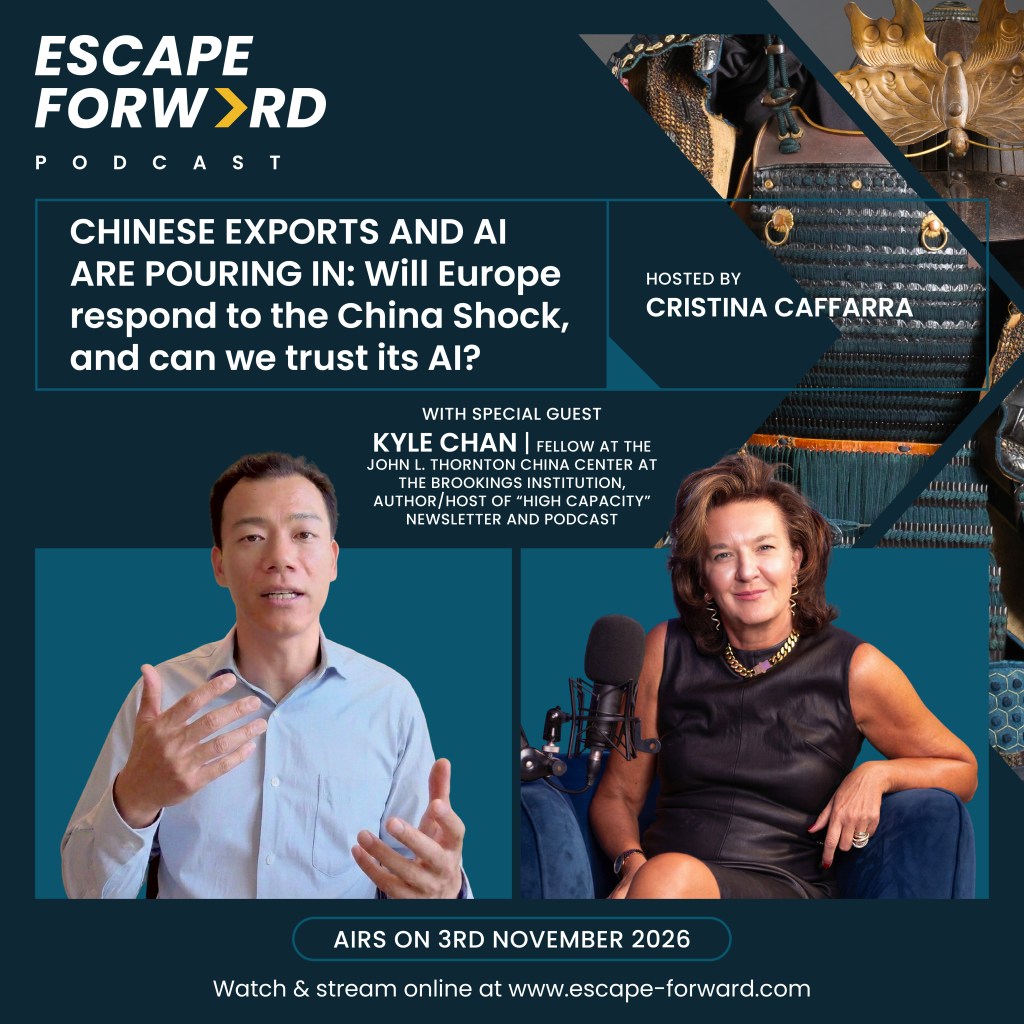
While Washington builds tariff walls, Chinese exports and Chinese AI are pouring into Europe. Cristina Caffarra talks to Kyle Chan of the Brookings Institution about “China Shock 2.0”, now hitting the core of European industry, from machinery to chemicals, and why Europe’s narrow, rules-first trade response falls short. They also look at the rise of Chinese open-weight AI models, which offer Europe an affordable route to sovereignty but may come with strings attached as Beijing considers export controls. Chan’s verdict: Europe has more leverage than it thinks, and the lasting answer is building its own models.
Transcript
ESCAPE FORWARD Ep. 14, 2 November 2026 with Kyle Chan
Fellow at the John L. Thornton China Center at the Brookings Institution, author/host of “High Capacity” newsletter and podcast.
Cristina Caffarra
Hello everyone, I’m Cristina Caffarra, and this is Escape Forward, the space where I have the privilege of going beyond my original domain of antitrust, and have interesting conversations on how to “join the dots” with friends and people I learn a lot from and I like a lot. We are recording this episode on the eve of the midterm elections in the US, which are going to dominate the timeline for a while. But today’s conversation is about something which is as salient and immediately pressing for Europe. Because while Washington has been building walls, Chinese exports and Chinese AI have been both pouring into Europe. And we will discuss this with someone who actually studies how China does all of this from the inside.
Let me just set the scene a little bit, and then I’ll introduce my guest, I’m very excited about. Two main parts to this conversation. The first is what is known as China Shock 2.0. We describe it as that because we had a first permutation of a China shock, which was very different, in the sense that it didn’t affect quite the core of Europe’s industrial might in the same way as the current shock is doing. So we are in a completely different paradigm from anything that we’ve seen before, both in size and in depth of this tsunami of exports from China into Europe.
Europe is known for playing by the rules, being always super fair – or at least tries to think of itself that way – playing by WTO rules, doing targeted proportionate interventions to address individual trade imbalances, or individual trade areas where we think there is possibly a subsidy, and so on. But what if Chinese firms are actually very competitive and, in fact, not just subsidised? We had important voices in Europe – Sander Tordoir for one – and also from the US, Brad Setser, who’ve been really pushing a change in Europe’s attitude to China and how we deal with trade flows and imbalances. And there’s been some sign of movement – they’ve been very effective in moving the conversation. This is one topic where I would like really to explore what our guest thinks Europe is doing and should be doing.
The other big topic, of course, is AI, with Chinese open-weight AI models becoming very popular. Can they be a sovereignty option for Europe? Will it be a trap? These are the question we’re mulling over in Europe right now. Export control noises are coming from China. So, do we need to worry about that dependency as well as the US dependency?
With all of this as the background and the landscape we’re going to cover, I would like to welcome Kyle Chan, my guest today. He’s a fellow in the China Center at the Brookings Institution since last year. He’s a widely read analyst on China’s tech and industrial policy. He has an unmissable podcast and newsletter, High Capacity, which everyone should be subscribing to and reading; appears regularly on Brookings’ Beijing Brief; and has testified before Congress. Has also written a very controversial – shall we say – New York Times op-ed, titled “In the Future, China Will Be Dominant. The U.S. Will Be Irrelevant.” Now, that’s a way to attract attention, Kyle. You’re welcome.
Kyle Chan (07:26)
Great to be here. Thanks for having me.
Cristina Caffarra (07:53)
Thank you for being on the programme. You are a US-based analyst who has been, of course, most preoccupied – because of where you sit – about the relationship between the US and China, that dynamic. But occasionally you also stray and talk about Europe. And so I want you to pull your framework across the Atlantic today and focus on where Europe stands and what you think lies ahead for Europe, and how we should think about it and what we should do.
Let’s start from the first big area. I want to take a step back to the beginning of your work in industrial policy in China. You started your research on how China built the high-speed rail – it was a comparison of Chinese and Indian rail. And what kind of playbook did you see China playing there? And how have you seen it being reused over time? Just to start us off.
Kyle Chan (08:32)
Yeah. The high-speed rail story in China is fascinating because it defies stereotypical views in either extreme. It is not just a story of China buying wholesale foreign products, foreign trains from Germany, from Japan. It is also not just a story of China building all this on their own, developing the technology on their own. Crucially – and this is probably one of the biggest themes of China’s whole development trajectory – it is a hybrid approach, where they combined very, very deliberately and very strategically the acquisition of foreign technology and know-how with their own investment in local manufacturing knowledge and technological research.
Rather than buying trains – train sets made by Siemens, say, in Germany – and importing them, the then Ministry of Railways had this fairly brilliant strategy of promising the foreign train makers an unbelievable market opportunity: the chance to be part of a once-in-a-century build-out of China’s national high-speed rail network. At the time they had zero kilometres of high-speed rail, but they had big plans to build a whole national network.
And they played the different foreign train makers off each other. They would have Siemens and Alstom and Kawasaki, Bombardier compete for contracts and agreements. And eventually they had them each pair up with a domestic Chinese train maker to produce those trains domestically within China. And you can see, especially in the early days, the train sets, the models that were produced in China looked very much like the joint venture partners’ from these different countries that they were learning from. And through a longer process of not just building jointly in China, but trying to understand the core technology – signalling, communication, brakes, traction – developing more advanced communication equipment, all of that laid the foundation for China to eventually shift from learning to then exporting its high-speed rail technology abroad.
I think this is something where, to this day, Alstom has blamed Siemens for giving away the golden goose, and Siemens was like, “We never did that. You know, it was a fair deal.”
Cristina Caffarra (11:18)
Well, this is fascinating precisely because it is a story of indigenising foreign technology and essentially owning it and developing and building on it. And this appears to have been really the blueprint on which so much of China’s current impressive power is founded.
One of the things that you also comment on frequently is the nature of the five-year plan which sits behind this remarkable growth. And one thing that you say is that plan is not exactly a detailed blueprint, but it is a general signal, a signal of aspiration. How does a signal of aspiration translate ultimately, on the ground, in factories being built, in assets being actually put in place? What’s the mechanism?
Kyle Chan (12:15)
It’s a messy mechanism, to be sure, but one that has had some profound effects. Basically, what happens is every five years the central government develops this set of goals – not necessarily a blueprint per se. It is in some ways not quite so detailed as “how to build up manufacturing capacity in each sector”. It is almost more like a wish list of key technologies, key sectors that Beijing wants to prioritise for the whole country.
Once that five-year plan is released – and the most recent one was the 15th Five-Year Plan – that gives a signal to a number of different actors within the Chinese system to aim for those particular target sectors. Who are those actors? They include local governments: provincial governments, city governments. They include different ministries and agencies and their sort of branches further down below. They include state-owned enterprises, which play a really crucial role in supporting and sometimes directly implementing some of these policies.
At the local government level, they formulate their own implementation plans. They try to interpret what Beijing is saying – for example, “We want to build a nationally competitive electric vehicle industry.” And the local governments then take that signal in turn and say, “Okay, how do we do that? How can we participate in that, and signal to Beijing that we’re with the plan?” And they do that by coming up with ways to attract investment, or ways to build up manufacturing capacity in some of those areas. Sometimes they offer tax breaks or tax incentives, sometimes they offer cheaper land. There’s a whole range of tools. But really, a lot of this is happening at the local government level in terms of actual implementation.
Cristina Caffarra (14:05)
This is fascinating because, as you know, in Europe a big part of the conversation is what we describe as Chinese overcapacity. There is too much capacity, which essentially translates into this flow of excess product, as we see it, coming into Europe. And there is great anxiety about this is overcapacity that is not being absorbed internally. It is growing, and using exports as a valve.
What is the internal control over the capacity lever? Is everybody incentivised to go hell for leather and do as much as possible? Is that the incentive scheme, and that then translates into these enormous volumes that are available, not absorbed internally? How does it work?
Kyle Chan (15:00)
So there is a market, and there is supply and demand, but it’s not in the way that we traditionally think of – in terms of customer demand for electric vehicles and then suppliers who will ramp up factory production capacity. Instead, you can think about supply and demand in terms of local governments who want to have that ability to tell Beijing that they’re on board. They want to have factories in their jurisdictions to show that they’re pursuing these national goals, and to boost their own industrial output numbers and economic activity figures. That’s where the demand is coming from. And the supply is these firms like BYD or Xiaomi, or some of these other Chinese EV makers, that offer the technology and capacity for building these factories and building these electric vehicles.
And so you have local governments all falling over themselves trying to attract EV makers across China and incentivise them to build factories in their own jurisdiction, regardless of whether it would make regular economic sense in the traditional way. They’re looking to basically boost their capacity numbers. They want employment, they want revenue from this. Their goal is not necessarily to make sure that these are sustainable on their own, right? They want to hit these targets earlier on, and have that career signalling mechanism to their higher-ups in the party-state system.
Cristina Caffarra (16:42)
But what is the internal discussion, if at all, of the balance between internal consumption and exports? Of course some of this stuff gets purchased internally. There is a big discussion about how much internal demand is depressed. And therefore exports are the natural valve. This is something that preoccupies Europe enormously. There is a huge discussion about what could China do to increase internal demand, so that it absorbs more of what it produces instead of effectively sending it all out. How do you see the internal discussion of that? Or is it, “Well, whatever we can’t buy, we just send it out, and that’s it”?
Kyle Chan (17:31)
Yeah, I would characterise China’s approach as a producer-first approach. Everything is about increasing production capacity, increasing production output, and consumption is something that they expect to follow indirectly from that. So, for example, even when they purportedly do things to boost consumer spending, boost household spending, a lot of those are actually producer-targeted policies – like, for example, these recent trade-in policies, where you can trade in an older car and get a newer car. That seems like a consumer-targeted plan, but it’s actually about boosting more production of these sort of vehicles.
And fundamentally, I think that while in the West – in the US, in Europe – the consumer is the ultimate goal, increasing the quality of life of everyday people, in the Chinese system that is seen as something that will happen when the economy grows faster. When China’s production output grows faster, then wages, jobs, all of that will follow downstream of that.
Cristina Caffarra (18:46)
So let’s talk squarely about the impact this is having on Europe, as far as we can see from here. We see ourselves as having taken a big hit, because the US has built its tariffs, and off this wall the products have bounced and ricocheted back into Europe. There’s been a diversion of Chinese goods into Europe. And the response of Europeans – and we’ll get into that in a moment – has been very cautious, because retaliation is something that preoccupies us no end.
Germany, as our industrial core, as Europe’s industrial powerhouse, is clearly hurting – the car industry, but not only that. The core of Germany’s machinery and mechanical engineering, all of these traditional strongholds of European industry, are effectively under a lot of pressure right now. And the German Mittelstand, which is again the lung of Germany’s strength, is under a lot of pressure. So which part of the industrial landscape you see in Europe is being particularly exposed, given the nature of the products that are coming from China, what you see as the future focus and the current focus of Chinese effort?
Kyle Chan (20:22)
There is this thick middle that China’s now entering when it comes to the value chain and the industrial production ecosystem, where China’s really now starting to compete with, as you said, a lot of the German Mittelstand producers, a lot of the components manufacturers, industrial equipment and machinery. Things like tunnel boring machines, which China used to import a lot of – now China is the largest exporter – or other industrial automation equipment, industrial robots. China was previously importing a lot of these, and then doing of foreign manufacturing in China, and now a lot of that’s being exported out to the rest of the world. And we see even Chinese industrial robot brands appearing in places like Europe.
Increasingly it is also areas like chemicals – it’s probably one of the biggest challenges to European industry. So whereas in the past it may have been certain kinds of lower-end consumer goods that Europe was not especially keen on holding on to, necessarily, now it is hitting at the higher-value goods, those intermediate capital goods, the inputs, where you really get that value add and a lot of the higher-skilled jobs required to produce these things. That’s where China’s really starting to challenge Europe. And that’s where it is the biggest struggle and, yeah, the biggest risk in terms of economic impact.
Cristina Caffarra (22:04)
Yeah, it’s hurting because the first shock was basically washing machines and dishwashers and what we call white goods. And the sentiment in Europe was, “Well, this is kind of lowly stuff, let them do it. We are over that.” And now it is where it really hurts, in the list of products that you’ve given.
Let’s talk about what Europe is doing and what it could be doing about this, because, of course, this is a huge discussion in Brussels and in national capitals. You described Europe as one of the last believers in WTO-style rules. And it is true that Europe somewhat persisted in this approach of “We play by the rules” – is one of the things we keep saying about ourselves. “We’re just going to abide by the law, and if others don’t, well, we will continue our own way.” And that, however, translates in an approach which is what Sander Tordoir describes as “shooting peas at an avalanche”. Because what we then do is narrow subsidy investigations on narrow product categories to try and uncover subsidies, when the problem is systemic – the issue is systemic and much more structural than that.
But of course, the position has always been here: sharp intake of breath, “We can’t really do anything really, really strong,” because we are worried about retaliation, particularly in rom Germany – and we’ll discuss in a moment how this is changing. But essentially, this softly-softly approach hasn’t worked. We are not making any progress with this, and we have been sitting on the fence watching this avalanche of product coming, without being able to oppose any resistance. And frankly, this diagnosis is pretty irresistible. Would you agree?
Kyle Chan (24:18)
Yeah, absolutely. So I think up until now Europe has taken a process-focused approach, trying to come up with a system that feels fair in the process of how it is evaluated and implemented, versus a results-based approach, where however you got there, if the share of the market within Europe of certain kinds of equipment is now 50, 60% Chinese imported equipment, that is the final indicator that you really need to pay attention to, and everything backs out from there.
So the recent efforts, for example, to calibrate the Chinese EV tariffs according to estimates of how much government subsidies each of the different Chinese EV firms received seem to be sort of like rearranging deck chairs, in terms of focusing on these detailed minutiae, ultimately, right? The entire Chinese EV industry benefited from broad-based industrial support. Maybe some of those specific subsidies are changing or even going away, but ultimately where do you draw the line? And it doesn’t even really matter if you are suddenly getting hit with a wave of Chinese imports.
So what I would advocate for is to focus on what the goal should be for Europe, and then work backwards from there to see how to achieve that goal. I think one reasonable goal would be not outright decoupling, like is often talked about in the US, but a way of just controlling the pace of change and preserving space for European industries to still continue to play an active role in the European domestic market. That seems like a very reasonable end goal. And as part of that process, then you need to figure out: if we want to cap or slow down the rise of Chinese imports for certain industries that we find very valuable, then how do we do that? What kind of tariffs are needed? What kind of other sorts of protectionist measures are needed? Always trying to find a balance, of course, along the way, with other producers who are maybe dependent on Chinese components. There’s a good way to calibrate it. But overall, taking that ends-based approach – seeing what results we want and then backing out from there – I think might be a more powerful strategy.
Cristina Caffarra (26:48)
Let’s dive deeper into that. I mean, that’s the big-picture goal – as you put it, as a posture, you should be asking yourself, “What do you really want to achieve?” and then you walk back from there. That’s fine. But let’s talk about what the diagnosis really is, in terms of then leading to the measures for what can be done.
In Europe, the voices that have been most influential in the diagnosing and the potential remedies, have been Sander Tordoir, Shahin Vallée and Brad Setser. They have written a lot about this. They’ve written joint paper earlier this year – being very explicit in putting the blame very much at the door of Germany: its ambiguity in policy terms vis-à-vis China. We know that the car industry in Germany was not favourable to raising tariffs, because of course they produce a lot in China. So there is that dynamic, which is inevitable, and it is very salient to this discussion.
They clearly pointed to Germany, but the suggested remedies are slightly different, because what Brad has been focusing on has been much more the currency aspect. He thinks that the currency – the renminbi – is undervalued. The currency is undervalued by 20%; he even talks about 30%. And he sees that undervaluation of the currency as being the real problem. From there follows that the remedy, or a solution – an attempted solution – could be to put pressure on China to revalue the currency. Because waiting on China to do rebalancing of these imbalances on its own is going to be pretty hopeless. And push, for the same reason, reform inside China that could absorb some of this production.
Now, Sander has a complementary approach, if you like. He, like you, talks about the need to ultimately come up with stronger trade defences – less emphasis on the currency, stronger trade defences – some preference for European products, “buy European” mandates, to effectively protect critical industries in Europe.
So how do you see this range of recommendations? From the currency – the pressure that we need to put for this to be dealt with, and there’s indeed talk of an EC delegation going over to Beijing and talking about the currency in the next few weeks. There’s that, and then there is the more industrial policy, “buy European” and trade defences, set of complementary measures.
Kyle Chan (30:03)
Yeah, I think it’s worth considering the full range of tools at Europe’s disposal here. I think Brad’s approach, focusing on the currency valuation – could help to some extent, but it will be a tough uphill battle, especially given China’s sensitivities. Looking at Japan’s experience with the Plaza Accord, there’s a lot of pushback from Beijing. So how are you going to convince them to be willing to do this?
I think Sander’s approach is ultimately the longer-term strategy here, which is you need to use a variety of tools, both to control the pace of Chinese imports and their market share, and also preserve space for domestic industry. I see those as defensive measures. But also should be accelerating offensive measures, that is, ways to make Europe more competitive in the meantime.
Because fundamentally – and I don’t think they would disagree with this – the fundamental issue that Europe faces when it comes to China is not so much the government subsidies, or the currency issues, or some of these things, or even the overcapacity more generally. The fundamental issue is that China is moving up the value chain. And China is starting to go from importing, to substituting, to outright exporting and competing with Europe in more and more of these key high-value industries. And so you might point to the government subsidies, you might point to the currency as being what gives Chinese companies a bit of that extra edge. But fundamentally, none of this would be sustainable if there was not a degree of competitive advantage there.
And so, because of that, that’s why I would pair these sort of defensive measures with an offensive measure. The US is facing a very similar challenge, actually. And we’re working here at Brookings on trying to figure out a strategy for the US to both build resilience, especially across critical supply chains, but then also accelerate efforts to develop emerging technologies, new industries, so that we can compete with China at the cutting edge, rather than just focus on protecting our market and sort of pulling back.
And ultimately, for Europe it’s important to preserve that space within the domestic market. But of course, what has made Europe so successful is not just selling to other Europeans, but selling to the rest of the world. And so making sure that you are able to compete with Chinese products not just within Europe, but everywhere – in the US, in other developed markets, in emerging markets as well – I think is really, really crucial. So I see a combination of tools as being required. Just relying on one – banking on the currency appreciation, for example, or just relying on sheer defensive measures – I don’t think is enough.
Cristina Caffarra (33:03)
So this is the core of it. I mean, your suggestion about offensive measures – increasing competitiveness, ultimately, of European output and our ambition – is key. As you know, this is a very, very delicate discussion here, because Europe is in a predicament in which – and we’ll get to the tech piece in a moment – it is not in control of much of its own technology; it is lagging behind in many dimensions. So for now, I think that there is still going to be considerable focus on what you call defensive measures.
And it’s interesting that you think that any delegation of Europeans who went to Beijing trying to convince them to revalue the currency is not going to be met with great enthusiasm, right? Because this is an internal decision that they make, not just to please us.
There has been, though, in Europe a remarkable shift, because for quite some time France was the only country which was essentially saying, “We need to be stronger on this, we need to show some muscle in dealing with China.” And Germany was pulling back. What we’ve seen, as a result of the effort of perhaps Brad and certainly Sander, is Chancellor Merz actually pivot towards a more “aggressive”, in inverted commas, approach, and saying, “Yes, the currency issue is real. The IMF is understating it, and so is the World Bank. We think that’s a real issue, and we need to see more progress.” And there’s even a joint French–German non-paper that is essentially telling the Commission, “Do some more here.”
How do you think this is seen internally in China? Is there any kind of, “Well, you know, okay, we hear you, but it’s your problem. We are not going to move just because you are in trouble”. And so you can send however many delegations. We had the Trade Commissioner, Šefčovič, just come back with a little bag of goodies, saying, “They promised to reduce EV exports a little bit, and to reduce some other exports…” And people here said, “Well, okay, very nice, but what’s that going to do?” And I can imagine – or at least there’s a school of thought that says – well, this is China just sending you off with a bag of goodies after the party, but it’s not going to be a game changer, and nothing is along those lines. So how do you see how Beijing is approaching, or really interpreting, what Europe is trying to do?
Kyle Chan (36:13)
Yeah, I think that Beijing is trying to project strength and leverage in this China–Europe relationship. They’re trying to position themselves as this unified system that can move more nimbly, act faster and push back harder when Europe tries to do something – especially if different parts of Europe are saying one thing, but other parts of Europe are also saying, or quietly doing something else, or trying to send a different signal.
So from Beijing’s perspective what’s really interesting is, overtly, they are trying to signal strength. But in reality, I think that they know that they are very dependent on Europe, and that Europe has tremendous leverage as well. The question is, when will Europe wake up and use it? And for them, they see leverage in two areas. One is obviously the European market, which is tremendously valuable right now to China, especially to Chinese firms, when they’re facing very, very difficult domestic overcapacity at home, very low profit margins. They’re struggling. They are increasingly being shut out of the US market, which was before very lucrative for them. And Europe is really not only vast, but has the margins for these Chinese producers. So that’s really, really important. And the second source of leverage is supply chains, right? There are deep interdependencies that run both ways, and China still relies on a lot of precision components from Europe, on a lot of high-end industrial machinery from Europe.
And this is all just to say – not that Europe should systematically try to weaponise all of these interdependencies; I think that could potentially backfire, or there’s risks along the way – but I just think that Europe needs to take a step back and realise that you don’t need to be begging or asking China for certain things. If you can have a coherent enough approach, you can pursue certain policies, especially ones that should be seen as within the remit of European domestic policymaking. That is, the choice to place tariffs on imports on any country is not really an attack on that country… Ultimately, that is a domestic policy decision that should be made with domestic interests in mind. And yes, you can think about the second- and third-order consequences – what will China do to retaliate? – so that should be incorporated as well, to a certain extent. But in general, it doesn’t need to be this hope that China might act in Europe’s interest, in Europe’s favour.
And so I think overall, from Beijing’s point of view, for now they are hoping to push back hard and have that messaging around “We’re not budging, we’re not going to.” But in reality, I can see them already starting to shift their posturing to allow for, say, different sorts of agreements in that grey zone between open markets versus shutting out Chinese goods entirely. They see that there’s some room here. And I see also Beijing doing similar kinds of negotiations with other countries with sizeable enough markets, like Brazil, or even dealing with India, where they’re trying to find some kind of balance. Because I think at the end of the day they do have something to lose. And I think that that’s something that Europeans should not forget.
Cristina Caffarra (39:53)
This is so important, because one of the great frustrations that we have in Europe is the sentiment we have that – “wait a minute, we are not irrelevant”. This is the sentiment across the land: we’re not irrelevant, we are a big market, we are a rich continent, we are attractive as a destination. And yet what we see our own institutions doing is capitulation, constantly. But there is no sentiment in Europe that this constant capitulation and begging for a little concession is where we should be. It isn’t about adopting a belligerent attitude, but being aware of respective strength and leverage points is important. And I would imagine that Beijing, being very strategic, not blind to that. And this will have to, at some point, play out.
We are frustrated in Europe about what we see our representatives doing in this space. So many in Europeans in industry, in other places, are saying, “Why are we being so weak?” – which is very much in the spirit that Sander and others write.
Now I want to move on to the other part of this conversation, which is just as exciting, and it is an area that you cover so well, and I’m really super interested in your insight. Because we are in Europe, when it comes to AI in particular, in the midst of a huge discussion again. The premise, of course – and I want you to expand on this – is that China is in a different race relative to the US when it comes to AI. “Race” is a terminology I don’t like, but let’s use it for the moment.
Just to set the scene a little bit. Europe is being convinced by the US labs, by US tech – that we are completely hopeless. We are behind in a way that we cannot ever catch up. And therefore we should just resign ourselves to effectively open the door – in fact, beg the frontier labs to give us access to their models, without which life would be intolerable. And we should beg so much that we should actually be incentivising American hyperscalers to build compute in Europe as a quid pro quo for access to the models. There is this sentiment that is being thrust upon us that these models – these frontier, closed-weight lab models – are so existential that without them, Europe will be over in five years. There’s even a novelette written about this. So this is the sort of fairly hysterical background against which everything is moving.
At the same time, we have also seen in the summer the rise of Chinese open-weights models in terms of their performance. This has kind of blindsided many, because, yes, DeepSeek we knew, but then there’s been a set of other developments – Kimi K3 and others – that effectively have been impressing people. So take us through this in stages. First, lay out – one of the things you’ve been saying is, “Well, China is not racing for AGI. China’s got other objectives; it is using AI for a different vision of the world.” And all of this American end-of-civilisation hysteria – is not really germane to us. Give us that piece first.
Kyle Chan (44:12)
Yeah. So while in the US there’s this obsession with AGI and pushing the frontier on foundation models, in China there’s a much greater focus on diffusion, integration and adoption of AI throughout the economy. And this is a long-standing technology playbook that Beijing has used with things like the internet, or the rise of computers. And you can see a lot of parallels, for example, between China’s Internet Plus strategy a number of years ago and China’s more recent AI Plus initiative. They do many of the same things. They talk about trying to boost adoption, trying to find novel ways to use this new technology, and to target especially parts of manufacturing, which China sees as its core strength, for being upgraded by this new technology.
And what’s really interesting is that China’s really focused on these good-enough models. You see a lot of the Chinese AI labs wanting to post benchmarks that look very competitive with the US companies. I don’t think they’re necessarily trying to surpass their American competitors. I think they just want to show that they’re roughly in the same league, roughly in the same ballpark, but much cheaper and more efficient. And that’s the way to diffuse powerful AI across the economy. So I see that as quite a distinctive difference between the two countries’ strategies.
Cristina Caffarra (45:44)
Kyle, how do the Chinese actually perceive, as an aside, the whole big bubble hysteria in the West around “AI will kill us all”, and “this is a technology” – in the Anthropic statement – “which is potentially going to have catastrophic consequences for humanity”? This continuous effort by the labs to continue to just raise this flag and this danger, and “this is all terrible” – it doesn’t appear to be a narrative that has very much purchase in China.
Kyle Chan (46:27)
That’s right. Yeah. You hardly ever hear about people talking about the existential threat from AI – that you have this intelligence explosion and that AI will take over the world. You really don’t hear that in Chinese policymaking circles.
Cristina Caffarra (46:43)
And why is that? Because it is so prevalent in the West.
Kyle Chan (46:48)
I do think part of it is a cultural difference: that a lot of Silicon Valley grew up reading sci-fi novels that end with the same kind of narrative, which is the machines that take over and wipe out humanity – like Terminator, Skynet. You can even go back maybe even to, like, Frankenstein, right? We build things and they come back to haunt us. Whereas in China, the story of technology is about catching up, and the fear is not of the technology itself, but of falling behind – and being permanently behind.
Cristina Caffarra (47:03)
True. So what has been very exciting in the last few months has been, indeed, the notion that there is a plethora – if not a plethora, a number – of innovative models in China which come close to the performance of the frontier labs and, as you say, are much cheaper. And for a continent like Europe, which is cost-conscious, behind in terms of adoption, and really worried about the ability to protect its own data, know-how, IP, the notion that these models can be ultimately downloaded and ultimately run locally – with local data, with your own know-how and processes and IP – is very attractive. So what we are certainly seeing in Europe is a surge in the use of these models. And we’re seeing it also, I believe, in the US. I was reading The Information, which was saying that the use of tokens by top developers of the top labs has actually declined significantly in favour of Chinese models in the last quarter. So this is having an effect.
So the concern, at the same time, that you hear everywhere in Europe is: well, this is good for now. This is a really attractive alternative, particularly for industrial applications, where we need to marry our own industrial capabilities and domain data with AI capabilities. And the notion of a great big whooshing sound of all of that going to Silicon Valley doesn’t appeal to us. The fact that you can localise something and keep it there is attractive. But the concern is that this is not going to be an equilibrium – that Beijing will turn this off, effectively, once the dependency is established, and perhaps even sooner, turning off the key. And the discussion now is around export controls – the Ministry of Commerce is discussing limits on the availability of the most advanced models – and this is something very recent. Please take us through that. What is really happening, and do we need to really worry about this?
Kyle Chan (50:13)
Yes. So up until now, China has really emphasised this open-source strategy – these open-weight models that are very capable and that can be downloaded and run on your own servers, your own systems. And that has been really key to their growing global adoption. But what’s interesting is, now there is a shift in tone from Beijing, in terms of being more concerned of the risks from AI, and potentially some of the risks that might relate to some of these open-source models. The risks include cybersecurity capabilities, maybe even bio or other sorts of weapons development risks. And I think Beijing’s worst nightmare would be for a Chinese open-source model to be used to hack and take down a Chinese government website, as an example.
And so what we see here is Beijing trying to send a mixed signal. On the one hand, continue to support open-source development, open-source models, but on the other hand, start to put in place the apparatus for monitoring and then eventually controlling open-source models. So it still remains to be seen how this trajectory will go, but I could imagine one scenario where, above a certain threshold of capability, China might not allow its AI models to be open source for the rest of the world. That is one possibility. And what that means for Europe is: don’t bank on having access to Chinese models forever.
Cristina Caffarra (51:55)
That’s a strong statement.
Kyle Chan (52:06)
And I think that for now it’s useful to have this combined approach – using American models, using Chinese models – depending on your budget, on your needs, whether you need to, say, control the model yourself and you don’t want to send data back, for example. But ultimately, I only see one real solution for Europe in the long run, which is to develop European models.
And it doesn’t have to be racing to keep at the frontier of, say, OpenAI and Anthropic. That would be a very expensive, very difficult and unlikely path. But what we see is models today, at their current capabilities, are extremely powerful and extremely useful for a whole bunch of tasks – whether you’re talking about the service economy, whether you’re talking about maybe integration into your industries. I think that it should not be seen as a binary – like, Europe should either develop frontier models or just give up entirely. I think that there is an in-between there, where you can develop very powerful models. They might not ever catch up to the best ones from the US, but you don’t need to. You can still get a huge amount of benefit from having secure, sovereign access to AI within Europe.
Cristina Caffarra (53:17)
This is very much music to my ears, because, as you know, I’ve been pushing in Europe this movement for – you know, call it sovereignty, for want of a better word – but it is about essentially building assets. And when people say, “Why is Europe so behind?” – because we haven’t been building for a generation. And that’s why we’re behind. There isn’t a single authority telling us to build. We have regulated our way into the current situation, thinking that the market would take care of it if we only clipped the wings of the big digital platforms. It didn’t happen. So we are where we are.
But it is foundational, what you say, because one school of thought is, “Well, we can arbitrage between US and China and just try and get the most of that.” That cannot be the only strategy, and certainly not beyond the short term. What constantly happens is there is disparagement of European effort: “Yes, you will never get to do a frontier model.” So what? The question is, for the use cases that Europe has in front of itself – for the industrial processes that can be augmented by AI, you don’t need to boil the ocean with Anthropic to do that. And we have, as you say, companies that are making progress in that direction, from Mistral to others.
What is your judgement at this point – fair-mindedly – about where Europe really needs and can be? Because I get very unhappy about the way in which we tend to be talked down: “You are just a middle power. You’re cute, but you’re not going to achieve anything.” And I continue to think we are a massive continent, with 450 million people, great capabilities. Don’t talk to us about middle power. We are doing stuff. We are behind, but we will be okay. That’s my view.
Kyle Chan (55:36)
Yes, I share that view. And there’s a tremendous amount of talent, and there’s a tremendous amount of capital resources within Europe. And what I think is interesting is also to build maybe not a frontier model, but a very, very excellent model, a very useful one, doesn’t require, say, the entire GDP of Portugal to pull this off. And some of the Chinese AI companies are fairly small and scrappy, and their access to compute is not really that huge. And so for Europe, it doesn’t need to be this massive Manhattan Project, centralised effort to catch up to the US and have a European alternative. It can be a smaller-scale effort; it can be a multi-party effort. Different countries, different hubs can support this locally.
And crucially, I think there needs to be support for open source in Europe. Because one of the advantages that Europe has is this really important data, that you don’t want to just give this all away to the American companies. And also you want to be able to improve the models that you use, to tailor them to your own specific use cases, especially in industrial use cases. And so that’s where that data really matters, and that’s where open source really matters, because you can have that greater customisability.
Cristina Caffarra (57:01)
Open source – good that you mentioned it – is the magic sauce for Europe. There is a great deal of passion for open source. There is a history in Europe of really privileging open source, transparency and approaches. So that indeed is very important.
But it’s also important that you focus on you don’t need to have a centralized 800 billion effort to do something, because Europe will not do that. We are a fragmented reality, and that’s a feature, not a bug. We cannot all of a sudden create – nice as it would be – a CERN of AI in Europe with a single source of funding that matches or approximates what the US have been doing. We keep putting ourselves on the back foot and saying, “Look at this money, we cannot spend this money” – but this is not the plan. And we don’t need to adopt that plan. And it doesn’t mean that we are going to be defeated just because we do not follow the same playbook. I guess we are completely and violently agreeing on this proposition. I’m glad that you support it too.
Kyle Chan (58:24)
[Laughs]
Cristina Caffarra (58:30)
And I want to conclude with a bit of a cheeky question, perhaps, which is going back to the title of the New York Times op-ed that was so controversial in 2025, when you wrote “In the future, China will be dominant and the US will be irrelevant.” Where will Europe be? Will we be irrelevant too?
Kyle Chan (58:55)
No. And to be sure, I did not choose that headline for that New York Times op-ed. But I think the message I want to give to an American audience is a similar message that I would like to give to a European audience: China is moving very, very fast. They want to become a leader, if not the leader, in a lot of the industries of the future. And up until now, the kind of complacency that we feel in the West – in the US, in Europe – about being a technological leader across all these different key areas, from biotech to industrial equipment – that status quo cannot be taken for granted. And increasingly, we all need to be running faster, because China is certainly not going to be slowing down in any of these areas.
Cristina Caffarra (59:46)
Wonderful. Thank you so much. I want to end on this note. Kyle Chan, thank you for being a wonderful guest and for having enlightened us on so many things. I look forward to talking to you another time. Thanks again.
Kyle Chan (59:59)
My pleasure. Thank you.


Leave a Reply