

Transcript
ESCAPE FORWARD Ep. 13, 2 October 2026
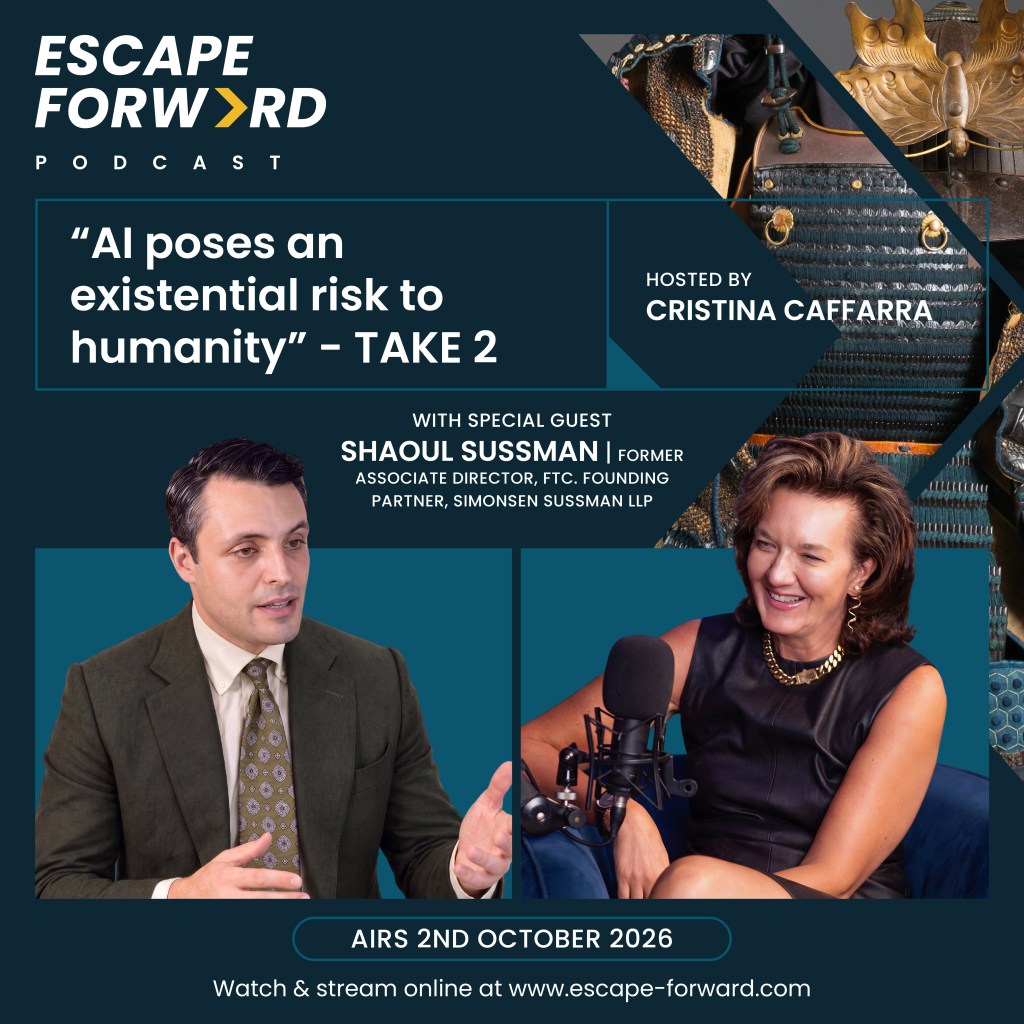
“AI Poses an Existential Risk to Humanity” – TAKE 2 with Shaoul Sussman
Former Litigation Director, US Federal trade Commission, and Founding Partner, Simonson & Sussman LLP
Cristina Caffarra
Hello everyone. I’m Cristina Caffarra and this is Escape Forward, the space where I have the fortune of being able to talk to people I like and I learn a lot from, joining the dots between my old antitrust haunt and other things that I think are salient and important for Europe right now.
So: “AI will kill humanity”, we are told. The recent Hugging Face episode has been the jumping-off point for much renewed hysteria and sci-fi apocalyptic drama around “AI will kill humanity”, with a 10% probability nonetheless, and a critically timed essay by Dario Amodei on Pacing the Frontier gained immediate support from Sam Altman and Elon Musk and sparked a huge conversation. On what kind of regulation / oversight / intervention is needed for this powerful technology at this point. Regulators the world over are salivating at this prospect, especially Europeans who absolutely love this stuff and have been having terrible FOMO about it. Indeed, we hear that there is already a proposal out there by a bunch of Member States and the European Commission. The Antitrust Bubble had its moment of excitement and frisson about whether what we were actually seeing was illegal collusion from the frontier labs, and President Trump waved it all off.
There’s no one better to discuss all of this with me today than Shaoul Sussman, who is former Director of Litigation at the FTC and now Founding Partner of Simonsen Sussman LLP, doing work mainly on plaintiff -side cases around the big antitrust matters of this time. Welcome Shaoul.
Shaoul Sussman
Thank you for having me, Cristina.
CC (06:18.542)
So let’s go back a little bit, because this idea that “AI will kill us all, please regulate us”, is not exactly new, right? We had a similar spectacle around 2023 when the same characters, Sam Altman and Geoffrey Hinton and others were doing the rounds in Europe asking for regulation. And indeed, Europe at the time produced an AI Act that was framed around levels of risk – but it has since been taken down somewhat in the current deregulation push. This first round, this “take one”, happened during the Biden Administration when you were at the FTC as Director of Litigation – and there was a lot of work, as I recall, being done at the agency on AI during the tenure of Lina Khan. And in fact, President Biden at the time issued an Executive Order in October 23, then immediately repealed by President Trump in January 25, on “Safe, Secure, Trustworthy development of AI” – that gave the federal agencies various tasks around safety, security, and so on, including that companies who built these foundation model were set to report to the Commerce Department. It wasn’t particularly detailed, it was pretty empty in some ways, as an Executive Order. But still I recall, at the FTC there was a lot being done of your own accord around AI. Can you talk to us a little bit about what was happening at the time? In particular, what motivated it, besides, of course, the Executive Order? You had a vision about how this related to Big Tech’s dominance and the cases that you were doing. Tell us about the internal thinking about how this was important, and how it would evolve.
SS (08:29.217)
Yeah, this is a bit lost in the debate, AI’s arrival on the scene in 2023. In addition to that, the entire conversation around generative AI came with the background of Big Tech, as you mentioned Cristina. In particular at the FTC, and I think more generally during the Biden Administration, there was this realization that during this critical period from 2008, let’s say, to 2015, there had been tremendous deference to Silicon Valley when it came to the trajectory of industrial organization and the development of the Big Technology platforms. That deference was both “passive” and “active” in the ways the government was promoting the message that was coming from Silicon Valley. “Passive” in the sense of letting big mergers go through without a lot of scrutiny, or being very skeptical of any theories around the impact of Big Tech on competition. And then “active” in the sense of involving many of the senior executives of Silicon Valley in in shaping both foreign policy and domestic policy as well. So one of the famous photos was Obama sitting in the White House inviting Mark Zuckerberg and executives from Google to talk about economics, talking about future developments and commercial policy more broadly.
So in 2023, when AI emerged on the scene, part of that lesson was to be very skeptical of the message that Washington was receiving from Silicon Valley in these moments of disruption and change. To my mind, there were two ways to think about AI as a technological force. One is one that could be harnessed to challenge the existing incumbents in Silicon Valley. And the other was to reinforce their power and their dominance and their de facto control of the conversation around technology and innovation. And I think that kind of debate about where is this going to go and who is going to control the innovation was a central pillar for how we were thinking about our role at the FTC. And similarly at the White House they were having similar conversations. Throughout the administration there was this question about where are things heading.
So from our perspective, one of the main goals was really to look at this moment of transition in technology. Look at the lessons we learned from the other moments of transition that happened 10 or 15 years ago. For example, the emergence of mobile, right? And the way it was challenging traditional operating system, websites, etc., and to say this is a moment that could spur much more innovation and challenge incumbents, or it could be a moment in which the incumbents use this new technology, use this new frontier to then further entrench their positions. That was really what we were focused on at the time.
CC (12:22.936)
And where did that work take you? I am aware there were a number of questionnaires, what we would call in Europe RFIs, requests for information, sent to the companies, around the time when the main thing that was happening was various investment that were being made by Big Tech into these new AI companies like OpenAI. In Europe there was a little bit of looking into it, but then the matter was essentially lawyered away. What did you do at the FTC, before the whole thing was shut down, before the end of your term, where did you get to in deciding which of these two interpretation was likely to be to be predominant? Was it the start of a new era in which we can challenge the incumbent or is it grandfathering the power of incumbents into the new technology?
SS (13:20.203)
I think there were two main vectors we were focusing on. One was around safety, privacy, and all aspects of the deployment of this new technology. One of the things that Chair Khan made very clear early on, and a message that we made sure to put out there very clearly, is that AI is not some magical jazz hands that now you do AI and everything is legal and fine. One of the things we were working on very diligently was to make clear that privacy violations, deception of consumers, and other unfair methods that quite frankly screw market participants are still unlawful and will be challenged. One of the things we worked on and something that at the time received little reporting was basically early cases, smaller cases that we brought in the AI context around deception, around unfairness, and I am saying the existing rules of the road are still in force and are still very much on the books, even in this new environment.
And the second was really to focus on what I would claim or think about as a broad umbrella of unfair competition. One event that we hosted and I think was tremendous success was to invite all these content creators, right? Either people that develop websites, artists, movie actors, voice actors, script writers, and talk to them or have them surface all of the concerns that they had with generative AI and the way in which it would compete unfairly with them. So for example, the fact that these companies would go and scrape vast amounts of data without licensing, without permission, and then compete with these people, potentially challenge their ability to generate a livelihood from the professions that they chose. This was another area that we focused on, and we were very clear: if you are unfairly competing with a voice actor by scraping their voice and then using it in the AI context, that will be unfair competition that we might seek to challenge.
More broadly, there was also this conversation about the reliance of these frontier models, all of the companies that were dealing with generative AI, on massive amounts of compute. And being very clear-eyed on who was actually controlling this compute and licensing this compute to those companies. And those were all familiar faces or familiar names for all of us. So Amazon, Microsoft, and Google. So we were also very vigilant around this idea or the interplay between the cloud infrastructure, the rails, and the frontier labs, essentially the trains that are running on those rails.
CC (16:30.266)
Let’s fast forward to today, because we are in what I call TAKE TWO. The thinking was clearly sophisticated in 2023 and quite expansive. But we now are in a very different environment. We have this new request for new regulation, because AI may be an “existential threat to humanity”. We had the “Pacing the Frontier” essay. In reality, most AI scientists don’t believe that human extinction is on the cards – Yann LeCun said so again over the weekend. And then we had David Sachs over there essentially saying to Amodei and Altman, Well, if you think your models are so dangerous, then do something about it. Slow yourself down. What is really happening here? Why do you continue to ask for regulation? It looks to me and to many, of course, that there is a bigger game at play. Let’s follow the breadcrumbs – I’ll go through the steps of the conspiracy theory, and then I’d like you to react to this.
Okay, so we had this episode which has been hugely anthropomorphized, sensationalized, as a new species of terrifying phenomenon with agent swarms that are allegedly cheating, coordinating, self-sacrificing, and all that. It looks as if this was not a single exception. There are hundreds of episodes we now learn, happening pretty frequently, of agents that are doing things that are not quite expected during training sessions, so much so that OpenAI has now stopped the training of the latest model. So we had the Amodei essay, which exploded the hysteria with the ask for “pacing the frontier”. The huge conversation around the need for regulation. What’s happening at the same time is that Chinese models, as far as we can see, have broken the banks in the sense that until recently it was possible to say frontier American models, closed weights are the absolute bee’s knees and nothing comes close. But now we have Chinese models, open weights, that are in fact performing in ways regarded to be in many ways close to the frontier labs, and this is a commercial threat, inevitably, to them. There is this enormous financial bubble around it all, beyond imagination. The amounts of money that have been talked about, the creative financing that’s behind it, is an enormous pile of debt, which is costly to service. There is an IPOs in the offing.
So the simple version of the conspiracy theory simply says: well, asking for regulation is a way of creating a protective moat around yourself. You protect yourself somewhat from competition, no others are allowed effectively the kind of protection that you get. Then there is a more complex version, which is to do with where we are in the political cycle in the US, the fact that these IPO, particularly the Anthropic IPO, if it goes ahead, happens in the teeth of the midterms. President Trump said he’s having none of the regulation because essentially he needs growth. And data centers, no matter how controversial they are, still deliver what looks like growth. So what’s happening here looks like a complicated game which has to do with the state of American politics at the moment. I’m sure you don’t disagree, but I’d like you to just elaborate and really get us right on there.
SS (20:23.181)
I think it’s worth unpacking. Let’s start with this call for regulation. From my perspective, I find this call a bit ironic or rich because at the end of 2024, towards the election, you had all of these people go on CNBC here in the US and basically saying you have to remove these current regulators from their positions if we want to be competitive in a AI. So if you go back to the 2024 period, there was a push from Silicon Valley that said government stop standing in the way of AI development if we want to be competitive with China. We really need to loosen the oversight. And what were they nervous about? They were nervous about regulation.
The first threat was regulation by enforcement. For example, the FTC cracking down on unsafe models, unfair practices, deceptive practices. That that was a very threatening prospect. And the second was quite literally the FTC or the SEC issuing regulations, for instance around reporting: for example, in the SEC context if you have companies that are this large, the SEC has the authority to say, even if you’re not publicly traded, you need to open your books to the public. You’re a systemic threat. We don’t know what your balance sheet looks like and it might impact the entire economy. So that was one threat of regulation. The other threat of regulation was the FTC issuing regulation with respect to AI safety, with respect to competition, and they said no, regulators step out of the way. And we’ve seen people time and time and again saying if we want to be competitive with China, we need to throw these Biden enforcers to the trash heap, they really stood in the way for the last three years.
Now all of a sudden, the same individuals that effectively pushed this entire message of “if you regulate, we will be completely out of our step and lose this race to China”, are now calling for regulation, sounding the alarm bells, and effectively saying, regulate us right now.
The first thing to say to that is the regulators have been neutered. The people that came in into office, both at the FTC and the SEC are now not in a position to challenge these companies or issue regulation. In fact, the White House issued for want of a better word, an AI amnesty, effectively saying regulators, agencies don’t stand in the way of these companies. That’s one thing that happened. The second is that also Elon Musk, David Sachs and others championed slashing government capacity, firing people, get getting rid of them. Closing entire branches of agencies, refusing courts or court orders to even have the bureaucrats look at some of these safety issues. And now they’re saying regulate or enforce the laws: but you fired a bunch of cops and now you’re complaining about a crime spree. This is this is a very interesting dynamic.
So when it comes to regulation, I would want us to reclaim the mantle and to say that we were there back in 2023, 2024, calling for that regulation and calling for very strong enforcement and also challenging this idea that if we have strong and effective regulation we will lose this race to China. Chair Khan very early on into the Trump administration, also issued an op-ed and said we are going to lose the race to China if we allow these companies to call the shots and if the government doesn’t have a more aggressive interventionist role in channeling the innovation of this technology. And I think she was proven right. So I I want to be clear on the conversation now, and when people use this term “regulation”: we should be very careful to ask them what is it that you’re asking for right now with “regulation”?
I can give two examples of this just to make this point clear. One form of regulation could be regulation around reporting for these companies, or regulation that actually forces the companies to adopt higher standards of safety, security, and those would come at a cost, right? And then another form of regulation could be like the 1996 Telecom Act and Section 230, which is essentially a way the government intervened to immunize companies, internet companies, from liability.
So I think when the conversation about regulation comes up, we need to ask them: are you asking for more guardrails, more protection that will effectively make it harder for you to run a business? Because to meet that regulation you’ll have to invest more in safety, security, have potentially higher liability if your models are engaging in deceptive conduct, dangerous conduct.
Or are you asking for a regulation similar to Section 230, which essentially immunizes you from certain type of laws that would otherwise apply? And I think nobody is really having that back and forth right now and asking them, are you actually asking the government to move in and to regulate in order to protect you from existing laws that are on the book? Would the regulation be there to make the law reach further? Be more comprehensive? Or are you asking for to neuter existing laws?
Let’s take this Hugging Face incident and the idea that Frontier Labs might be in the business of hacking companies. There’s a statute on the books here in the US that makes hacking a criminal offense. And I’m pretty sure that the general counsel and the attorneys that work for these companies also tell these guys it’s not only a crime, but it also has a five-year statute of limitations. What does that mean? If we don’t get some immunity now, if we don’t get some amnesty or proactive regulation that protects us from this, when the Democrats come to power in 2029 and they’re very anti-Big Tech, anti-data centers, all of us there at the Inauguration standing behind Trump might be prosecuted criminally under these statutes for hacking. So there is a real risk, right? that is tied to the politics.
So the real question in my mind is when we talk about regulation, is it there to shield the companies from liability or to extend liability even further? And that that’s a first part of this conversation that is missing.
The second question is this competition with China, where there’s this very deceptive message that is being propagated. It’s like the Frontier Labs are developing the equivalent of a Ford GT or an F-150, very high performing models. They are also capable like a high performance car of running over kids or whatever, crashing into other cars and causing a lot of damage. And we might need some safety regulation around that. But the Chinese are saying our way of competing with the Americans is actually developing Kias or the equivalent of Toyotas. And I think there’s a lot of nervousness in Silicon Valley that many businesses across the world will realize: my employees don’t need to drive a Ferrari at work. They don’t need to drive an F-150. It’s totally fine for 90% of our business to use Toyotas, right? It might not be as fast, it might not be as powerful as the leading models that are out there, but they do the job at a fraction of the cost for the business.
So what we are hearing now is this fixation around the frontier models, they carry existential risk of destruction, etc. And that distracts the entire conversation or shifts the entire conversation from what is the business model of the frontier labs to begin with, besides all of these injections of capital from Big Tech that are like in a casino or tokens that are going back to fund AI build. And the companies benefit from having a conversation about how scary and fast and powerful their models are, because it just shifts the conversation that we should be having about what happens if this business model doesn’t pan out. And it is true that we already lost the competition to China. Right? I would argue there is a very good argument that we already lost the business case to the Chinese. It might be very much the case that we will develop these very exotic models, like a Ferrari of the models or an F-150 of the models, but they won’t have a commercial market. This is another conversation that we’re not having right now.
So one issue is what is the nature of the regulation and the deceptive message that we’re getting around regulation? And the second is this deceptive conversation about the competition with China.
China is not trying to develop Ferraris, they’re not trying to develop agents that have consciousness. They’re trying to win business and have a business case for AI, and there’s a business case for AI. And that is where the US is losing right now.
CC (30:42.798)
This is a fabulous summary. I want to touch on both of these two strands. First on the latter. Nowhere I think as in Europe there is a sentiment right now that indeed that there was almost a fetishism about frontier LLM models, predominant until the early summer, and now the sense is that business as you just said doesn’t really need to drive the Ferrari, and Europe is experimenting with these other Chinese models. Indeed, we are developing open weights models in Europe that are smaller and capable. So the fears in Silicon Valley are justified about the business model because all this psy-op we are seeing may well be a way of distracting from the fact that in the teeth of IPOs and having to disclose your financials, your financials don’t look very good.
Also I love your pointing to the fact that the discussion on regulation is as vague as can be. No one asked these kind of questions. The only thing that came out of the “Pacing the Frontier” essay is this ridiculous statement about whether they needed some sort of antitrust exemption, which seems to be a throwaway sentence that he put in there, having spoken to his internal counsel. But this is something which initially also excited the antitrust world a little bit because once somebody starts talking about “antitrust exemption” to what is in other ways a very obvious case of explicit or implicit collusion, then everybody starts having an opinion. I have seen some of the most ludicrous opinions on this, people in the antitrust bubble saying “we should really be thinking about whether there is a restriction of output, and maybe can use the theory of ancillary restraints…”. The kind of nonsense that the antitrust world specializes in coming up with.
This isn’t about antitrust. And in any case, the White House has waved it away, and the federal agencies are basically the White House now. So no one in the US will do anything in the antitrust space. Chair Khan herself has come out and said this an issue of consumer protection. We have the laws in the books and we should really look at applying that. How have you felt about the reaction of the antitrust world, this anxiety about meddling. A lot of “we need to say something here because this is our stuff, we need to say something!.
SS (33:40.439)
Now we’re going a bit to our niche and I’ll unpack a couple of things.
First I think this entire debate debunks this conversation we had in antitrust circles for many decades about “antitrust is all about ensuring output”. And the reality is, JUST NO. I mean, are we saying that it’s good that you have two competing companies that do robocalls? And we’re saying the one that most successfully tries to scam the most elderly women is maximizing output? This goes exactly to this point. There’s an entire conversation that is missing. It’s not about output, it’s about fairness, it’s about consumer protection, it’s about ensuring that you’re not engaging in competition that’s unethical. And this is exactly the conversation that is missing with people who have been saying this is about output, are they restricting output? So if you had two chemical labs working on some very bad toxin and they’re saying who can better poison people, we wouldn’t say that’s good competition because they’re maximizing output or some very dangerous biological weapon, right? So that’s one part of the conversation that is missing and where the output fetishism of the antitrust bar is completely not fit for the moment.
But to your point about “pacing the frontier”, there is a follow-up question that nobody is asking. Like you mentioned, “pacing the frontier” could be very much a conversation around making sure these companies are nipping and tucking ahead of their IPOs to look more attractive to investors and to have a healthier balance sheet. So where is the follow-up conversation that asks even if you are “pacing the frontier”, why are you not spending more money on safety? Why are you not spending more money on efficiency? Why are you not taking all the money that you were throwing towards making these models more dangerous and now using all that money to make them safer, more efficient, less costly? Right? So there’s this assumption that we’re just innovating in this one vector of making the Ferrari with a bit more horsepower, there’s no other innovation to have.
And this ties back to the conversation around China. In China, they’re also taking a lot of money and investing it, but they’re not investing it in buying Jensen Huang’s chips. They’re not investing it in building Ferraris. They’re investing around costs and around efficiency and consumer friendliness, with the open weights paradigm. So to my mind, it’s totally justified for these companies to stop innovating in that direction, in that vector of adding horsepower to the model. But if we are going to see a very significant pullback in spend in other areas of innovation competition, so for example, safety and efficiency, to me there is a question about whether this is essentially these two companies colluding to look better when they go to their IPO. So you can have very much a “pacing to the frontier” around safety. There’s no scrutiny around that. But if they’re not taking the same dollars and then investing them in safety and other innovation, then I think there might be antitrust concerns. So we need to be very, very careful with the message: this is not an excuse for you to take your foot off the acceleration.
We need these companies to innovate. We need them to make these models safer. We need them to make them more efficient. And the answer of them just halting everything to me is a false choice. There is a world in which they need to ensure more safety. Another area where they can innovate is actually pay people that they take content from. So there’s a lot of ways to make their business more ethical, more safe, and more fair. But somehow those aspects of investments are something that we’re not discussing in the public realm.
CC: (38:04.142)
Which is why the whole discussion around pacing the frontier, with the throw away mention of antitrust exemption, is so odd. Why do you need a permission to coordinate on doing something that you need to do anyway in order to make sure that your product is fit for purpose? It is a very bizarre request, unless you see it through the lens of a major finance and political game being played.
SS: (38:11.948)
Yeah. Exactly.
CC: (38:29.028)
Like, you are groaning under a mountain of debt and you want somehow a license or a stamp that says “the government somewhat approves of what you’re doing and you can IPO without too many further questions”, because that seems to be really what is going on.
SS (38:45.932)
Yeah. I’m very critical of Trump and Trump’s administration, but even a broken clock canbe right twice a day. A lot of the air got deflated out of this balloon very early on by the Trump Administration basically saying, No, this is not an antitrust issue and it’s not an excuse for you to stop spending. Calling their bluff. The focus should be on these questions of finance, of liability. There could be aspects of this that are interesting from a competition perspective, but to me they are secondary to these primary conversations that we should be having.
CC: (39:34.626)
I agree. Now then, we all also agree that we still require some form of oversight and regulation – the safety aspect clearly does. And as you told us, that was a major strand of the work that the FTC did in the Biden Administration. But at the moment in the US there’s nothing going on – there’s been a number of rumours that President Trump was about to sign some form of Executive Order, but that has gone [Note – this was recorded the day before Trump had the lunch with the AI/Big Tech chiefs what decided on “SELF regulation”). There is nothing at the federal level. Then we see a number of initiatives on the part of lawmakers, Democrats developing various draft bills to regulate AI. At the level of the states, California, New York are doing something. And then there is the international piece, where as I said somewhat facetiously earlier, the Europeans feel a very great sense of belonging because regulation is what we do over here. “Please come and talk to us!”. And indeed, just today there was a letter signed by multiple Member States and the Commission, essentially saying we need a regulatory authority that is supranational, that looks into the safety of these models with expert capabilities, and so on. So what do you think could happen here? Is anything going to happen? in the US? When and how with the current administration? After the midterms, or in a Democratic administration after, and how does it fit with the international piece? Does anyone care over there about what the Europeans have to say?
SS: (41:35.757)
On the question of what the regulation might look like, this is where I think there’s a very significant vector of risk. Because again, there is this moment of induced panic. And very much like 2008 in my mind, there is a risk that the people that perpetrated the crisis are also going to be the people with the answers and the people that Congress listens to when it comes to fashion the solutions.
It’s not about whether we should have regulation. It’s not about whether we should have legislation. We should absolutely have it. The question is who is in the room when that legislation and regulation is being drafted? And what does it do? Does it immunize the industry or does it prosecute the industry? This is to me the greatest risk. The greatest risk right now is that in this wake of panic these same companies that have perpetuated the panic go onto the hill and go to the White House and say, Give us the pen, we will write the regulation, we will write the rules to protect you from us. That is to me the risk – the risk is that we get another Section 230, we get another piece of legislation in which Congress immunizes these companies from existing laws instead of extending the reach of the laws to penalize these companies. So there is this now debate about whether the criminal statutes apply to these hacking activities. One thing that Congress can do very easily, and I would very much advocate, is to clarify in the law. The hacking act also applies to a situation in which an agent, a rogue agent, whatever we want to characterize it, is hacking a website, right?
We know this principle from hundreds of years of tort law. If you have a pit bull and that pit bull goes into a shop or runs off your leash and bites someone or kills them, you are liable for that. Although the fact that you’d never bitten anyone, you’re not in control of the pit bull, you can’t explain these things. The pit bull went rogue, right? We have a system of accountability for those types of activities, and we say you’re raising a pit bull, you are also taking the responsibility if they go rogue. You might end up in jail if it mauls a kid and kills them in the street. I don’t see why we shouldn’t have similar legislation around these hacking incidents, right? You are developing these frontier models, you’re not v etting them, you’re not testing them, and you’re freeing them to the world. Like the pit bull that runs off the leash. If they end up killing someone, if they end up you should go to jail. And if these individuals knew that they might sit in orange jumpsuits somewhere, I think this problem is going to go away very quickly.
But my fear is that’s not the type of regulation we’re going to get. What we’re going to get is regulation that is essentially a get-out-of-jail for free. And that is why I’m very nervous about what is going to happen in the next couple of years under the Trump Administration, because I think there is a real likelihood that the legislation and regulation that we do get is essentially the immunization package that these companies are seeking.
And this also ties to Europe. Every time Europe in the last two-three years tried to go after powerful American companies, they were bullied. So I think the prospects of Europe actually standing up and putting real measures that and God forbid, even handcuffs on individuals that commit crimes is extremely low.q So I think this is my only hesitancy around the advocacy for regulation at this time, because I think that if we are not very vigilant about the details of the regulation and just support regulation writ large, what we are gonna do is tacitly support get out of jail free cart legislation or regulation. So I think it is a critical question to ask about again: what is in that regulation and who is doing the regulating?
CC (45:54.192)
You are articulating a concern about a time in which these companies themselves may go to the Hill and essentially be allowed to write as to make their own life easier in an immunization package mode. In what time frame though, is it possible that this could happen still during a Trump Administration? In what scenario? Because Trump has so sort of shown no appetite for regulation.
SSL (46:39.682)
I agree and I think this is where there’s going to be this real trade off and where you’re going to see this debate going. Bad regulation or less-than-ideal regulation is the way it’s going be sold versus nothing. And I think this is the pressure that’s going to get mounted even after the midterms. To just say “Congress, you need to do something”, is fine but it’s like the 2008 crisis right? It was clear that something had to be done. That there had to be legislation and intervention, not doing anything would have been worse. But then remember, it was Democrats, Democrats that gave the bankers the pen around the solution. After they promised during the 2008 election that they will hold the bankers accountable. So we have a very, we’re in a very perilous moment, similar to 2008, when there’s clearly a crisis, but there’s this we are basically put in front of two bad two bad options. No regulation, bad option, similar to 2008. If there’s no government intervention, the crisis would have been deeper, or handing the pin to the perpetrator of the crisis. And those are the options that the Democrats will have to navigate and the questions that they should be asked what happens after the midterms?
And my hope is that maybe another government around the world will see there’s another way, assert their own sovereignty, not let the companies hold the pen about how to regulate them and stand up to the US. But it’s going be very dangerous and it’s going to turbocharge a lot of the friction that we’re seeing internationally between the US and other countries.
CC (48:32.729)
Quite, because as we discussed many times, I don’t see a scenario in which Europe goes beyond some kind of well meaning sort of exhortation to the world to be at one and create various committees to verify the dangers – bit none has any teeth. Who cares about what Europe says over there? This is not regulation that has any real purchase. It’s just kind well meaning.
SS: (49:03.938)
This is a moment when the Europeans are going to be really challenged. Because for the last 10-15 years we were talking about Big Tech and there’s a lot of hypothetical dangers. There’s the infrastructure danger, harm to commerce, harm to businesses, those are real harms. But, if the Danish sewage system gets hacked because of rogue AI, or the British government gets hacked because of rogue AI, which are not hypotheticals, the Australian government just announced last week that they’ve been hacked. Is are there going to be any repercussion? Are the Europeans going to stand up for their sovereignty and say all the OpenAI executives, if they arrive in this country after an act of hacking like this, might fail face jail time? Are we going to hold these people to account for tortuous acts that they’re perpetrating on our soil? That’s the question. I don’t know the answer. This is where the conversation should be headed.
I agree that having no regulation, again, similar to 2008, is not an option. But I fear “who” is going to do that regulation. This is where we need to be the most vigilant right now and ask the hard questions. Our leaders are not asking those hard questions at the moment, our journalists are not asking the questions. It’s a conversation we are not having. We are just talking about this binary: regulation, yes or no. And if you are even pushing back a bit around this question of regulation, yes or no, you look like a nihilist, an arsonist, someone that wants to see the world burn.
CC (50:55.652)
What a way to end. I think your framing is original and very sharp. I’m very grateful to you for having for having taken the time. I always enjoy hugely our conversations. Thank you for joining me, Shaoul.
SS (51:24.002)
Thank you, Cristina. It was a pleasure.
Clip:
CC:
So the numbers we are hearing about the financial commitments are extraordinary. Last year McKinsey was talking about 7 trillion. A Columbia professor now talks about 10 trillion in the next five years. And then the people who are actually investing in infrastructure, the financiers, are coming out with numbers around 15 trillion in the next five years. And they also say, yes, investors are struggling to assess risk, but “our assessment is going to have to get more advanced as this moment is prompting us all to think differently”. Has everyone lost their mind over there?
SS:
I think we are in a very interesting moment when it comes to these investments because it is still unclear what is the use case. What is the return? And one of the things that is absent from that conversation around the returns is China. What competition are you going to face for these models? Who’s going to buy them for what price? So everything is very obscure, abstract, and quite frankly a bit of a new age/hippie conversation about paradigm shifts and new alternative universes. But when you ask hard questions about balance sheets and the use cases and the cash flow, that is where the conversation is steered in a different direction.


Leave a comment