

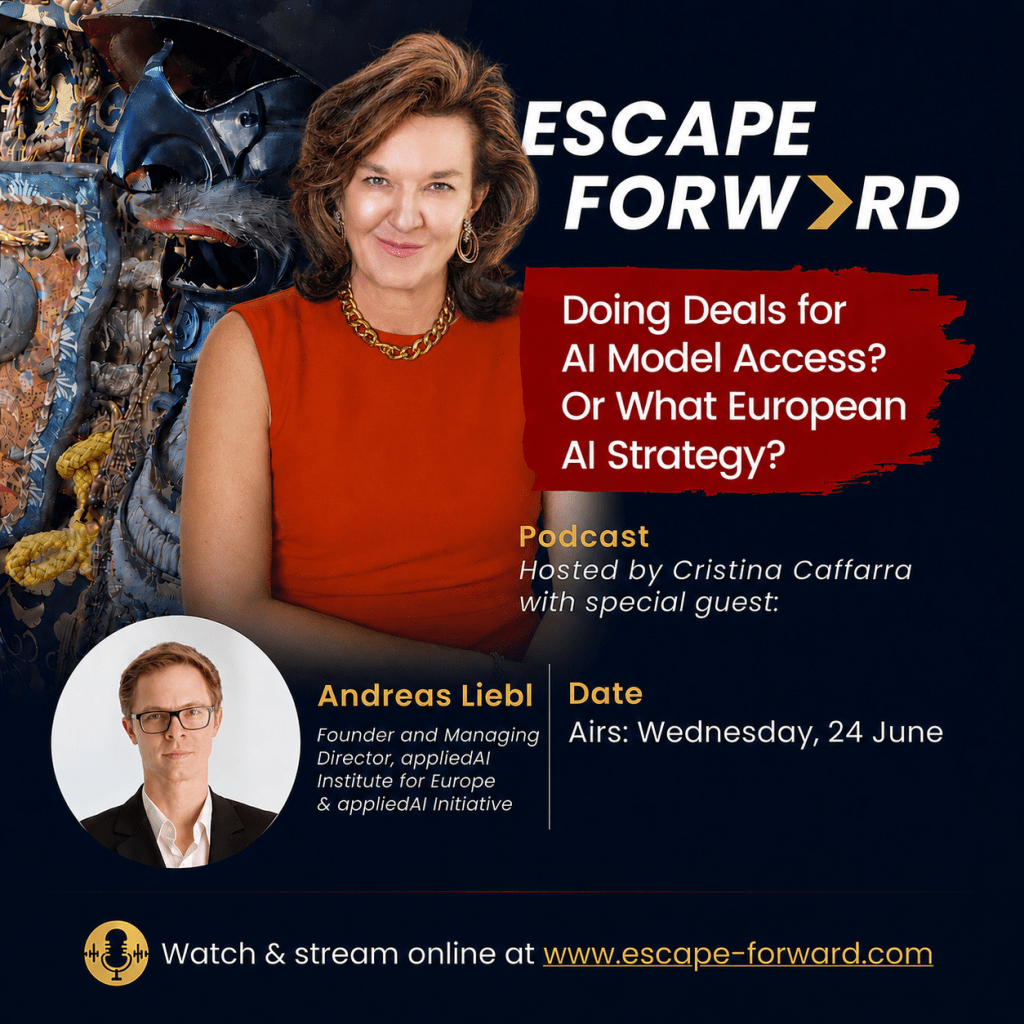
Cristina Caffarra in conversation with Andreas Liebl on the way AI FOMO on “god-like” LLM frontier models is being weaponized in Europe to push US tech economic and geopolitical dominance, alongside the campaign to kill the European sovereignty movement. The future of AI in Europe may involve different paths, may be about much more than frontier models, from orchestrated agentic structures be architected for organizations using smaller more specialist models (can they deliver powerful results?), world models, causal models, embedding context, recursive self-improvement, robotics & physical AI (which have different requirements from cognitive side). Still a lot to play for – though yes we must build our own compute as it is essential infrastructure.
ESCAPE FORWARD Ep. 10, 24 June 2026
“Doing Deals for AI Model Access? Or what European Strategy?” with Andreas Liebl
Founder and Managing Director, AppliedAI Institute for Europe and AppliedAI Initiative
Cristina Caffarra
Hello everyone, I’m Cristina Caffarra and this is Escape Forward – the space in which I have the privilege of moving forward from my original domain, antitrust, and have conversations with people I really like and I can learn from in areas that I find at this point much more important, salient, and interesting than where I started from. Today’s discussion couldn’t be more timely. We are recording this pretty much a week after the very high-profile episode in which Anthropic pulled its models, Fable 5 and Mythos, globally as a result of an executive order from the Department of Commerce. That intervention was not particularly directed at Europe in any shape or form, was effectively a matter of internal domestic US policy around AI and security – but has had enormous resonance across the whole of Europe. There has been a huge discussion, still going on, of “the kill switch” and its implications for our dependencies, for our future and AI in Europe.
This is falling right in the middle of a parallel big discussion going on in Europe around sovereignty. as many of you may know, I’m very involved in that discussion. Tech sovereignty is very much something which is at the moment on everybody’s mind. It is the subject of a package with the Commission has issued, but more than that. There is a great deal of discussion at the level of Member States. There is a joint French and German initiative. There are initiatives at the national level and generally a lot of soul searching in Europe as to what we can do to reduce our dependencies and what sovereignty really means in this world. So these two conversations are happening in parallel with the AI developments, and one of the themes that I often get to face is “but you sovereignty types are not really getting it. You think that it is achievable to develop a sovereign position for Europe. Europe is way behind in every dimension. We cannot aspire to anything remotely close to sovereignty where it matters, which is Frontier AI, which is will determine the future of Europe”.
So, we need to think about something much more pragmatic about how we are going to pursue our own position. There is this criss-crossing of themes with the sovereignty people saying we still need essentially to develop our own capabilities in Europe, and the AI crowd, particularly the maximalist frontier crowd, saying this is hopeless, you haven’t a chance in hell, this is all a waste of time, focus on what matters, which is try give us some compute for the future.
In all of this, I’m particularly delighted to have with me to discuss these topics Andreas Liebl, who is the founder and the managing director of the Applied AI initiative that looks at how AI is shaping competitiveness of European industry, and also at the same time of the applied AI Institute for Europe, which is a foundation that looks at the at the broader perspective of how to develop trustworthy AI for the future of Europe.
Andreas, welcome. great to have you here. I would like to start indeed with inevitably at this point, the event that has focused everybody’s mind in the last week and it has driven a lot of emotion around killer switch and a renewed call to arms for Europe (like we needed yet another wake-up, call as if we didn’t have enough so far). The pulling of the Anthropic models in itself doesn’t have enormous practical implications because it’s not clear how many people were really currently using them in Europe. But of course, the symbolic significance is very clear. And the reaction to that has been twofold. One bunch of people have been running around headless chicken mode, we need to do something, we need to do something, whatever that is. Another bunch of people have been saying, look, this is telling us what we already know. Europe is incapable ultimately of competing at the level it requires. And we’d better accept it, we’d better be realistic about it, we’d better not be dreamy and make the most of our circumstances. So try and obtain compute in any other way, try to even convince ultimately hyperscalers to invest more in Europe so that they can commit to giving us the computer we need for the future.
This is a very confused debate at this point. There is also a paper that’s come out in the last few days called Euro 2031, which we’ll discuss further, that kind of presents a dystopian view. Your institute has produced a white paper in March that looks at the future. Where are you at this point in your thinking, given last weeks’ developments. How does that colour how you see the future and what we then could be doing?
Andreas Liebl
Thank you for having me. I’m really happy to have that conversation with you. Obviously it’s a very complex theme. Maybe there are some simplifications at some point. but we need to have first an understanding of the different aspects of what we’re looking at.
So from our perspective, and as you mentioned, we in our Institute and in our non-for-profit organization, we monitor developments to have a good understanding of what the most likely trajectory of technology development could look like, and we actually monitor four different topics.
One is the model capability. And this is what we talk about with the Fable Five version and so on. And the question is what if Europe does not have access to a particular type of capability of individual models? What is happening there? are there alternatives? are scaling laws continuing and like all these questions.
The second is agentic autonomy. Agentic autonomy is a little bit of a different story. And I think this we can talk about this as an avenue for Europe. The first one is to train and invest in the most genius out there, maybe 100 years ago the expert in building a new car. There’s one person having the idea of what a car could look like, designs makes the engineering, it’s also the one who’s building that. We put that into an organization. We distributed work, we made it in a way that the average human can work in that environment, that together we can create a very complex outcome. And what we did is we made that knowledge of that one person institutionalized in the processes and the roles and the descriptions of that organization. Now this is what is happening in agentic orchestration. We bring one very genius AI model, the most powerful that is out there, and need to move it to a setup where we have orchestrated multi-agent systems in organizational contexts.
Where we embed the knowledge of creating something very complex is in the orchestration and not in the individual model. So if we do that, we can replace the models. Like humans go come and go in in organizational setups, and it’s not breaking down the organization because it’s in in in the org knowledge itself, we have that move from single individual very powerful models to an orchestrated environment in which that orchestration can achieve a very complex goal setting. And we need to discuss of how are multi-agent orchestrations moving forward as the second avenue which really drives adoption because it makes us independent from the single model capabilities.
The third one is recursive self improvement, the ability of AI systems to train the next generations of AI systems, or at least parts of these generations of the systems, which will dramatically accelerate once we actually get there. And this is still something else than talking about single individual capabilities of single models.
And the fourth one is the robotic side, because once we get into physical world we talk about a whole different game than just look at the kind of intellectual cognitive side and the theoretical word like in in pure L elementative and AI model.
So these are for us the four major drivers of what defines the speed of development, which we need to cope with. And it also defines the implications on the labor market, on society, on science systems, on innovation and all other parts.
Now we can influence the different kind of directions on the input side, and we can also influence them on the output side, and we can talk about both. And these are very different discussions that we’re having. Now the discussion around the Mythos and the Fable models and the overall discussion about are we dependent from single model providers really falls in the first input category.
And it’s an important one. It’s something we need to kind of discuss because in user cases where the single genius thing that is most advanced really makes a difference, maybe in scientific research, maybe in cybersecurity, we just need to have access to the top models, otherwise we will not be competitive, then the question is how we get access to that model.
But in many other cases it’s not the question of how to get the most advanced model to do the most stupid task, but how to distribute the work in a way that with small models and with specialized models we can actually in an orchestration perform a very good output that is very, very efficient. So in the first instance yes, we need to talk about access to these models, but there is plenty of other fields in in our world where we just don’t need the best models in the access and in the discussions those things get confused, we mix them, we bring them together, but I would like to really separate these as different discussions.
CC: This is super important, and very much the reason I wanted you to be here, because you and I had this conversation before, and I think the way you think about it has to come forward. There is indeed this confusion. The public discussion that many effectively are exposed to starts from a premise that only frontier models matter at all. And if you don’t have frontier models or access to frontier models, you are entirely doomed. In a general sense, your future is over. This is very much the spirit of this, for example, you call it one can call it a novel, they call it a novella or novellette. This paper that’s doing the rounds called Europe 2031, written by some researchers, that essentially tries to attract attention by presenting a dystopian view in which Europe does nothing in the next few years and effectively finds itself in 2031 hollowed and incapable of maintaining even a basic standard. And the premise in that paper, and I’ve discussed it also with authors, is very much that it’s frontier models.
As the only worthwhile thing that we should be having. And if we are behind or cannot get hold of that capability, all sorts of evil things will happen, which therefore motivates a set of policy prescriptions that are kind of worrying for somebody who worries about sovereignty because these policy prescriptions go through, well, look, it’s hopeless, we might as well accept, we are totally dependent. We will encourage hyperscalers to build in Europe, get them to commit to give us compute, increase our dependency. Well, that’s a thing we have to accept because there is no alternative.
So the distinction you draw, and I’d like you to actually go further and unpack it and really make it very clear, is that for certain user cases, that is true, and indeed access to frontier models is essential. But there is a host of user cases which matter for the economy, for industrial capability, for what we do, in which models that have got perhaps a little gap, or a gap, an actual gap, are adequate? Is that what we’re saying? Is that what you are saying?
AL: Maybe if we unpack it further, as you said, then let’s first look at the frontier model discussion, it’s in very interesting dynamics currently happening. the what kind of in the in the research field, but also in in the field of the experts of the top Frontier model developers at the moment. For example, a discussion we had this year in Davos was that well, there is an option that we continue to grow with even larger models, with more compute capacity, just like using the scaling laws and getting better and getting to something like a very powerful AI models, AGI, ASI type thing and we just need to build more and better and greater and so on. If that is the case, yes, then obviously we need to talk about the infrastructure for that. We need to talk about massive investments. If we say, well, this is the only trajectory that we believe in, that this is happening. But even there, we said, well there is a maybe 50% probability that this is the winning race. There might be different ones because
We might need to find a different basic underlying architecture. It’s not the attention based models, but more like causal models, something like Yann Le Cunn, for example, is following, or also maybe there’s something like Deep Mind is really following. and there are alternatives that might actually be more promising than just continue to scale and scale and scale and then again the third way would be to have these kind of self improving loops, the recursive self improvement. and there are companies like Sakana in Japan with from Llion Jones, one of the main authors of the Transformer paper back then. and he works on that in Japan. Or there is Richard Socher now in in the US building recursive and this is a kind of new startup where they say, Well, we believe that we can kind of outpace the existing ones that follow more the this scaling laws, but we can do different things and from there on we can continue. But like technology is developing and that means massive depreciation cycles. Technology is outdated in six months and 12 months and we can go in with new approaches. And then the question is from that point on can we continue at the same speed like the others?
But there are always new points to enter the race. therefore I think there is also option for Europe. We can either try out different model architectures, very much more efficient ones, we can enter that recursive self-improvement race, the causal model, the more kind of the physical world, with the world models and so on. But believing that we in Europe can win the race in scaling laws with just more and bigger and better L L models, I don’t think this is something. But again there are different options. and even if we say that first one is it takes three, four, five years to build the data center capacity.
CC: So let me let me stop you there because I think that this is this is going exactly in the direction I want. We are taking things piece by piece. So you talked about the frontier model and you gave a vision of how this sort of notion that there is only one path, which is the current frontier models as they are understood and as they are developed in the US labs is the only option, is not something we should blindly accept. Why is it then that that is so much part of the current policy debate, that what you see in the policy arena are people coming out and essentially making this point, which is: look, this is the only future. So, you know, people like Anton liked, people like you know, this 2031. Really, you get the impression reading this that it’s frontier models or nothing.
Nothing else exists, and unless we adopt that vision, it is going to be hopeless. What disturbs me about that, and I’m not asking you to comment on the motivation of the individuals, but what disturbs me about that is this idea that this is actually the narrative that hyperscalers themselves are putting forward, right? Because in order to push their own, and by hyperscalers, I mean the US, the US kind of frontier labs, their own position, they say, Well, you have no alternative but us, and you will have to ultimately build on us because there is nothing else that you can do. And so you are in the position of being at the best a smart follower.
At most, you can be a follower and adopt our stuff, and so you should ask us very nicely to give you compute because that’s the only solution. What you present is an alternative vision, which is not quite as deterministic. We are not just in a world in which is frontier models or bust. And I like that notion because it’s not quite as widespread in the debate.
There is much noise that is made around this, it’s all doom and gloom, unless you have the frontier ability to invest in in this kind of scale. So that’s really what I find, I find, I find a bit disturbing and not very encouraging in the in the intellectual and policy discussion.
AL: I think so I would agree in parts actually. So on the one side, yes, there are definitely more ways, and maybe my interpretation why the reason is only to look at this one because it has been like proven that this one is at the moment a successful path. It’s one, but it’s a successful, but we know already that this is a successful one. So it’s easier to say, well, why don’t we jump also on that same kind of avenue? That that we know that this is successful. The other ones are more like bets. We don’t know. We intellectually think this might be a good way and we might find a there must be a much more efficient way of doing the model training but also the model inference the there’s from the brain brain’s efficiency to what we now see in the transformers there’s a massive gap so somehow there need to be some solutions in there.
That we just don’t see and we might need to get into that direction. But it’s much less clear. It’s much easier to say, we know this one is working, we need to jump on this one. So let’s discuss how we get to that. So I think this is one of the reasons why we are looking at that. On the other side, I like what we currently have with the existing technology is a very good way of improving the speed of coding. Th there was a nice chart from Anthropic a few days back where they said the output of the like individual coder, the engineer within Anthropic improved from the a ratio of one so averaged on kind of a factor of one to a now a factor of eight. And this massive jump was only in the first two quarters this year, with access to METOS to kind of the fifth generation of the models, to dramatically, like dramatically improve the output or increase the output of the single individual developers there. So it’s w what we currently have is a technology that lets the developers accelerate the development itself.
And this is available bound on the available access to these types of models, but there are open code, there are different other open source models that we can access alternatives, and compute. And we need compute. We are we far we don’t have enough compute in in Europe. So I independent on the discussion on what we need in terms of the research and the fields for developing new models.
There is without any doubt the need to get more compute. And we in Europe just don’t invest enough in that field. So I really would encourage everyone. We somehow need to get more compute to make it available to Europe. in in all cases, like we had a few years back discussion and brought Sam Altman also to Munich, and the discussion was about the availability of compute for any single developer and on open AI versus the whole of the technology the technical university of Munich in terms of compute resources and I mean the balance was well that they might actually have as much compute power as a single person than the whole of the researchers. So it’s a disbalance and we need to have more compute access for our researchers, for the universities, for the developers, for the startups.
We are far away from what we would actually need. So I encourage like really investing in that one. That’s a no regret move from my perspective, independent of the models that we develop, independent of any other strategy, even for the inference that we we need that. So their investment definitely is.
CC: And you’re saying that that is because compute is fungible in a sense. You know, depend the models that you use in it can be different, but computing power is what is needed regardless of the model.
AL: And in it at the lowest level, at least for the acceleration of the development of something else. Like it all like if you only use it for accelerating coding, and we just don’t do anything, not training, nothing else, but just accelerate output of software. that accelerates then again all other parts. The more we can create in code, the more it accelerates in research, in healthcare in in all other parts and we know already that AI is pretty good in coding and what it needs is hardware and compute resources for create more coding output. So I think that alone drives that without even like considering other applications.
CC: But what is your view as to how that massive increase in compute should be coming about? You’re saying I encourage everybody to do it. Do you have in mind, I mean the European Commission is throwing some money at it, is doing these gigafactories, not clear exactly where that is going.
But how do you think this could happen? Because one answer, as I say, has been: well, you know, we should allow hyperscalers to actually continue to carpet Europe with data centers, and that’s how the compute is going to come because they got the money and we don’t. So pragmatically, where do you see that boosting computing potentially coming from? Is it the private sector? Is it subsidized? What are we looking at?
AL: I mean at least there are business models out there, so I think the private sector can invest in in compute infrastructure. maybe it can also be some states that really invest in that, at least those that have access energy, it could be Iceland, could be Norway, that really invest in that as a kind of a national infrastructure, to to boost ultimately then GDP to boost value creation in their own countries because they have that as an infrastructure as well. I wouldn’t invest in countries where there are already high electricity prices or the grid is at its limits. maybe that’s not the best location to do that. But just looking at Europe as a whole or also other parts in the world, I think there are plenty of opportunities either through the private sector or through the governments or public private partnerships. I think there are different ways but for me and again I like would like to split that, this is a more strategic option because even if we now decide and tomorrow pay, it takes some time to build it up. So and until it’s there, we just need to deal with the resources that we are having. and if we develop new models now then we cannot rely on an infrastructure that’s being built in three, four, five years out in the future. So it like no regret, we need to do it, we need to have it independent of how it’s being paid, but it still does not solve anything on the more strategic topics of now what do we do now? Because we can’t just wait for the next five years. So let’s maybe move back to what we do now.
CCL I want to also bring another factor that I really very much confront when I speak to companies. I speak to a lot of companies that are building data centers or aspire to building data centers in Europe. Private sector. And they say, Cristina, what we face is not a limitation even on funding. Funding exists. you know, people are willing to give you money to build a data center. What is the constraint is whether demand exists. This is the question is adoption and diffusion. Because you talk about academic research, and I’m sure all of that is there. But someone who builds a data center says: for me, the question is whether I can actually sell my capacity to customers in Europe, or essentially I have to sublet it to Microsoft, who’s gonna use it, or AWS who’s gonna use it, because I have not enough direct demand from industrial customers migrating to this kind of service.
And that adoption and diffusion ultimately of AI, but of services is how is that gonna drive? Do you see, you know, what’s the time, what’s the vision you have about that? Because unless demand moves, you know, building is not build it and they will come. People build if there is demand.
AL: So that comes from my perspective to that world of agent orchestration, of agent autonomy, where I believe this could really a way forward also for Europe. but maybe just one more comment. As initially said, I believe there will be some application areas for the really the frontier models and we as Europe need to decide if you want to be part of that or not, which is on the cyber side, which is on kind of some fundamental basic research, where just better kind of cap intellectual capacity gets us to better outcomes and if we want to be part of that we should as Europe invest in any type of infrastructure or model or project that helps us to build. But I would kind of hatch things. I would not just put it into one and say we build the next Anthropic or OpenAI with the same approach, but maybe there are different other ones where we also would like to invest in something to have something there. So now from that to the very fair point, are we in Europe than actually using the capacity that we are building. And like if you look at compute capacity, you can basically simplify, use it for two things. One is the training of the models, one is the inference, so the use of that models. Now do I believe that we feel that capacity only for making available for training of the models actually that’s sad, but no, I don’t think so. I think there are hardly any companies in Europe that train so large models that we can really make use of hundreds of thousands or millions of GPUs or TPUs or any other processing units that we want to use for that. If you look at the inference side, I believe yes, we will be able to use that because it is again a very simplified function. The more compute you throw in, the better the outcome is. And just looking at then some marginal returns, there will be plenty of use cases where always a little bit more compute justifies the better outcome because you might can monetize the outcome better.
And as we started with that growth trajectories of AI models, we obviously also need for the compute investments the understanding that AI models will continue to get better. So we will have environments in which we will use multi agent systems and organizations for running the whole R and D pipelines. And again, if you have more compute, you can instead of creating three new products, create four or five or six more products. because the pipelines are there and the more you throw in the more runs you can do in that pipeline, the more product variants you can create, or drugs are being discovered. The more compute you have, the more often you can do these iterations, the more discoveries you can actually make. Or scheduling in the production or the order to delivery process, or if there are robots, then we need the compute resources maybe for doing some manual and physical task as well.
So I believe just considering and assuming that we continue to grow in terms of AI capabilities, the value of these capabilities increase even further, and that would lead to a system where we can create more outcome than ultimately the compute actually costs and then there is a business case behind it. XXXXX my core assumption really is on the inference side and using multi agent systems to let it run in loops, that will we can build quite a bit of infrastructure just for that and we can actually make use of.
CC: So I want to pick up a conversation that we also had before and is very popular in Germany too, this notion that yes, you know, again, leave aside LLMs and the race for LLMs, it’s not where we’re at. but there is special capabilities that Europe has that we need to leverage and will allow us to do much more than perhaps many think. So the whole discussion around industrial AI, physical AI, which is regarded of course as very much where Europe should really bet given that we have industrial machinery and mechanical engineering capabilities, incredible data sets, you know, things which are unique to Europe but can represent an asset base that we can leverage.
How is I’ve been witnessing many discussions, you know, at an overmesse in many other places in which industrial enterprise has been coming out very boldly saying this is the future, this is what we’ll do, this is this is how we will increase productivity in Europe, we will develop industrial strengths that will allow us to recover. How are those industrial AI models going to look like I mean what is the vision there? Who is going to develop? Is it the companies themselves develop them the you know taking something and developing it internally? Using what? just tell us the story there.
AL: If we talk about industrial AI models, I think we need to separate the discussion, look at different types of models. So the first one is we talk about the classic machine learning applications, and there is maybe a computer vision algorithm for quality control or an AI system that can predict simulation methods, but it’s a thousand times faster than actually running the simulations or the specific trained models to make the design of chips or something else. So there are particular models that are trained with a very concrete data set that is only available for a few players that can then do a job very good because it’s been trained on that model.
So this is one and this in the classic machine learning topic, but even on the LLM side to assume if a healthcare model trained on healthcare data, it’s much better in predicting diseases or giving me recommendations on my health, because it’s been trained only on health data and not like everything else. that is one. Then there is a second category of saying there is a particular model that is not mirroring the capabilities of an LLM and is maybe a specially trained PhD instead of a general generally intelligent person that XXXX kind of did a studies on a variety of subjects and just reads a new paper and say, well I have a general intelligence, I read that, I now can apply it, but I train specifically for that particular this is this one, but it’s basically the same type of thing.
Then the second category is specific industrial models that can do something that LLMs cannot do, that is really design production lines, because the underlying knowledge of how a good is being produced with kind of what thing comes after the other, what types of manufacturing steps I need to do, these things are embedded in that model. But this is not a classic language model, but more that world model type that has a concrete understanding of the manufacturing processes that you actually need to do to get from a raw material to some particular output. And you need to apply that to a different set of problems than the LLM models. that is kind of the second type of model.
Now there is that that third approach to say, and I’m a big fan of the third one, you just need to have, let’s say, generally intelligent systems, agents or language models. and then you provide the context in a way that that generally intelligent model can make sense of the context that you provided ad hoc. And that context can change. Like it to tomorrow it’s different than today.
I make an adjustment here in in different companies, it’s different, but using a generally intelligent thing to make sense of what I provided with is actually what we are used in organizations since forever. We hire a new employee, you give them the information, and that generally intelligent person can make sense of that. what you give that. the third approach is interesting because you separate the development of that kind of generally intelligent thing.
From providing the specific knowledge of an industrial player, for example. While in the first and the second case, the performance of the model is always bound to the availability of the data, of the training of the model. And only if you do that it actually gets better. Because it’s always a specialized model that you improve. Now, for the first one, the very specialized trained models on very specialized applications, there is a business case. There are tools that you create that you cannot create elsewhere. For the LLMs that you train on industrial data and you try to embed more industrial knowledge into them, I personally would say I would ask or question if someone who’s developing that can compete in terms of speed with the increasing intelligence on a general level that just is provided the context on the side. Can that be successful? Yes, it might be, but I would and I and we follow the more the idea of well then let’s really focus on providing the right context and embedding that contextual knowledge in a new type of operating model for organizations, while you just can replace them the model behind it. Can be an open source model, can be a European one, a Chinese one, an American one, it can be the proprietary models, but once we are very good in providing the context to that type of orchestrated system, then then it actually helps. So I believe in that discussion on industrial models, again we need to split it up a little bit because it’s more complex than is industrial AI successful or not, or do we have something in there as Europe or not? But to look at the different options that we have to develop something. there are players in Europe also to follow, like really collecting domain knowledge, building their own preparatory models, but then they really need to keep up with the speed of development that we are seeing out there. Can they be successful? Yes, they can. It’s a avenue worth trying. We will see where that turns out. But for many other applications, I believe let’s concentrate on making that context available.
Now is that unique to Europe? That’s the second part of the question. I would be very honest and say no, it’s definitely not. It’s Chinese companies have similar quality, if not better quality on manufacturing processes, on product development, and on many things where we believe that we are very good in the most modern plants are being built in China, they have a pretty good understanding on these ones as well. It sh we should not underestimate what’s there also in terms of data and what’s kind of unique to us in Europe. The second one is whatever we have, is it really in the data or if it’s in the heads of some experts that maybe in some years leave the company have their pensions and are not available there in anymore and it’s in ex it’s implicit knowledge in in some experts’ heads and not explicit made available for the agents to also work with because then it’s also not helping if there are people that that just know about this. So the availability of the data and the accessibility of the data, I think we really need to look at and we need to do our homework there. There is a potential. But it’s not a kind of something a free lunch where we just say that’s all there, we just use it and this is our winning strategy. There is hard competition from China. We have to do a lot of things there to actually be able to compete there. Might it be a case? Yes, it might be, but it’s not easy.
CC: So this is this is super fascinating, and I’m struggling to keep up with you. But what you’re saying is that this context approach is something which is promising that we could develop. And is it going to be developed by enterprises individually? So I don’t know, Mercedes, Siemens, Bosch are gonna have their version of these bespoke models that tailor to their needs and take into account the context that they actually operate in. Is that how it works?
AL: Okay, let’s dive deeper into that one, which from my perspective again is a very promising way of how things can develop also here in Europe. Just think of the classic organization. You have structured it in a way that you have different departments, you made a reorg, whatever, to think that this is more efficient, but you split work into different categories, you assign it to different teams and they split it up to different humans that do some jobs, process descriptions that you have. And ultimately, you can build a great car, or you can build a high-tech chip, or you can build a laser, or very complex products as that organization. Now we get the agents on board, and again you need to make that context now not only available to the humans, but also to the agents. Because they can do some work like the humans can do it. They can do research, they can use tools, they can go through databases. and you need to design the workflows in a way that many things can be done agentically because it’s much, much faster. and some things the humans do, verification, quality control, some work that only humans can do, but you need to redesign the end-to-end workflow. Now in that context, you need to develop or kind of make all the information that you have embedded in the org structure and the process descriptions for humans also available to the agents. This is a job that like every organization did for their own employees and that makes them unique as an organization and I still believe this is a job in the future for every company to make it uniquely for their own agentic workforce that work in addition to the human workforce. So every company needs to find their own answer for that. But as for the human organizations, there will be tools in the future. There will be new software, no new infrastructure coming in, no management systems for agents.
So this is exactly and this is this is a new avenue for the startups, for the innovation ecosystem. Do we need European solutions for that? Yes, urgently we need some. That is the new infrastructure on how organizations are being run. This can be really a new tech field that that is emerging already, but that continues to emerge. but the answer for every individual company, I believe every individual company needs to create for themselves and for that they need to get started, they need to start building that and what I call organizational intelligence, to make the intelligence of the organization itself accessible to the Argentic systems.
CC: And how fast is this sinking into the minds of you know the C suite, the boards? Is there is you describe it as an urgent need. Is this happening at what speed?
AL: I would say since about one or two months, they like if you talk to them, they understand and they see that it’s then also their job because it’s rethinking the organization, rethinking the org structure, rethinking responsibilities in their teams. It’s not something you can delegate down, but it’s something that on the management level needs to be committed to, decided and then kind of continue to be executed. The realization is happening now. How good are we? We actually need to get better, we need to learn. I mean the same thing is happening in China, the same thing is happening in the US. They also do that type of learning. And I would say, at least looking at what’s happening in China, they are further ahead. We need to catch up there. At board level have created that type of understanding and then really start to accelerate to execute. That’s currently actually a lot of my tasks. I did a board workshop on Monday, a top management workshop on Tuesday and Thursday on Wednesday this week. So this is currently happening like every day. And then companies really say, well let’s start with one kind of nucleus of a multi-agent system in my organization. Get an experience, start learning from there, and from there on we really expand it to a much more horizontal process, much more complex ones. But this is now really happening at that point in time when we talk.
CC: nd you think Europe in this sense is on a similar path? I mean, you talk about China as being, of course, also a very significant player in this space. But do you think Europe, in terms of where we are in that trajectory of companies getting on board with this and really rethinking organization, is it on a similar path to the US, for example, at the level of corporate environment, or are we behind in that dimension?
AL: I think it’s a different path. I think it’s not more ahead or less, but it’s a different strategy. I mean, you see the announcements at least of a couple of companies in the US really dramatically reducing the workforce. You see that massive backlash now coming in society oOn the student side against AI. So there’s an anti AI sentiment really growing because companies really kind of heavily just cut things down and try out new things. In in Europe we go kind of more step by step, we do that more collaboratively, we explore it with workers unions, see what kind of transition there might be as well.
That maybe in the beginning is a bit slower, but we don’t face that much of a of a backlash at the moment. Maybe we can shape it in a different way that actually helps us much more and is also beneficial more for humans because ultimately we do that for humans, right? We our purpose as applied AI is shaping a future that we desire to live in. So let’s think about what we desire as humans. We don’t do that work for the agents to be satisfied, we do that for the humans. And I think we might take some time to have a good answer there, explore it, develop it. That’s a different approach than the US. but I think we are following that we are not too far away from the US.
CC: So I love the way in which you are so good at essentially drawing lines and distinctions and indeed explaining how the doomerism we see out there as predominant in the conversation doesn’t necessarily need to be what we what we essentially adopt as a posture, because there are alternatives, there are paths. There are things that we still need to clarify, and we’re not at the end of time, and there isn’t a single path going into the future. That said, where, you know, I I don’t want to play geopolitics, but where, even within Europe, how do you see the evolution? Is it member states doing their own thing? sort of Industrial ecosystems doing their own their own thing inside a member state. Or is there any value in coordination at the level of industry or at the level of member states? I don’t even dare mention in the Commission because it is difficult enough as it is to get much done in a community of 27. So how is this piece does it matter or is it the case that everyone is gonna be doing whatever they can the best they can and we see where we are?
AL: So I think at the moment we are in in many cases on a discussion that is based on technology that is out there since a month, since a year, but always kind of on past technologies. There is a mythos coming out and then we start the discussion on what it actually means for cybersecurity, only discussing on what the mythos model is actually being capable of. What I would like also Europe to get to is to a much more strategic discussion to say if mythos is available today, what is available in a year from now or in two years from now? And how do we need to prepare now for that future technology that is coming up? This is obviously a much more difficult discussion, but I think the one we actually need to be having.
The current one is distributed like everyone is doing their own things. but the questions we need to tackle there are small ones. They can be tackled in a distributed way. Now if we continue to advance AI, we get into the major questions. This is what we have in our in our kind of observatory report on the tr trajectories of AI also on the output side, we look at the whole labor markets, we look at state financing and the social systems, how we deal with that. On cybersecurity, we will get into a world where like autonomous agents with massive kind of capabilities of writing code autonomously compromise systems that are in the internet. We need to think about different ways of communication. I personally believe that in a few years from now, the Internet in the way we have it now is dead. Because once you access that, you are hijacked by whatever a North Korean AI system that is continuously searching for hacking things and so on. So we need to get much more in a discussion on what will be there in a year, in two years, in three years from now, and how do we prepare as Europe, as a society to actually get there? And there we need to cooperate really across Europe much more than we do now.
CC: But how? Who does that? Who does convene? I mean maybe it’s your institute, I don’t know. Who does it? Because the experience we have is of course that we do a lot of distributed talking, workshops, this and that, but ultimately the do is another matter. The thinking, the purpose, the strategy collectively designed is not there. I don’t disagree that would be great to have that kind of strategic thinking mapped out. How is it going to happen? Do you think? What should happen? Who could induce it?
AL: The only thing we can do is to give a good understanding, the kind of research basis on what we believe are the most likely trajectories, what we believe are most realistic technology developments, and what this means in terms of different categories of our life. What we want is then kind of discussions around the specific field. So in the labour market, there need to be the unions, there need to be the associations from the employers, there need to be the politicians coming together and saying, well, we ha really have to have a discussion of how we tackle that change that is coming in the different trajectories, faster, slower, more extreme, less extreme. But for each of these probable scenarios, we like to have a good answer because the worst thing that can happen if something really then it becomes true in let’s say a very fast transition and Europe has no clue how to react to that. Maybe some people at least have some thought about it and it’s somewhere as a concept and we can say okay let’s start with this one. Like for pandemics, we do we do kind of plans that we can then rely on once we need it. who is that? I think hopefully there will be some governments coming together or some ministries in the different countries coming together and say, let’s have a discussion there. Maybe it’s a unions across Europe coming together. on one just one more example. I had a discussion with a researcher who is as a professor in his field using AI systems for over the weekend, starting new research and the next weekend writing the papers of this research. And he is writing per weekend 16 different papers through kind of massively leveraging AI systems. So ideally, universities come together and say there is a new way of doing research. And we should learn from each other how we accelerate research as ourselves because every professor is used to you doing the work in the way they did it maybe the last decade or two decades, and there needs to be a connection of how research is done with AI systems. So hopefully universities come together. I think there’s not one single entity that can kind of do that convening, but it can be in the different fields. Yes..
CC: So you see it as a as a distributed effort. Yeah. God, the idea that somebody is writing 16 papers a weekend is terrifying. Imagine somebody having to somehow read it. The last question or the last quick topic is we talk about Europe. There is also a discussion out there about joining forces with others who are like-minded or are in similar places. So there’s a lot of discussion of things we should do in common with, you know, Korea and Japan and Canada and the UK, not just you know, Europe as a continent, but reaching out and essentially extending cooperation, particularly when it comes to… There’s ideas of moonshots as well that we can put money together collectively to create alternatives. But do you see this kind of, you know, aside from the fact that we all can kind of like motherhood and apple pie, and it’s all very good to be friendly with nice people, and all of that is accepted. But do you see this as something that we are gonna do, or is it going to be too difficult to coordinate? It’s gonna be just a couple of very good meetings in good locations, but nothing much will come of it.
AL: So to that point, and maybe that also links first of all also to the other and just a comment to that one, as also with that convening power, I think it’s in everyone’s responsibility to really understand what it means for their own kind of piece of work or circles of influence and act. I don’t want to point at someone and say that One is responsible for doing something on this one. Everyone, all the listeners here have the responsibility to understand what the impact is and get active and shape. Our responsibility, our approach is that we should be the ones shaping and not being shaped by others. But this is an active part. So I think it’s really important to have that that action there. Now, when we say how do we do that, multilaterally,
The first time I talked in a kind of high level circle with the European Commission and a couple of commissioners is when we honestly discussed which way to go. Do we try to involve everyone? Then we are at the pace of the slowest.
Or do we actually take the wo those who really want to go ahead and then be and this is defining the speed of development. Now we have very open and serious discussions with that accelerated technology development that we are seeing since a couple of months. And the core question is how can we keep up with the technology that is being developed? And my core belief is we cannot wait and move at the speed of the slowest.
But we need to move with the speed of the fastest, and even that might be too slow. So I I’m a big fan, and I think that’s the only chance also for Europe to multilaterally approach that problem. It’s not the Chinese way, it’s not the US way, kind of state directed, or very rich companies and much private money coming in. So something we can do together in a much more multilateral approach, collaborating, sharing knowledge.
But ultimately being faster together and I think that needs to be the core. everything that slows down, we just leave out. We cannot afford to be too slow. We really need to focus on being as fast as possible. Those that join that speed, happy to have them on board, but really let’s focus on how fast can we possibly be. I think that should be the core kind of premise that we really follow and then we select those who really can forward, like can move with at the same speed with us. And then the job is to make that available for everyone else who’s not able to follow that fast, to kind of have that pull effect to get them on board as well. But I would not follow a push strategy to try to push everyone to because then again we are at the speed of the slowest.
CC: but of course there is an inherent tension between involving more people, as you say, and speed, because the more you involve, the more transactions you have to make, to compromise it. So do you have an initial sort of sense of who could be speedy and move fast is Canada an obvious candidate? Is it Korea? Is it even conceivable that given the problems I mean the problem I have is that we don’t seem to be able to get Iraq together as Europe. And then you think okay, so we’re going to agree with Korea? Good luck to us. that’s the question.
AL: Yes. I think so yes, there are some, there might be is Japan, there’s Korea, there is Canada. I believe there are a couple of countries where we can find coalitions to drive things forward, but then I think it’s about the very, very smart definition of what we are going to do. And if we are able to separate work packages in a way that we say, Well, you do this, I do that.
And we bring that together because then if both of us are accelerated, then I I believe we can in a very modular way also add more people in because everything that helps us to accelerate. And we currently actually internally discuss is this like a an open source community type of setup of work split, because in an open source community you somehow have a structure. by adding more people in, you create more output that drives the whole project further forward. It’s self-organizing in a way. Well, there are some that organize a bit more, but overall it helps us in a very distributed setting work productively together. So we might be look at the open source community and learn from how they structure and organize and transfer it to for example an a multilateral AI strategy.
CC: That’s wonderful. Andreas, we have been speaking for over an hour and I cannot believe it because when I mean for me it’s flown past and I always learn so much from you. So I think we’ll leave it there because we are of course at time. thank you so much for making the time. and I hope we will continue this conversation inevitably going forward, but you’re one of the leading lights for me with pragmatism and knowledge that I think people should follow. So thank you again for being here.
AL: Thank you very much for having me.


Leave a Reply