


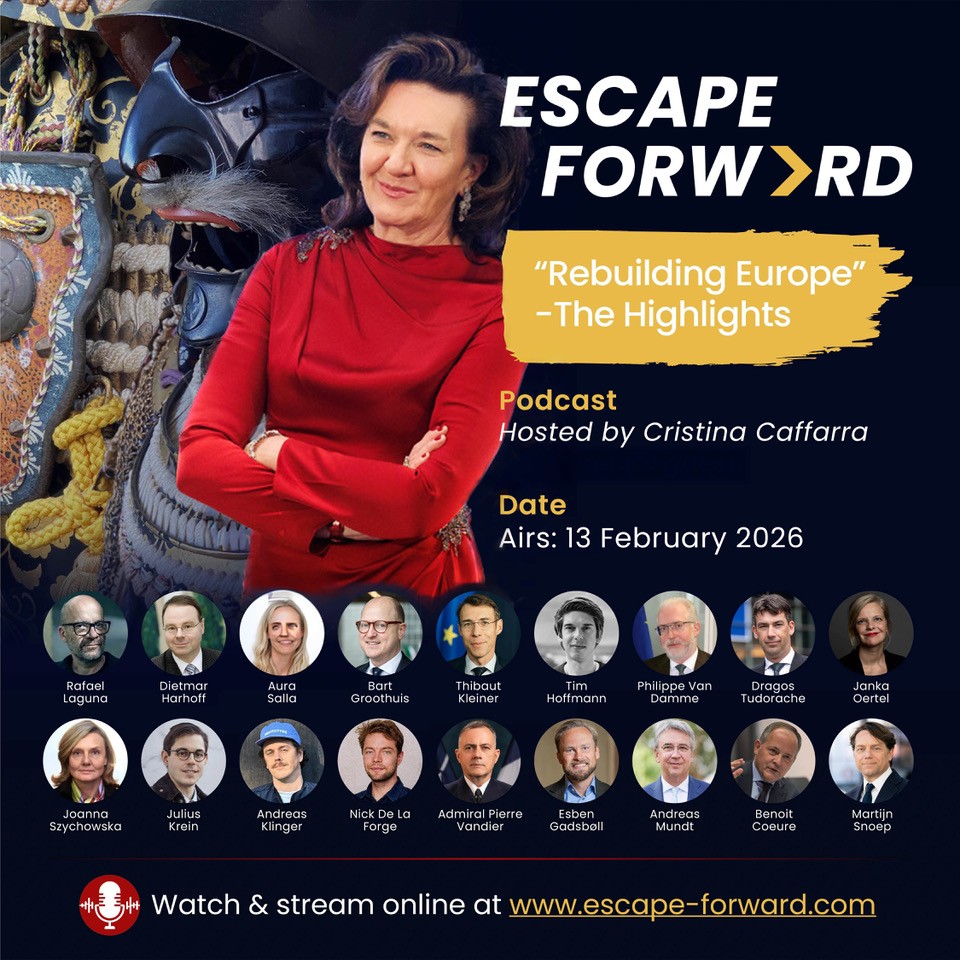
Andreas Klinger, Founder & Investor, PROTOTYPE Capital, EU-INC, talks about what is holding Europe’s tech industry back and how to solve it.
ESCAPE FORWARD Ep. 8, 27 February 2025
Innovation Continent: Europe’s Leap Forward, w Andreas Klinger
Founder and investor, Prototype Capital, EU-INC.
Hello and good day. I’m Cristina Caffarra and welcome to Escape Forward, the space where I get to talk to some of my favorite people, people who’ve got something new and original to say or are pushing for change across policymaking and tech in particular. I’m particularly delighted today to have with me Andy Klinger, who is a real superstar in tech, was a runaway sensation at my conference a few weeks ago, talking about the work he does.
Briefly, he’s originally Austrian, experienced startup founder. He’s been a CEO, a CTO. He has created a number of companies pretty much across the world, as well as in Europe. He spent the obligatory five years in San Francisco and in Silicon Valley, then came back to Europe and wrote and said many times that he considers himself a proud European. Then turned into a funder, a champion for European tech. amongst many other things, he runs a fund called Prototype that writes checks for European startups. First check, first round, precede all frontier tech, automation, robotics, engineering, and so on. He also hosts a well-known YouTube channel, Prototype that gives visibility to the most ambitious European tech startups, very popular channel.
But also, the of the reason we are starting this conversation here today is very much that is well known for having inspired and led a very high profile campaign known as EU-INC., which is actually succeeding in creating a uniform regime for European startups. It is being adopted by the European Commission. President von der Leyen mentioned it in Munich. A rare case, in fact, of a grassroot campaign that actually succeeded, got there, and very fast.
Andreas, welcome. We will talk, of course, about EU-INC, where it stands, how you got there. Also the future of Europe, inevitably Eurostack, my own initiative, which is running alongside sharing some common mission.
But let’s start from the journey that you have taken to get to where you are specifically on this very important policy initiative. You had a complicated and very successful business life, we’re not going to go into that part of things. But really, you started writing as long as 15-20 years ago about what was missing in Europe to develop a startup tech ecosystem that was going to be successful and was going to be durable. The diagnosis that you had back then is one that has become well established. We all know it, it’s the whole lack of risk appetite, the limitations of capital, fragmentation and so on. And then around 2023-24 you wrote a very interesting post that was titled “Dear Europe, Please Wake Up”. In there, you were pushing back against what you described as the American meme about Europe, this vision that Europeans work less, that Europeans spend more time on holidays, that quality of life is so good that we don’t make a real effort and so on. You were saying with facts, this isn’t actually my experience. But then you said what is really holding us back in Europe is FRICTION. So with apologies for the long introduction, but I wanted to frame the discussion, that’s where we start. I’d really like to hear you talk about your understanding of this friction, how you ended up settling on that as being the main problem that you needed to solve and how you then went about solving it. Over to you.
AK: Great. This was based a lot also in discussions I had in San Francisco. A lot of the discussions I had there always felt very simplistic, essentially we take the current status quo and just say this is how it is. And then out of that, we say everything is different and that’s the reason things are bad. My classic one was in San Francisco with my coworkers: “Europe has too much socialism, not enough capitalism”. And I’m like, dude, we invented capitalism. What the hell are you talking about? And if you actually look at just as the numbers, 24 % of the world’s unicorn founders are actually European and only 38 % are American born. The problem is the European ones don’t start those companies in Europe. They start them in the U S. There’s hundreds of reasons you could argue for that, maybe it’s a mindset problem, maybe it’s just too hard here – people around you don’t support you and so on. But I always believed that mindset is actually the outcome of a system. If it’s more likely that stuff succeeds, I’m more likely to do stuff. If that stuff is more likely to go really big, I’m more willing to take more risk. So for me, mindset is always an outcome of a system. And the system we have in Europe is the fundamental problem.
To say this in a less abstract way: we are a bunch of small markets isolated from each other act competing on global level against massive blocks. So it’s not Europe versus US and China. It’s the Netherlands or Slovenia or Italy against China or US. And on that level, in a time where power law is everything, where “winner takes all” is everything, that’s not really competitive. The main idea behind EU-INC. was can you, at least for founders, create this unified market that actually works for them? So it’s actually possible to say, I want to raise money quickly. And the analogue to this is the US Delaware Inc., which is a legal entity in America. A lot of founders in Europe actually use it just to be able to raise money efficiently – because no investor understands how the Hungarian legal entities is called or works or the Slovenian or the Italian – outside of those countries, nobody uses them. So why should I now learn how to work it and go into risk as an investor? I don’t want that, I don’t want five years later to figure out, hey, there’s a fun gotcha in Slovenian corporate law. That’s not what you want to do when you invest millions of dollars. And the outcome of this uncertainty is that in Europe less than 18 % is actually pan-European when it comes to early stage investing.
Or differently put, if you don’t have local angels, most likely you won’t be able to quickly raise, you won’t be able to raise a lot, and especially you won’t be able to raise from the best people worldwide. And that’s the big disadvantage that European founders here have. There’s this common saying in Brussels: we have enough startups, we need more scale-ups. And I think that’s bullshit. We need more acceleration. Because if we have a ton of companies that just break out in velocity, there will be a lot of investors who want to put money into those. The real problem we have is acceleration. And this fragmentation between all these little markets is the fundamental problem. And this is this big system disadvantage that founders have here in Europe, in my opinion.
CC: So what you identified as friction ultimately was this notion that the 27 Member States have different tax rules, different legal requirements, and all of that was daunting for a startup that has to create a position across markets. Of course, it doesn’t in itself address the issue of funding, for example. The fact that funding is also fragmented. We don’t have a unified pool of capital, but your effort has been focused on the friction that really prevents people from even thinking about going beyond the national border – right?
AK: The way I think of this is most of my investments in San Francisco never leave California. They have one office in San Francisco, but they raise money globally. This is really, really hard to do in Europe. If you are based in Slovenia, it’s very unlikely that people outside of Slovenia will invest in you. And we can call it like friction. This additional effort to figure out how do I invest in a Slovenian company? And yes, of course I can figure it out. I can spend a few days finding a lawyer that hopefully has experience with startups. I can find out if the founder picked the right entity, the right setups, the right everything, then I can figure out how can I translate all of the things that I expect into Slovenian law, and so on. I’m willing to do this if I want to invest multiple million dollars. I’m not going to do this if I’m an angel and I’m literally one of the first people giving this person money. Imagine you’re a wealthy tech entrepreneur, like a founder in France. Would you now go and spend two weeks with like a Slovenian lawyer figuring out all the details? And the upside is that everything is the same as if they would have just picked some entity that your lawyer knows, .
The downside is that five years later, you figure out all of your investment is gone or worth nothing, although the company is a billion dollar user case now. And so the reality of this is let’s say you as an English or French angel want to do this because you want to support Hungarian corporate law for some reason, you’re doing all this effort. The next big investor, why should they do that? Why should do they? They will just be like, look, there’s standards, can we just use the standards and trust them? You don’t want a euro that’s different in every country. The euro doesn’t solve every problem we have in finance, but it makes trade across borders so much easier. And that’s the same thing. It’s just a standard.
CC: So just take us through what the EU-INC initiative involves. I think you were somewhat helped along the way by the fact that in 2024 Enrico Letta, the former Italian prime minister, just before the Draghi report issued his own Letta report. And one of the key recommendations there was something he called “the 28th regime”. in effect, this was a parallel idea, but was very much going in the same direction. So you had wind in your sails also, I think, because it was recognized by someone like Letta that this was an absolute necessity. But tell us a bit about the evolution of the campaign, how it really unfolded, but also where you are now. What’s going happen next?
CC: If you think of innovation in startups as infrastructure, basically what are the standards and what are the things you need to actually have pan-European scale to be able to quickly start and quickly raise money and then ultimately to do an exit in a pan-European legal stock market. For the first part, for the quick incorporation and quick investments, the idea was to have something analogous to the Delaware Inc. A standard that all investors know, trust, and the idea is if you have done this 50 times, if it’s the same legal documents, you might not even need to involve your lawyers. If I do an investment in an American company and it’s the same standard documents I already know, I can just docusign because there is no surprise. And out of this standard comes confidence, out of confidence comes momentum and out of momentum comes ultimately speed. This was the idea. So let’s create a standard for legal entities in Europe.
The problem is, Europe is a messy system of multiple countries, so how do you do the alternative here? Originally we were thinking we would introduce holding companies – very transparently, very easy, private market solution. This is what founders nowadays do anyway. And then at the same time, the Letta report mentioned the 28th regime. And I want to give a shout out here to the Startup Associations which pushed a lot to make that actually happen. And then all of a sudden this thing that everybody in Brussels told us would be the right solution, but will never happen, came forward. It was like a meme – yeah, yeah, of course, yeah, that’s the right idea, but no. And then all of a sudden, there was a discussion. Like, hey, what? Instead of doing this hack, what if we just push and just get that properly done? So what we did in the next step was we worked together with the best legal teams in Europe for startups like Orrick, Osborne Clark, multiple big successful law firms, 100 plus open source contributors. And we wrote essentially a proposal.
How could you within European law, with all the different trade-offs, find a solution for a legal entity that would solve the problems for startups? And the way we think of this is it’s not the perfect solution, if rank trade-offs differently you may come up with a very different solution. And we intentionally said, let’s think this properly through because we cannot expect politicians to know all these trade-offs that are important to founders. We made an 80 page legal proposal. If you’re very bored at some point, feel free to read it. It’s 80 pages of legal text. We got over 23,000 founders, investors in Europe behind this. Basically every unicorn founder, every investor that matters, signed this and said yes, this makes sense. It’s not perfect, but it’s solution that actually would improve everything by a step function.
The main idea behind it in a nutshell is one new legal entity at European level, standardizing corporate law for this legal entity. So on a European level, there’s now like a 28th version of corporate law, which counts in all of the countries that implement it. But this is the trade off. We keep employment and taxation local. And the reason is very simple. We want this entity to be available to any kind of company, no matter if somebody in Brussels thinks they are innovative enough, no matter if somebody in Brussels thinks they are big or too small or whatever. We want all kinds of companies to take this entity and grow.
CC: So this was perhaps helped by the fact that what you were doing was inventing a new regime that, given the way things work in Europe, did not require individual countries to change their own laws and uniform them, because that would have been a total doom loop, given the speed and the way in which people work in Europe. The real innovation here was to create a different paradigm altogether. Where are you now? President Von der Leyen has talked about it, including in Munich, and there is a lot of expectation that this is going to come very imminently. Where are things?
AK: We are now in the perfect storm state. It’s on one hand extremely successful and yet nobody absolutely knows anything because in the end we are basically rain dancers, we are doing stuff and then hoping something happens. We don’t make the law, ? And the commission wants…
CC: It’s in a sort of a black box.
AK: Yeah, it’s not as bad, but it’s still a very non deterministic. Right now, the Commission said that they want to propose how they think it’s doable in March. So I assume that means end of March. Everybody assumes like around 18th, 20th of March. Let’s see. We have now a few meetings with them this week and next week to like give feedback on stuff. Let’s see.
Right now, what we managed is that the goal is agreed on. The ambition level is hopefully agreed on. That’s said, what people say and do is always a thing. The question now is the implementation details. And they still make or break the whole thing. From my point of view, the problem you have with politicians is that they think of it in terms of “how much political effort does it take to make this happen? And we think more in terms of how much is the effort to actually build something that’s going to adopt that, making it like something that people actually will use. And finding quick little hacks in politics to make something pass is great. But if the thing afterwards is useless, then we’re nowhere, ?
CC: Do you have the usual kind of traps in European policy making? The divide and rule, you have different Member States who in the end need to also approve the path, not just the Commission, not just the Parliament. In different places somebody is throwing in some spanner in the works. Are you in this world in which you don’t know exactly which Member States are really supporting and you’re lobbying that?
AK: Right now everybody’s in a waiting position because everybody wants to first see what is the actual proposal that Brussels comes up with. That being said, my background is engineering, not politics. If this whole thing was software, I would assume it’s built in a way to be dysfunctional because especially in our case, to make it actually properly implemented, all the countries would need to agree on it. You need unanimity. And we have like 27 members. I think about it, statistically significant means you have one case in 20 that’s different, , and it’s still yes, yes, that’s fine. Let’s move on, let’s make a decision. In Europe, if one in 27 blocks they block everything. What the hell? Who came up with that? But that being said, we still push for that because we believe that it only makes sense to do it properly.
And we also intentionally from the very beginning had as a compromise: not employment, not taxation, just corporate law. The only goal of this is to get more money into your startups in your country. That’s the only goal of it. We will see. I always hear about people who will be against it. I have not met anybody who is actually against it yet. And I think this will crystallize in the next quarter. I’m always hearing this country could be against it, but so far everybody likes it.
CC: Because you don’t have the problems others have, and we’ll get to that: that the powers that be, the hyperscalers, are lobbying necessarily against you. This is not something that they really, presumably, hate as much.
Now I want to broaden the lens a little bit. thanks for that summary pf EU-INC, and of course, we’re all keeping fingers crossed about where things are going. But the reason this is also exciting is it fits into a time, a period in Europe, and you spoke at my conference, you were super, super popular on your panel for saying it like it is. We are at a time when we are realizing in Europe that there is no time to waste, that we are absolutely in many dimensions of digital colony. This is a phrase I use quite often, although it upsets people. And you focused on the question of startups, but the tech landscape in Europe is certainly one that is beyond. And the reason we care is not just the resilience and security dimension, but it’s also the notion that tech feeds into every sector of the economy. And if we’re not invested properly in tech, then we are not growing the way we should. So what do you see as the path to European resurgence to some extent in tech? I
For instance there is a narrative out there that says, well, we’ve kind of given up on cloud and software because we have no chance of recovering ground. But there is a huge opportunity for us in AI, particularly given our own special domain knowledge in mechanics and engineering, the kind of things that Europe is a champion of. We combine that with AI, our own data, special industrial data, then we become champions of industrial AI. We’ll do so many verticals. We don’t need to do LLMs. That’s kind of done. And that will be the path to future Europe resurgence. What do you see now as that kind of landscape? What’s investable? What is promising? How do you see it?
AK: yeah, I see the next 20 minutes will be two people agreeing on everything… so there’s a quote in a book that recently came out, which is called Breakneck about Chinese industrialization. And there is an interview with a guy at Foxconn, during COVID and all of a sudden Foxconn, which is known for
Apple phones and all the most high tech stuff builds hygiene products like masks and everything for COVID. People were asking, why are you doing this? This isn’t really your core competence. There is already an established market, blah, blah, blah. And the guy’s like, our core competence is making money. In Europe, genuinely people told me we should no longer focus on LLMs because it’s done – already two years ago.
And since then so much happened, and I feel like we are very, good at quickly giving up on stuff, which is to me absolutely hilarious. And then the other part is in the things that we’re actually good at, we’re really, really good at not giving them space to grow anymore so that they either have to leave to the U.S. or sell to Asia. For example, in industrial, as you mentioned, is a good example, like Europe is very proud of being the second largest manufacturing power in the world. And we have some of the best precision manufacturing, some of the best industrial robots. But we are systematically selling them to Asia. in industrial robotics, like pretty much every important European company has been sold to Asian ⁓ pirate equity or competitors.
We should absolutely stop doing that and instead re-industrialize and build up the next generation of these kinds of companies. Because the same way as we are now dependent on digital, we will be dependent on hardware. And at some point, for every euro you make, you send 20 cents to the token provider in San Francisco and then 20 cents you send to China for the hardware and then all of a sudden your margins go down, you have no more value chain in Europe all of a sudden. If we go this path and continue this path, we are a very nice, quirky tourist destination. And that’s about it. And I think this is absolutely ridiculous. I personally, with my fund, I heavily invest in hardware robotics automation because I think this is something where we actually have a claim to be winners. And if you are building robotics right now, Zurich or Munich is as good of a hub as like San Francisco, and ItIt makes complete sense to invest there. All of the reasoning in LLMs comes out of Europe as well. So much of the core technology actually comes from Europe. We are so bad creating a system where they can absolutely afterwards become a core company. In hardware, you have a little bit of an advantage. If you are selling a robot for an industry, customers don’t really care where you are based. And language is not so much of an issue. There’s a lot of things that are a big topics if you do social media or if you do enterprise sales, which are less of a topic if you’re building hardware. So for me as an investor, this makes a lot of sense. That being said, the next generation of farmers will use electric tractors that are fully autonomous, that can like be controlled with an iPad and an AI agent. The question is will we build them? or will they be built in China and we will just buy the ones in China? And my personal take is we have to build them here, period.
You can call it sovereignty if you want, but I also think of it very pragmatically. It’s the value chain. If we don’t have these GDP driving companies, we don’t have these premium companies, we don’t have these premium jobs, which are needed for our premium living. We need to fix our attitude towards success and towards being number one, either now or we are pretty much as bad as America currently puts propaganda on us in 10 years. So from my point of view, we have now 10 years and we have to decide how much do we still want to fuck around.
CC: You said 20 minutes of two people agreeing with each other, and I sign up to everything you said. Let’s riff a little bit more around that. The narrative that we hear now is very much “this industrial AI will be our future. We don’t need to look back at the other bits of the value chain because we will grow all of that frontier stuff in industrial AI and it’ll be cool and we will be making Europe great”. And one thing that I find bizarre in this narrative is, well, but the value chain is the same. You don’t build AI industrial businesses on air. You still need compute. You still need software. And if that value chain is owned by completely somebody else, sending revenues and profits somewhere else, how is that going to grow us? That seems to be a very basic notion.
I’m glad you brought up the value chain and the fact that we need to appropriate in Europe the substance of these value chains that we build, because it is something that seems to be forgotten in all of this. It’s almost as if you can build on this other cloud over there. You just get the bit on the top. Can you elaborate why just getting the bit on the top is just not a plan?
AK: I think it’s very easy when it comes to manufacturing. The classic idea is what’s very valuable is the R &D, then manufacturing should be as cheap as possible, like serial production. And then you have marketing and branding and it’s like making it wealthier. These are the value parts, this is a low value part. The problem you have in any non completely established technology, like frontier tech, that so much of R &D actually stems out of manufacturing issues. And so much of the new R &D comes from new features you’re building in hardware, so much come out of new capabilities in manufacturing. You ran into a problem, you figured something out, we can do this, holy shit, we can do this now. Hey, let’s do the next model we do around that idea. And that’s in manufacturing completely normal. Basically, he who owns the manufacturing also owns the R&D at some point. And the same is true in software, especially nowadays when you have almost full verticalization through the AI stack.
So the way to think of LLMs is not like this is a new layer in software, this could be the industry after software. You can say, yes, we are building a very good layer on top that allows better use of a layer, that’s a valid business, but there’s a non-zero chance that the next generation of LLM models can just do that layer on their own. You’re almost actually competing with them, you should at some point build new foundational models. You should go deep in there, and at some point, if you really want to be competitive, but you can’t do that because they make money with legal and 50 other things at once. So all of a sudden you have a different economy of scale, the same in manufacturing,
Right now, people don’t go to China because they are so much cheaper. They go to China because they can actually do those things that you can’t. And soon they can do them, they can do them a fraction of your cost because they fully automated it. And you can’t. I mean, and all of that learning is like it’s like compounding and compounding over time. And we just somehow in the 80s, somebody had this genius idea, I think this is the product of Wall Street and cocaine combined: , let’s outsource every cost center because who cares anyway. And since then, step by step qw outsourced actually core competence and core know-how. And that’s something we have to reverse. And from my point of view, for a region, even if you’re not the best in something, you still have to put effort into this region. Like for example, in your case with the Eurostack, even if you’re not the best cloud provider in the world, the learnings you get out of this building a cloud provider, the teams, the people, the process knowledge will enable them to build some other new ideas that pop up, and so on.
CC: This is exactly the mission. And that’s why I say what we’re doing is complementary because of course you’ve been focusing on the startup. I’ve been looking with EuroStack at what’s there and the notion we are contemplating an infrastructure which is not ours. I wholly agree with the importance of this. The difficulty of course, politically, is that what you’ve constructed, is another paradigm. And while it is novel, it is not necessarily challenging the incumbents. What I’m suggesting and what I think we need to do to retrieve for Europe some capabilities, inevitably clashes against the incumbents who are saying, look, we’ve got this wonderful service suite here. Why do you need to even try? We are nice. We are serving you. You can build on top of us. And any effort to try and carve a position for us, we are not saying rip it up and throw it away, it’s not the case, but every effort meets with “but this is really dangerous. You will go backwards. You will kill your productivity”.
This is what we are faced with. And the risk is governments don’t want to upset the current powers that be, so they try and somewhat take a passive least resistance. That’s what worries me.
AK: The funny thing for me is we’re now at a point where people are like, we can’t build LLMs. I’m like, okay, we could. It’s just like a ton of cost and effort. But then there is also we also cannot build Microsoft Office and therefore we cannot move away. Okay, so we can’t do the last generation. We can’t do the journey. Maybe we should just give up. But what’s the idea? The way I think of this is ⁓ to fix tech in Europe, we need to make it possible for innovation to actually go on the market. How can you get innovation to the market? I think of it as a core loop. And that core loop can only compete on continental scale. It has to be a market that’s big enough so that you have actually the dynamism in the market such that the best people invest in the best founders. And those founders get a lot of credentials and like a lot of people put eyeballs on it.
For that, you need something like EU-INC. standardization of investments, incorporation and stock options. And if you fix that, the early stage is 10x better, 100x better. Then the other thing you need to fix is the exit scenario. Like an IPO case. A lot of the reasons why these industrial robotics companies we mentioned before, like ABB is a good example, sold to SoftBank, is they’re selling the companies for five, four billion, something like that. That’s a seed round in San Francisco right now.
The main reality for me is that there isn’t a stock market big enough. In the US, they would just go on NASDAQ. And then because there’s so much volatility in the market, there’s so much volume in the market, it makes sense to go IPO. It doesn’t make sense to go IPO in Switzerland. We have stock markets that are smaller, of course it doesn’t work. You need a pan-European solution.
So that’s the core loop. And then you can add more money into this. You can have easy employment. There’s multiple things, but those can be fixed on national level. But the core loop at the European level is incorporation exit. And then additionally, the other one is you need to think about every industry full stack. And that starts from the lowest level, ideally from mining up to the application layer and everything in between. So the goal is not just to do cloud. The idea is to do the whole hardware stack of cloud as well. Obviously, that’s hard to do and scary to do. But as a continent, it’s absolutely doable. And especially if you also take into account that a lot of those industries are constantly changing. So right now in compute, you have like optical compute and so on and so on. There’s so much happening, and there’s multiple industries where right now this is possible.
Of course thinking full stack is scary, and it’s very counterintuitive because the classical European way is like, is there a quick fix we can do? Is there like a little thing we can do here and there? and that’s obviously hard. The Chinese did this very, very well because they intentionally want to be full stack on everything. and because of that, now China will be the first country in the world in humanity’s history that’s able to think about every problem from a point of view of energy abundance. And if you have infinite energy, you can rethink every problem. Like climate change, you can get the carbon out of the air. If you have infinite energy, this is no problem. Compute or AI, if you have infinite energy for AI, that’s new industries opening up. Same with automation manufacturing. You can rethink everything if you have infinite energy. And China is now the only country that will be able to do that because they intentionally thought full-stack about everything.
CC: So you talk innovation and then exit and then the bit in the middle, which is where we are now. The thing we grapple with on the “full stack! is really how to induce migration to European solutions, because as we all agree, you can talk about using European assets, but unless there is demand, unless there is actual money to be made through contracts, through shifts, then things don’t happen. My clear experience of the Eurostack is that people talk about it, particularly at the grassroots level. This is something that people have absolutely internalized – when I go around Europe and talk, they all say, hell yeah, we need to have European assets. Absolutely. But then when you have to shift from your comfortable AWS, from your comfortable Azure, from your comfortable Google to a European solution, well… I have this very comfortable wall to wall functionalities. So this is what we need to shift out of, because I think it is a trap in which we are
AK: I would deconstruct this. So there are industries that are 10, 20 years old, like cloud, for example. And obviously, if you have already something established and you’re using it for 10 years, switching from that is a pain in the ass to do. But there are also new industries popping up. There are also new technologies popping up. So I would almost have different strategies for those. And in some cases, they’re as nascent as they are in the States. Fusion energy: we are leading in that, but it’s as nascent everywhere. Still, an American founder will be able to raise at least 10x of the amount of a European founder. Quantum compute, we are leading in multiple areas here. We have multiple companies that are already actually having quantum compute available as a cloud infrastructure. If you want to hear about amazing European companies, my YouTube channel is for that. I’m intentionally keeping it narrow now because I’m so close to pitching each of them. But we have this, but that’s the next generation. We need to think what is the infrastructure they need to become as successful so in 10 years no one needs to switch away from them.
That said, I fully agree with you that we also need to think about all the “classic infrastructures” like cloud. And cloud also for me means semiconductors, GPUs, all this kind of stuff. Need alternatives there. With China, we are right now in such an extreme position – decoupling between China and the States is impossible, even warfare wouldn’t be possible without Chinese parts right now. If you do drones, yes, you can source a lot of the components now in Europe, but the magnets will still come out of China. The actuator will still come out of China. There’s so many parts that will still come out of China. And the batteries will still come out of China.
CC: But Andy, I mean, Europe 20 years ago was at the forefront of technology. had companies like Nokia and Ericsson inventing radio technology and giving it to the world. And now 20 years later, we are somewhat shrivelled and everything seems really depressing, We cannot give up. It’s not like we’ve 300 years behind. We have been 20 years of doing not very much. And look where we are.
AK: Yeah, that’s thing that I’m trying to get people to understand: we are living in a technology where everything is compounding. Even if you’re just five years behind, those five years of innovations compound, and what we have is whomever was good at software became better in cloud and because they were good in cloud, they became good at AI and because they were better at AI, they are now better in frontier AI and so on. These kinds of things compound really quickly. And the problem we have is, I see this regularly, you have a company that’s good here, they cannot become great here, and they now have the choice to either stay good or they go to the States.
In so many cases, back in the days when Nokia was a thing, the market was way slower. You could win locally and then go to the next market and next market. A friend of mine built a side project, basically a few weeks before Christmas, he showed it to me at Christmas and holy crap, that’s insane. It’s basically an AI agent that has access to all his data and can do everything, He went viral in a week, all of a sudden it’s the most used GitHub project. There’s countless of videos on him, he got an acquisition by OpenAI six weeks later, now he’s moving to San Francisco. And that’s the speed we are now at. The thing is called OpenClaw if you want to Google it afterwards. And the guy is called Peter Steinberg, a good friend of mine. He is now hailed like the Jesus of AI all of a sudden, and that happened within a few weeks. And that’s just different to how it was 20 years ago, the media wasn’t that fast. The interconnectivity wasn’t that fast. But now we live in this time where the internet access is perfect communication media, where everything can pop up everywhere. And now the only question is how quick is your market? And how much power law can you pull? And there large unified markets are just more powerful. That’s the big difference now.
CC: Last brief topic. One of the things that I find most frustrating about Europeans, we talk about the great things we are and the things that hold us back. And we cannot avoid talking about the things that hold us back because we got to deal with it. One of the things that I find most frustrating is the
notion that we need to somehow wait for the institutions to do something for us. We need the European Commission to do X. We need the government to do Y. I remember reading something you wrote time ago in which you said, don’t want to even think about the government coming in and doing stuff for me. It’s a sentiment that I share because much as these people are well-meaning and very nice, they are not entrepreneurial fundamentally. They are not technical. They are lawyers and bureaucrats. And so it is not going to be the case that we as Europeans can punt to the public sector as our future. It is not going to happen. We need to either do it ourselves or not.
Yet everyone you talk to is always somewhat expecting that the Commission will put in place something magical, some magical thinking that will make us all suddenly wonderful and sprout wings. And how is that going to happen? How do we infuse this entrepreneurial drive back again? Because that’s the only thing that works.
AK: One of my pet peeves is it’s almost like everybody in government is an idiot, but also everything should be fixed by the government. And I’m like, which one is it? Pick one, it can’t be both. And this was also our thinking behind the proposal. We want to be as detailed and possible because this is hard for us to agree on. And I have been doing this like longer than I like to admit, in our team there are insane experts in each field, and yet for us it was hard to agree what is the right path. I imagine a random politician who has never started a company in their whole life having to do that.
The quote you mentioned is from an article I wrote once about startup hubs. And I said basically something along the lines of a lot of people have opinions about how startups should be done and how the government should be helping with building startup hubs. And the worst part about this, many of them work in the government. I still fundamentally believe that it’s very bottoms up. You cannot create a PowerPoint for how a region becomes a startup hub, that happens on a grassroots level. And it’s really fascinating to me because I work very closely with student clubs and hacker town, hacker houses, and like all these kinds of like self selecting groups of young people. They get more done with almost no budget to build hubs than anything you have from the government. I can give you countless examples here. In Vienna, there is a group in a school. They’re 16 to 19 years old, and they build deepfake detection, drone stuff. They build sci-fi stuff. One of them approached me and said we’re thinking about raising money for this one idea we have. How much do you need? It was $5,000 for a new graphic card. Okay, here’s a donation, have fun.
There is in Zurich a student group called ETH Robotics from ETH, they are some of the most insane robotics people you will ever find, working together every day to build robots. In Helsinki, you have a group called FR8, which is basically one big house and there’s 20 to 30 young people doing nothing else but building every day. And they don’t get in by having a great business plan. You’re getting in by being very biased to action and very obsessed about a high-skilled tech topic. You need to be extremely good and you get in. They don’t care what your business model is. They don’t want you to build a startup. They want you to build something you’re actually obsessed about. And out of that group will come the next Google, 100%. These kind of like self-selecting, almost like safe spaces for ambition of young people will do more for European progress than any government initiative can. And what do they have in common?
They are curating, they’re making sure they work with the right people. They are extremely biased to action. They just do stuff, and they’re completely obsessed with the topic. And if this one thing is building farms on the moon, then this one thing is building farms on the moon. Who knows? But they want to do that. And I genuinely think we can learn more from these groups and we can achieve more by supporting these groups without messing with them, not telling them what to do, but like, what do you need? Here’s what you need. Now mid stage, late stage is a different discussion – they cannot fund billions of dollars, obviously, but they can filter the next high profile group of Google-level founders, this will be more successful than most of the university programs, most of the government accelerators.
CC: Andy, thank you so much for the burst of energy and you’re someone I could talk to for hours. This is a conversation that needs to be propagated and you should be adopted as the person in charge to make it happen. Because if anything can happen, it can happen because of someone like you pushing it.
AK: You don’t get out of this that easily Cristina. You’re the first person that gave me hope in policy work again. Like, yeah. Thanks so much for your time.


 Escape Forward
Leave a comment