

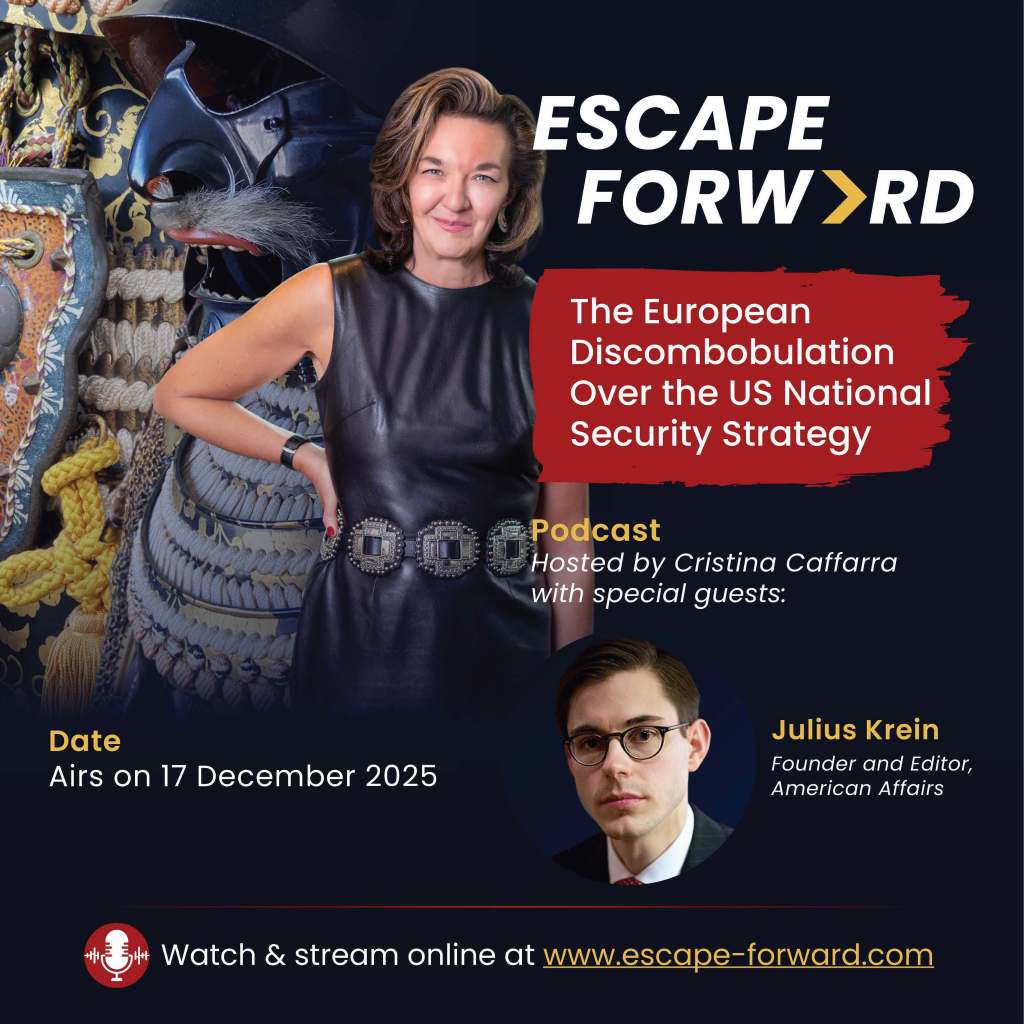
Julius Krein of American Affairs discusses what’s behind the US Administration National Security Strategy document which created such discombobulation in Europe. A rational tour de force of the conservative perception and assessment of Europe – from “civilizational” issues and culture wars to the EU’s “overreach”, defence decline, lack of “course correction mechanisms” to face the obvious economic issues, and finally the “moralizing” instead of “transactional” approach. And if we hate it, “no one really cares”. How many wake up calls do we need?
Episode transcript
CC: Welcome to Escape Forward, the space where I have the privilege of holding conversations with opinion makers, policy makers, thought leaders and commentators on the policy issues we are currently wrestling with – way beyond the antitrust domain, which used to be my original field. Today I’m particularly happy to welcome Julius Krein – welcome Julius! He’s an American political writer, editor, known above all for founding American Affairs, a very highly regarded, influential quarterly magazine dealing with trade, industrial policy, neoliberalism critique, role of the state, immigration, a variety of weighty topics, has received various accolades and recognitions and is known also to be widely read in the conservative camp.
Julius you were at my big Conference in January this year, just 10 days after President Trump’s inauguration. The title of the conference was “The Perfect Storm”, and the general atmosphere was one of anxiety and uncertainty as to what was going to unfold. I remember asking you as a speaker at the event what you expected to be the attitude of the new US Administration to Europe, and to the EC in particular. And you were quite magnificent because in a completely deadpan way you said something along the lines “I think the approach of the incoming Administration is that they will not care for Brussels and the EU. They may well try and connect with capitals like Paris or Berlin, but they will not be remotely concerned with Brussels”. And in a room with a thousand people in Brussels, a lot of institutions and lawyers from the “Brussels bubble”, that created quite a gasp. I made you repeat it, because it was such a strong statement and people were widening their eyes.
The reason we’re having this conversation today is that there is profound discombobulation in Europe around the National Security Strategy document that was issued by the Trump Administration just a few days ago. It has created enormous noise and near-hysteria in Europe. I plan to go through various aspects of it with you because I’d like you to help unpack what you think is the message there, how it comes about and what we should read into it.
Europeans are all acting shocked about it. The general sentiment is this is a slap in the face, it is unexpected, it is a blow. And even people who should be wiser heads describe it as an “unexpected attack on Europe”. But the clues have been all there for a while. You started that discourse in late January, but then since then in Europe we’ve seen JD Vance giving his well-known speeches in Paris and Munich; then we’ve seen Zelensky in the Oval Office in February; then we’ve seen Liberation Day with tariffs; we’ve seen the “capitulation deal” for Europeans in Scotland with President Trump on trade. We’ve seen the Alaska meeting. It’s not as if the writing wasn’t on the wall.
And indeed, even last summer there were already documents circulating around with various versions of this “civilization challenge” for Europe. I personally had multiple discussions in DC with members of the Administration about the “loss of Western values” and how we are at “risk of civilization erasure”. None of this should really be a surprise and yet the sense of “shock horror” in Europe is so pervasive. I won’t indulge reading them all out but the headlines have been “MAGA hates Europe”, “America has identified its greatest enemy: Western Europe (and this from a professor of international institutions), “The gloves are off”, “The US pounds the EU”, “MAGA is pushing for regime change in Europe”, “MAGA is driving Europe towards fascism”, “A worldview aligned with Russia”, and certainly big attention on tech oligarchs who are said to want to “dismantle Western liberal democracy”, “install the far right”, etc.
I would like you to help us understand this moment. As I said it should not be a surprise to Europeans; but the reason this feels so difficult for people here to process is that this seems not just like a comment on our geopolitical standing in the world, but a much broader critique about how Europe conducts its own internal affairs, including things that people consider prerogative of individual countries such as immigration policy. How do you interpret this? Help us understand it. President Trump also gave an interview on Politico a few days ago in which he doubled down on the approach: he kept saying I like Europe, I love Europe, I think the leaders are weak, but I like Europe and they’re at risk. Over to you.
JK: Thank you for inviting me back. It seems a lot longer than 11 months. It’s been a rather frantic period. And yes, there does seem to be a very large gap between American and European perceptions, even in January when I gave those comments. From the American side of the world, it didn’t seem particularly controversial, mostly just stating a reality. And when I spoke in January, from the American side it seemed to be just stating a reality – while it seemed very controversial in Europe. I would say similar things of the National Security Strategy: it’s really not meant to be a critique of anything. It’s an attempt to grapple with the new reality in foreign policy, the competition with China in particular, the multipolar world, the decline in U.S. power internationally. But also, and paradoxically, because the United States and the Trump Administration have an emotional – or they would call it “civilizational” – attachment to Europe, they would also say they have a particular concern with some internal governance issues that they don’t really have with other countries. And that gets into the “civilizational erasure”, the immigration issues, what seems to them as complete lack of confidence and competence.
They have seen what appears to be a Europe in decline for 10, 15, 20 years and no ability to “course correct”. And that’s deeply concerning to them. But I think that Europeans also have a bit of “protagonist syndrome” if they’re reading this as primarily about Europe. Really, it’s primarily about Asia. And about the Middle East that in a different way from the past has become a central pillar of American interest – with the Gulf States and the investment in economic cooperation there. It’s about the Western hemisphere, they are increasing that priority with the revival of the Monroe Doctrine and the Trump Corollary. And it’s also about Africa, because of the critical minerals and mining is getting much more attention than it has in the past from this Administration.
So it’s really not all about Europe. I think a lot of those things are in there because many in the Administration have this “civilizational attachment”, which you could describe as Ancient Greece, Ancient Rome, Christianity, the Renaissance, classical European history, and now they see the Continent, particularly under the EU regime, drifting away from that, declining in economic importance, completely declined already in military importance. And they’re trying to grapple with that fact.
CC: You are saying there is an element of “European protagonism” here, that this is seen as a document which majors on Europe, but in truth it isn’t. That said, it is seen as passing a number of judgments that are pretty painful, and some also say unwarranted. I recognise the “affection” for Europe, the curious attachment to Europe: I can personally witness to the fact that when you have conversations in DC around this, genuinely people in the Administration have said to me “in Europe you are letting the values of Western civilization slip, values which you imparted on America, values that were born in Europe. We are taking care of those values much more than you are”. This seems to be mostly about immigration, but it’s also broader. So I recognize much of what you say. It is something they believe in. But it is curious for most Europeans who have not had these conversations to hear this because the question is, where does this vision that Europe is erasing its civilization comes from? Is it mainly driven by a perception of what European immigration policies have been doing? We’ll get to the economics in a moment, but that seems the main thing that motivates this. Is that right?
JK: I think that’s correct. I think the document literally says “make Europe great again” at one point, and this is an indication of affection, if nothing else. But yes, it’s mainly immigration. It’s a kind of “cultural progressivism”, what Americans would see as a radical and self-defeating environmentalism. I would say the Trump administration has been a bit gratuitous at times on how they have communicated these things. Even leaving aside the Greenland episode earlier on in the Administration, some of these things would probably be better said in private and through more diplomatic channels than in public communications. But that’s not what the Trump administration is, and so they put it out there.
For instance there has been some genuine concern not only within the American right but even beyond that when you see things like discussions of banning political parties that are getting 20-30 percent of the vote in the name of “democracy”. That’s very confusing to Americans. We’re still going through our own issues on internet censorship and discourse and all that. So that’s just very sensitive from the perspective of our own internal cultural dynamics. But the Europeans, particularly the UK (at least in the news over here) appear to have taken a very hard line: people getting fined and facing criminal prosecution for Twitter posts and the like is very foreign, very confusing to the American mindset. And all these things added together in addition to the economic and military decline adds up in their mind as a form of “civilizational erasure”.
CC: Yes an issue that seems foundational and where a lot of the critique seems to be coming from is the whole area of freedom of speech. Europeans were shocked and surprised last February to hear VP Vance say that we do not have freedom of speech here and do not know what it really is; because Europeans regard themselves as being the cradle of freedom of speech. And conversely, there is a concern that what the current Administration there regards as freedom of speech is quite one sided. It favours a “right wing” vision of the world, and not a broader one. For instance there is a diffuse concern that the “platforms” as we know them are censoring, are using algorithms to just suppress European views on the left that are not approved of, and amplify views on the right that are approved of. At the root of it, there is a fundamental difference in the vision of what constitutes freedom of speech. It seems to me that is of course very different as between Europe and the US. Can you expand on that? Because people here don’t really understand what Americans are talking about when they say freedom of speech is something we don’t have.
JK: Well, we could have a long discussion about the philosophy of freedom of speech. I think that the European and American conceptions have always been a bit different. We have the First Amendment in our Constitution, which has a special status. Whereas I think the ability for government to control speech in Europe has always been a little bit different. Also what I think is often overlooked is that the relationship between the US and Europe has never been exactly as placid and tranquil as it’s often romanticized to be. Just taking the 20th century, you had the Suez crisis and all kinds of issues around decolonization. You had the end of Bretton Woods, France sent warships to take gold out of New York in the 70s. France was in and out of NATO. You had debates over nuclear weapons in the 80s. We had all kinds of debates about Iraq, which the Europeans were right about, I think everyone would admit now in the early 2000s. So there’s always been pretty sharp differences here.
So I think that taking a more material and concrete approach to this relationship would be healthier. At the moment, as you know, Europe is going through its own “China shock” and deindustrialization, which the US went through first. And given the way China has structured its economy, whether Americans and Europeans like it or not, or like each other or not, they’re facing the same problems. It would be best to focus on the positive, on forms of cooperation that could be achieved on the economic front. I have said this in public: I think the Trump administration has not handled that as well as they could have done, to put it very diplomatically. I think there’s actually going to be limited agreement on the “culture war” issues, but still a lot of potential for pretty healthy cooperation on other issues. And I think one can make criticisms of how the Trump Administration has handled that. But I also think that Europeans, mostly through sclerosis from what I can see, have also not necessarily been the best partners either.
CC: “Sclerosis” is a word that I will agree with. We’ll get to the economics in a moment, and indeed let’s leave aside the culture wars – I agree with you it’s not something anyone here should be so hysterical about. But there is also a strong sentiment in this document that somehow the European Commission, the EU, is different from Europe as a collection of Member States. As you said at my conference, “they will not care for Brussels, but they will deal with Berlin and Paris”.And this turned out to be true: in fact no one comes to Brussels except once or twice – there’s not been really any kind of presence in Brussels from the Administration. But we know what the reason for Brussels, for the European Union project are, of course: after the war Europe needed to be put in a position where people didn’t go to war again with one another, and this was a shared objective a few decades ago. What do you think is the vision of this Administration when it comes to that piece? We see Elon Musk
absolutely calling for the removal of the European Union, the breakup of the EU, saying we need to remove it and we need to return to Member States. This is Elon Musk and not the Administration as such, but what is the vision? Is there a preference for dealing with 27 individual member states? How is that?
JK: I think there is a view of the EU as an artifact of overreach. It’s one thing to have a customs union or a passport union, but the introduction of the Euro, the common currency and the growing power of an unelected bureaucracy in Brussels, exerting pretty significant governance over what the Trump Administration would consider real democratically constituted countries – is not only ineffective, but perhaps even illegitimate. And they would probably like to see the EU rolled back and more of its authorities devolved to the Member States, accepting still that there would be some kind of European economic community. But I think they’re perfectly happy to deal with the major Member States and that has been difficult given the internal politics of France and Germany recently. Italy, which I didn’t really mention in January, has emerged as a key partner for them. But I think the Administration feels that to the extent they can deal with the larger Member States and reach an agreement then you guys can figure out how to make it work within the Brussels framework or whatever.
CC: And would there be a preference for a federal Europe with direct elections? This is something that occasionally comes through: federal Europe with elected representation. As you said the critique is you have this unelected bureaucracy in Brussels that purports to make decision on the behalf of the people of Europe, but is far from being representative. Worse, today we also suffer from a major coordination problem as no one can agree on what to do. Some of the key levers of power are still in the hands of the Member States: for example, industrial policy is not centralized at the EU level, and nobody ever does anything because Berlin does Berlin, Paris does Paris, and there is no mechanism to coordinate. The governance of such a structure remains difficult to envision.
But let’s now move to another topic, which is very high on our mind – defence. The message has been heard loud and clear in Europe: “you’re on your own, we are not going to protect you and provide the umbrella we did in the past”. This landed with a thud in February when the meeting with President Zelensky took place in the Oval Office. Europeans were pinching themselves watching it, but were beginning to get the message. And that has led to a drive to hopefully spending more and doing more in that area.
What is less clear is what Europeans perceive as a rapprochement of the Administration with Russia – and indeed for example Russia has commented to the effect that they approve of this NSS document, or at least they’ve said they share many of the views in there. This is worrying because in Europe (especially Eastern Europe) there is a very strong sentiment now that we are on the brink of war with Russia. A bunch of defence ministers from Eastern Europe were at an event I attended last week and the message from Eastern Europe, from Poland, from Estonia, from Latvia, from these countries was “our hair is on fire. Wake up. We are not just dealing with President Putin being content with annexing the Donbas. He has a vision of his mission which is to reconstitute Greater Russia, something he needs to re-establish, and we on the Eastern flank are seeing the initial skirmishes that will lead us there. Why aren’t you Western Europeans helping us more?” So if the US is not supporting Ukraine so much, or seem to be getting closer to Russia, where does that leave us? That is a major concern.
JK: I think Ukraine and Poland are very different cases, and I think that’s also the view in the US. I wouldn’t be too concerned about defence, protection, support in all instances, but Ukraine is very different case from Poland. The reason is the concern about Russia and China: there was a concern that the events of the last few years during in the Biden administration pushed them together, much too closely. And that is dangerous for the United States. It has been interesting to see that for the Russians that alliance is maybe not as tight as some feared.
We didn’t talk about Ukraine at all in in January (at your event), but I would have predicted then that the Trump administration would have gone out thinking they would be able to make peace very quickly, and that would not work, and then it would be very difficult to figure out what to do. And that’s basically what’ s happened. But I also think that they do see an opportunity. Russia will never be an ally of the US, per se, it will always be its own national pole and exert its own interest. It is also neither a vassal nor a subsidiary of China. And I think the Administration see lots of opportunities for potential economic collaboration with Russia on some of these supply chains that are currently dominated by China. So without pretending that they’re going to be an ally, they can be thought as setting themselves up as an independent pole that one can at least do business with and negotiate with – that seems a reasonable goal.
And then the question becomes, what is the reasonable outcome for Ukraine? Because if the desired outcome is this maximalist view that Ukraine is going to reconquer all of its territory, including Crimea, I’m not aware of any credible analysis, I have not seen any credible military expert think that is possible. So if that is not possible, then are you going to fight this war forever, or are you going to find some kind of reasonable peace? There are a number of proposals on the table that may be inching toward some kind of resolution. And I think there’s also a question mark around what exactly do the Europeans want to do here – do they want to take over this conflict and fight it indefinitely? I don’t think the US would stand in their way, but they can’t do that. So a lot of this moralistic posturing comes off as just very weird and not productive at all. And I think there’s also a question mark of, how much of this is the European Commission? Is the European integration crowd using Ukraine as an excuse to push their own agenda within Europe?
CC: Quite a lot there… but I would like to move forward to the economic circumstances you alluded to, the fact that Europe is going through the same economic developments now that the US went through in the recent past – deindustrialization; and we at the moment very much at the receiving end of a China shock. It is hard to understand why so many in Europe are not yet seeing that as a major problem for us. Again at a recent event I attended the American China experts in the room were saying to the Europeans, why don’t you see that your issue is really China, that China is eating your lunch right now because this massive Chinese surplus is being directed to Europe – it bounces off the US tariff wall and comes into Europe, and that is really killing your manufacturing. More generally, the document reprises the view that Europe’s economy is in dire straits. Jamie Dimon of JP Morgan gave a much reported intervention a couple of days ago in which he was saying Europe’s GDP is now a third less than the US while it was the same, only 20 years ago, we’ve not done anything to Europe, Europe has done it to itself, their economic model is not sustainable. Of course this is a diagnosis that is known in Europe, but not being acted upon. And I guess that that is all also part of the frustration they’re not seeing anything being done about it.
JK: I think that’s absolutely right. I think that’s why you get into these questions of “civilizational erasure”. They think something must be going on here, because you’ve had such bad performance and you have no course correction at all. So, is Europe actually inhibiting democratic change in some way? Those questions crop up. There’s a deep, a deep. It’s not just frustration at the, you know, differing regulations or things like that, but a genuine confusion that Europe seems unable to not only fix its problems, but even to assert its own interest in a productive way. I mean, for example, on the tech thing, and people will not like me for saying this: there’s probably a real negotiation there where Europe has a lot of impressive industrial assets, mostly these legacy companies, legacy family-owned industrial businesses. There could be a lot of very beneficial collaboration.
For instance there’s often a lot of talk about you buying weapons from the US or developing them in Europe. But I think there’s probably an interesting question of how much is Europe going to ask for from the American tech sector in terms of developing its own industries or protecting indigenous European tech companies, in exchange for better cooperation on the industrial side in the US. But those discussions don’t ever really even ever seem to happen. To Americans it seems like Europeans are always complaining about something, but they’re never showing up with an actual solution. Of course Americans don’t like it when Europeans talk about we’re going to actually buy our own weapons, build our own defence companies. Every American official’s job is to sell America. But they understand the impulse or the need to do that. But it doesn’t even seem that you can get your act together on that. So there’s a deep confusion that there’s some kind of deeper root problem that that we don’t even understand.
CC: This is a key discussion: you mentioned the tech sector, the tension there and the tradeoffs. This is something which in Europe is perceived as an existential matter. I am not popular in Europe for saying that our regulatory effort has been mostly a waste of time, and people are offended at me for saying it. Europe regards its effort towards what they call “tame American Big Tech” as a fundamental expression of our sovereignty, because in people’s minds it is about enforcing our “rule of law”. So we have a set of principled rules we have recently introduced to tame Big Tech. They do not do very much, in my view. But leave that aside, there are these rules, they are our rules and the fact that there is such resistance, not only from the companies themselves, but now from the Administration, essentially pushing back on the enforcement of these rules, is deemed absolutely intolerable. And what I heard you saying is that people should be in some sense pragmatic and see what the bigger interest is. What does it do, the pursuit of these rules? Is this the hill for Europe to die on? My line is that this is a stupid hill for Europe to die on. But I am alone in saying this. Is that what you were suggesting?
JK: Yes, though I’m not predicting that it’s going to happen on either side. But you know, China does these one-sided exchanges, technology transfers in order to build up its own companies (Google and Facebook are not very big in China, they have their own actually); even Russia has its own social media networks. Americans don’t like it, they would prefer everybody used Google. But we understand what they are doing. We understand why they are doing it. In the European case, you’re not really building any of your own things. You’re just doing this seemingly pointless regulation to extract some fines or whatever. And one graphic that’s become very popular is that the revenue from fines of American tech companies is larger than the total tax revenue of all the European tech companies put together. So we understand why you’re even doing this.
CC: Ultimately the perception here has been the choice we face is ultimately are we going to continue to pursue this, or are we going to get clobbered with tariffs? This has been a clear tradeoff, although the Commission would never recognize it, in the trade discussions of last July and August, and since then we had Jameson Greer here saying, “if this tech regulation doesn’t get under control, we could see that we are not going to be making your life easier when it comes to steel or other types of tariffs”. So this is a clear quid pro quo, which is absolutely horrifying to Europeans, they regard this as the hill to die on, and we haven’t yet processed it is not a hill that does anything very useful for Europe. The disconnect is that pursuing an idealized rule of law, when in fact in terms of economic outcomes these rules and regulation don’t do anything, seems a completely vain effort. And I struggle, personally, to see why this is so existential, instead of building something of our own. This, again, must be one of the things that over there seems weird.
JK: Europeans really don’t like the idea of transactional diplomacy. They want everything to be based on some kind of moral principle. And that’s not how the world works, and that’s just gone. It’s a multipolar world now there’s no one to uphold these principles. It’s not going to be based on what some Commission thinks is the ideal policy practice and I think Americans have sort of moved past that and accepted it. But for the Europeans, that’s pretty much all they have. And so going to a transactional arrangement is very scary for them, because they don’t necessarily have much to offer. And that’s unfortunate for everybody.
CC: Well this is harsh, but I happen to agree with much of it. This is not going to be an uplifting conversation for Europeans listening to it, but the reasons I wanted you to be here and say it like it is and not mince words is because someone has got to say it in a rational and clear way. This is what is happening over here. There is a great deal of agitation around what is being described as a sort of “international fascist movement” that works with “backing from Moscow, Washington and the tech oligarchy”. This is the big boogeyman that is stalking many in Europe. And everyone who is a progressive or left of centre person has this notion that this is really what’s going on here, and that’s what we need to work against, the fascist conspiracy of the tech oligarchs, backed by Washington and backed by Moscow. I honestly don’t know where to go with that.
JK: Well, all of the people that they think are fascists, or authoritarians or anti democratic in some way actually think they’re protecting the interests of democracy and free speech and so on. As I said, I don’t foresee any agreement on that. That’s just a basic cultural division. But what I would say, on a more positive note, is that the US has made its interests very clear, and it’s open for business. And if the Europeans want to come and do a real negotiation, I think the Americans would understand that, and would try to find mutually beneficial areas there. There’s going to be disagreements. They’re not going to agree on everything, but we’re actually waiting for, for Europe to actually make us an offer on things that work for both sides. The moral blackmail just doesn’t work. Saying you don’t like US policy, and it’s full of fascist – nobody cares. Nobody cares. Absolutely nobody cares.
CC: That’s my position. We are just wasting time. Julius, I want to thank you for this. I think this will be for listeners quite a wake up call, because this is not where Europeans are. There is no one saying this in Europe as clearly as you did, and the purpose of doing it was really to lay it out in a way that is not hysterical or emotional, but pragmatic, lay out the choices that we have. I look forward to you again speaking at my conference in a couple of months, and I want to reprise some of this conversation. I cannot say that the audience will agree with much of what you said, but it needed to be said. So thank you for that clarity.
CC: Actually Julius, before we go, there’s actually one final point I wanted to make. One of the sentiments that again is very diffused in Europe at the moment is a sense that it’s only a question of time. That if we hang in there, there will be the midterms that will lead to a lame Trump presidency and then there will be a return to normality, to a Biden-like world. And it seems to me that that expectation is very optimistic and not realistic, but it is very much how Europeans at the level of institutions and elites are hoping things will go. Would you like to comment on that?
JK: No, I don’t think you can count on it. Again, the tone of the conversation would change, but the fundamental issues will not. US competition with China and all the implications of that. I don’t think any democratic administration is going to want to see the war in Ukraine go on forever. There’s still going to be a lot of, depending on how these things go, if you keep having some of these (non traditional, right) parties winning 40 percent plus or whatever, there’s all kinds of issues there. Those issues will all continue even under a democratic administration. People will probably get along better, but these issues will be with us for a long time.
CC: I think it’s fair to say that the Trump Administration is making these very starkly clear, but this sentiment is not entirely new in the sense that I recall during the Biden Administration when Biden officials were coming to Europe, privately they would share some of the same sentiment: my God, we got to go there and nobody knows what they’re doing. There was little difference in the fundamental assessment of how things were in Europe. So I’d agree with that. The tone is different, but it is not as we should have rose-tinted glasses about the future. Okay, thank you, Julius. Thanks.
JK: Always a pleasure. And you know, like I said, if people don’t agree, that’s fine.
CC: That’s fine, that’s fine. I get it, thank you again.


 Escape Forward
Leave a comment