

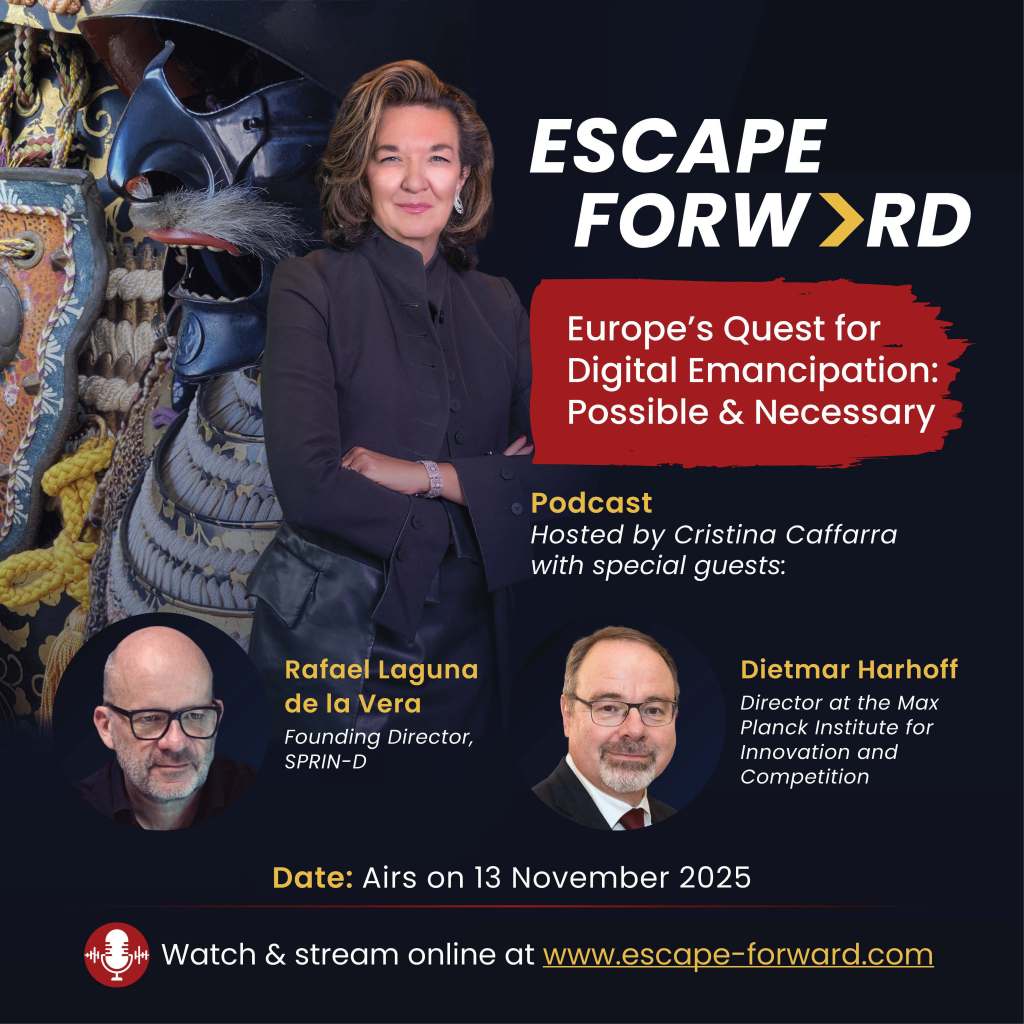
Europe is in the throws of an accelerating, urgent mobilisation around “digital sovereignty” – which does not mean protectionism and does not mean autarky: instead, an industrial project – led by industry – to strengthen our assets and capabilities, reduce dependencies and improve resilience. Not “just” for security, but for productivity and growth. A scintillating conversation on “Europe’s Quest for Digital Emancipation » (where are the choke points ? how did we get here ? how do we make it real ?) with two of the most influential »cage rattlers « around, fully intent on awakening European tech : Rafael Laguna and Dietmar Harhoff.
ESCAPE FORWARD Ep. 4, 12 Nov 2025
“Europe’s Quest for Digital Emancipation: Possible and Necessary” with Rafael Laguna and Dietmar Harhoff
Respectively: Founder and CEO of German Disruptive Innovation Agency SPRIND, and Director at Max Planck Institute for Innovation and Competition
CC: Hello everyone, I’m Cristina Caffarra and this is Escape Forward, the space where I have the pleasure of discussing with some of my favourite people the most salient issues in policy today, mostly outside the field of antitrust that was my original domain.
Today’s episode is motivated by something I feel extremely strongly about: how Europe, which was once a pioneer and a trailblazer in all things tech, has become a vassal, a digital colony where the bulk of our core digital infrastructure (and not just apps and services) is increasingly dependent on a handful of extraterritorial technology providers from chips and of course rare minerals to cloud to software to connectivity. We in Europe have amazing talent, innovation, economic power, and yet we have somewhat rolled back while non-European companies have rolled forward with services and infrastructure, seemingly without obstacles across the entire continent. And now we are faced with a new geoeconomic reality of hard power, where we have dependencies that are harmful because what we thought was the benign attitude of our protector and partner, the United States, has changed.
We see the Trump administration wielding resentment towards Europe for not burden-sharing enough, as a weapon to subdue and coerce Europe in multiple dimensions. But there’s also at the same time (and very much linked to that) a resurgence of pro-European pride, a growing desire for emancipation from our dependencies. EuroStack, which I’m associated with, is prominent pan-European movement which has grown at great speed, but it’s not the only voice. There is a big drive for digital sovereignty which is broad and growing. And indeed, part of the motivation for this discussion today is that the German government and the French government will hold imminently a summit in Berlin on European digital sovereignty – recognizing precisely that this is undergoing pressure.
So I’m delighted to host for this conversation two real leading figures in this discussion, both thought leaders and amazing “doers”. Dietmar Harhoff had a hugely varied and distinguished academic career in all sorts of innovation-related fields – research management, entrepreneurship, strategic management, intellectual property, is Managing Director at the Max Planck Institute for Innovation and Competition and Director of the Center for Innovation Entrepreneurship Research. Rafael Laguna de la Vera is best known (and very well known) as the founding Director of the Federal Agency for Disruptive Innovation, SPRIN-D, in Germany, which is a model agency for investment in innovative projects with enormous influence at policy level, and actually doing things. He has a background as a serial entrepreneur and is visiting professor at several universities. So they are the best to take us through a broad discussion of where we are, how we got here, and where is it this discussion of sovereignty going?
Good day, both of you. Again, delighted to have you here. I want to start with the status quo, an assessment of where we are. I mentioned the dependencies that are very much in the public debate that Europe suffers from. Let us talk about these dependencies.
Where are the real pain points? Where are these dependencies located? I’m interested in some sort of panoramic of the whole stack. We go, of course, from minerals to chips to AI via cloud and software and connectivity. So where are the dependencies? What are the pain points? What can go wrong? We had recent outages, which have been in the news – AWS, Microsoft, there has been a big discussion around those, and some governments waking up to the need to reduce these dependencies. Starting with you, Rafael: do you want to give us a view on where you think we are in this predicament at this point? Thank you.
RL: Thank you, Christina, for having us. Obviously, we’re dependent at all levels of the stack from raw materials all the way up through the stack to AI. And everything in between – we go from minerals to chips to the infrastructure software, application software, infrastructure for AI, GPUs, and then the application of AI all the way to the top. We all know the names whom we’re depending on. China with the raw materials, Taiwan mainly with chip manufacturing of leading node sizes. We can do trailing node sizes, but we can’t do leading node sizes. And even in trailing electronics, we can see the dependencies from China just now in the automotive industry with what’s going on in Holland.
Next level up infrastructure. While open source is delivering most of that software stack, operating and turning this into services that people want is what the hyperscalers do, and they do it very well at scale and with a broad range of services. Although we do have cloud hosting in Europe, we all know it’s not as at scale. It’s not as broad. The hyperscalers are more Ikea and Boeing or Airbus in terms of size and quality, but also in terms of scope of the services they offer. We have mom and pop shops when we compare to them. Software is not the issue. We all know very bright European people are developing the software, working at these companies, so it’s not a skill thing. We do have the skills in European people, but they work elsewhere. And that’s the issue.
Then we can go further up: applications. Here we’re all depending on Microsoft Office. I don’t know why because there’s lots of alternatives, but of course the big guys benefit from network effects, so it’s very hard to move away from these huge platforms because everybody else is there. Even when we’re upset and we’re moving away, we’re coming back because we’re being tracked into the network.
Then we can go further up, let’s say AI applications. In LLMs there is still a fight between open source models and closed models – the most closed one being Open AI. We see a battle with China as a country with Deep Seek open source models. Facebook is sort of fading out. We see European attempts, frontier labs like Mistral and Black Forest Labs in Europe that are trying to play the “big boys game”. We see people investing hundreds of billions to fight off the other ones. So it’s a brute force war that’s going on.
And then you go further up to agentic systems, which use AIs. You see edge AI and robotics and science, AI as scientists, so to speak. That’s all not settled yet.
So that’s the field today. But if this whole stack is not controlled by you, you’re in a losing game. We see, and you mentioned this, how this stuff is used to wield political power, as negotiating power. And I think what this comes down to is that we’re never going to be completely independent. That’s never going to work, but we have to have enough components. We have to have enough power at the table to be able to negotiate. Luckily, we have a company like ASML. Without ASML, there would be not a lot of negotiating power at the chips table. This is an important company. They have a monopoly that’s very powerful. But then that’s probably the only one in Europe. So we have to work on all these layers and create enough independence on all these layers.
It’s totally possible from a technological perspective. But we have to switch into “do” mode. We all have the realization that this is the reality. We have the realization that we do have the capabilities, people that know things, that can do things. Now we have to do things and that will need an orchestration between what companies are doing because in the end it must be companies that are doing this. Yet at the same time we see in the US and China that the government is helping a great deal, this is what governments need to do. Of course, we cannot wait for governments to do things. We should just start. But at the same time, to scale, we need governments with innovative procurement, creating the sizable capital market for the funds to be available to these companies to scale up – this needs to be orchestrated and done. And I think we’re now at due time, crunch time. We need to do things.
CC: You touched on a number of points that I want to dive deeper into, but this is a great starting point. The emphasis on “doing” is particularly dear to my heart as you know because we talk quite enough in Europe and we don’t “do” enough. Let me go to Dietmar now and I want to stay with this initial question on pain points and real risks of these dependencies. We mentioned the political risk, we see outages as well – in the last few weeks we had AWS, which has been very well documented, even applications which are deeply encrypted like Signal were out for a while, then there’s been the Microsoft outage, the Cloudflare one last year, which is always used as an illustration of the “single point of failure” problem in which a lot of things can to fall over. Some minimize this, of course, the narrative on the other side is well, things can go wrong, outages can happen, a 14 hours outage is not the end of the world.
Dietmar please give us your view on what Rafael started to outline. So what exactly are the reasons, other than pride, why we `want to “do our thing”, why do we really need to be building our own infrastructure?
DH: First, thanks for having me, Cristina, and thanks to Rafael for this great introduction and overview. He’s completely right about the dependencies we have. But what I’d like to do is start with a subtle distinction. We were just talking about pain points. And I want to contrast that with choke points. Pain points are controllable. You can take medication, right? You can do something about it. Choke points are life threatening. And resilience, that is the big term in the background, means that we must have control over sufficiently many choke points to counter the impact of the choke points that other people have. Unfortunately, the balance is not very good for us – as comes out clearly from of Rafael’s overview.
If other folks have choke points and kill switches, that creates a very, very strong dependency of our digital systems throughout. And Rafael pointed to ASML. ASML is for the highly advanced semiconductor manufacturing nodes, of course, a choke point, because without it, you cannot do it. Economists will talk about a Leontief production function. When you need it, you need it urgently, right? Just as the United States needs rare earth from China, because there is no production line right now. Maybe in five years there will be one from Australia, from South America. But all these things take time. And in the short term, you are dependent. And there is choking, potentially. Now, that choking is all the more dangerous if it is exerted by somebody who exploits the situation.
And what we have learned now is that, yes, presumed friends are also in the position now to try to gain advantage over us in some shape or form. That has now finally led to a waking up. In a sort of macabre sense, we have to thank Mr. Trump for teaching us the lesson, both on the military side, that the 3% or 2% targets are to be taken seriously but also in the digital domain, that we should not continue as we have. And to me, this is not a romantic principle. This is rationality. This is taking care of our own welfare and the welfare of our citizens. And I’m somewhat dumbfounded by the naivete of some of my economist colleagues who still believe that the world has a perfect trading system. that the WTO is still active and so forth and so forth and so forth. It is not. It hasn’t been in the past 20 years. Right. But we closed our eyes because we were so in love with our beloved theories, and trade was everywhere. So there was no strategic dependency anywhere. We now have strategic dependencies. We need to take care of them. We need to move in the direction of resilience.
CC: Wonderful and the mention of our profession, the economists, blissfully still going about life as if the world hadn’t changed is very welcome. Let me stay with this theme because both of you emphasise rightly the political dimension and the risks we are exposed to, given our dependencies. What I now would like to ask you respectively is a view on the extent to which there is also an important component which has to do with European growth – linked to this theme.
Starting from the Draghi report, a key cause he identifies for the difference in productivity growth between the United States and Europe is the digital sector, how the adoption of digital technologies has been a key driver of productivity growth in the United States, and Europe lags because it lacks that. So I personally think, and that’s why this really needs to be led by industry, that the fate of the European economy in the future is also linked to the extent to which we can make progress on this path towards greater assets and capabilities that are built and housed in Europe – for growth, not just for resilience, but for growth.
There are views that are not necessarily aligned with this. For instance Paul Krugman, who is a Nobel Prize in Economics, has written recently in his blog that Europeans are so worried about being behind in tech – but maybe they don’t need to. He looks at the U.S. and says yes, when you have a really active tech sector like Silicon Valley, the productivity growth in the West of the United States is higher than everywhere else, but quality of life and standards of living are not very different. So Europe, even if it doesn’t have a Silicon Valley, can have standards of living that are equivalent and doesn’t need to worry about creating its own tech sector – other than for security reasons. How do you see the link between the awakening to the need to do more digital in Europe, have more assets in Europe, and the broader predicament – the fact that our economy is in a particular situation at the moment. Do you want to comment on this respectively? Maybe Rafael you start.
RL: Yeah, I read this piece as well and I felt so much better after this – until I realized, well, maybe it’s not true. Yes, it’s soothing my European soul in a way. We’re not that bad after all. That’s something you really like to hear. And I agree in part that we have strong cultural foundations in Europe than many of these other regions have. I like being a European.
CC: That’s my feeling too.
RD: And I think we’re very attractive for people because we do things that others don’t. The numbers don’t speak to the quality of what we have. And I think Paul Krugman is right in that. But what he gets wrong is that everything digital is an enabling technology for creating wealth. And we better do it because otherwise our back garden, as beautiful as it might be, will turn into a museum for the Chinese and Americans to come by and see, look, this is where it all started. Wonderful. We’re sort of the poor Disneyland after that. We cannot be complacent because it’s all great. Obviously not. It’s still great. That’s the good news. We’re still okay, but the trajectory is not great.
All this wealth was created in Germany and Europe in the mid 1850s-70s, when technology was industrialized first in England, and then scaled in Germany because the Prussians were creating Germany in 1871 and they knew how to scale things. So chaos created innovation, and order scaled it. That’s the autonomy that you need, which is hard to keep up with. And we’ve seen three Nobel prizes to people that were researching that, which is fantastic. I’ll leave it to Dietmar to comment on that because I think he should have gotten the Nobel prize.
We lived for 150 years quite well with that system. Made in Germany was created at the time because we were just making and scaling and the automobile industry, pharma industry, chemical industries, machinery, everything was created at the time and created wealth for all the time, even with wars in between and everything destroyed. Here we are. The next industrial revolution is just now starting. We’re at an inflection point. And we all know that. We know that digital technology, including AI, now finally completely changes the world and every industry. Now look back 150 years: we had steam engines, we optimized for steam engines, we created generators, we created power for everyone, power lines, and so forth. That is going on in the virtual realm now. This is what we’re seeing. And this will be changing everything. Now, if you don’t build the foundations of that industry, you’re not building the subsequent industries either. So that’s what it’s all about. We can’t be complacent. Great place, good opportunity. We’ve done it before, but we’ve got to do it again.
CC: Over to you Dietmar, this is your specialist subject and indeed I’m awaiting news of your Nobel Prize next time! But most seriously, as somebody who has studied innovation all your life, the question really remains, Krugman is not right to suggest that it doesn’t matter if we don’t have the capacities over here, in the end, because perhaps it all evens out?
DH: That is right. I think what he overlooks is what we as Europeans have also overlooked for a long, long time. The Europeans have the incorrect perception is that as long as there is division of labour and we do our machine tools and our chemicals and our cars and so forth, the others can have digital and we will still be able to trade. And we overlook what Rafael just pointed out, that digital is potentially a choke point because it can control the rest, right? If you don’t have digital for cars, if you don’t have digital for the machine tools and so forth, you have almost nothing because the machine tools have become commoditized. China has learned a great deal from the German machine tool makers and the Swiss machine tool makers and is producing now competitive machinery. That competition has moved into the digital domain. That is also where the spillover effects happen into other sectors. We have been talking about digital as a general purpose technology for a long time. And we are talking now about AI as the general purpose technology of the century. Those are big words, but they are potentially right. That is not included in Paul’s analysis and it should be.
We have to move forward maybe with some specialization, for instance the coupling of industrial data and AI, the coupling of industrial processes and digital. But we must become better at digital technology. We missed the boat on that. Digital has been a missing element in our engineering culture in France, in Germany, in other countries in continental Europe. And we need to pick that up.
Let me just conclude with one point. The little diatribe that Paul contributed reminded me of his comments on Airbus, which he gave in the 1980s and 1990s when he tried to talk Europeans out of Airbus. And right now, Airbus is a wonderful contribution that Europe provides to the United States in terms of resilience, in case that Boeing doesn’t do a good job at certain times.
CC: I want to stay with you because what you touched upon particularly towards the end goes directly to the next thing I wanted to discuss. Before we talk about the future it’s useful to understand how we got here. You mentioned the lack of engineering culture perhaps in France and Germany on digital when doing education. More broadly we know what the diagnosis is. The number one culprit is that we cannot scale because Europe is a fragmented continent, so scaling is difficult. Yes there are barriers, but we have seen the hyperscalers roll across Europe. Amazon started in 2005 with a headquarter in Germany and then the instructions was just roll, roll out. They went to the UK, they went to France, they went to Italy, they went to Spain. It doesn’t seem they faced particularly great barriers. Of course there is the lack of a capital market, that is true. But I’d like you to elaborate on the back of your initial comment on lack of culture, also about the lack of capacity at the state level to do anything very useful in this space. I heard you before, Dietmar, lamenting the competencies of our bureaucracy in this space. And while nobody relies completely on the bureaucracy and the state to map the future, it is a question of capacity and competencies there. Do you want to give us more on that?
DH: Sure, let me start with your argument that apparently the Amazons of this world can deal with European fragmentation so easily. And you’re right in your assessment. But they all had starting conditions in Silicon Valley with a 300 million customers market in the United States with a reasonably unified capital market, huge financing opportunities and so forth. And that is what our startups at this point do not have. So fragmentation of the European market, the state of our capital markets, which are not deep enough, is really worrisome and we need to work on that. So I really welcome Mario Draghi’s and Henrico Letta’s thoughts on the 28th regime, the possibility of creating one legal form for startup firms in Europe so that they don’t have to incorporate in, let’s say, four or five European countries to come close to 200 million potential customers. We really need to look at that.
The second point you asked for the role that states have, and I think we have missed the boat on public sector procurement completely. The United States has been able to use that, and moreover to hide it from the sight of our fellow economists who think that everything is done by the market in the US. No, there’s very smart procurement policies in the Department of Defense, but also the Department of Energy and so forth. And they partly feed startups and allow them to grow by giving them procurement contracts rather than subsidies. We need to move away from the subsidization philosophy we have in Europe to a philosophy of enabling private markets to come in and enabling the public sector to use smart procurement
The engineering culture point is probably the trickiest. As Rafael pointed to the Prussian state, engineering in Germany only came about around the 1890s. Technical universities were only created in the 1890s. The diploma in engineering, which became a world famous degree, only came out in the 1890s. In France, very similar developments. In Continental Europe the engineer was linked to ingenium, genius. The engineer in Britain was the guy on the engine shoveling coal into the machine with a coal smeared face. No reputational advantage there. These things help to bring a profession forward and they give solid support for technical activity or technology in a society. Where we missed the boat was really how to bring digital into this culture, to bring these cultures together and enable our engineers to be as good in coding as they were in Silicon Valley, where the computer science guys were right next to electrical engineers while we packed them in Germany with the mathematics folks, and they did abstract computer science. We have very, very smart people, but what we need to realize is that we have to bring digital coding, computer science, AI into all realms of education in Europe. And that will enable us to be much better at bringing ideas to the fore.
CC: Let me pursue this with Rafael. Of the many things Dietmar brought up, procurement is something we all focus on because as Dietmar alluded to, the paradox of Europe is that while in the US you have buy American, in Korea you have buy Korean, China I don’t even need to mention, in Europe the default is “buy from everywhere.” Why? Because we are fair. We are fair and we don’t want to discriminate. And of course, originally the idea might have been that you don’t want the Germans only to buy from Germany or the French only to buy from France, but this is now being weaponized against us by outsiders saying, oh, you want to discriminate against us. That’s anti-competitive, that’s bad. So procurement is something I’d like you to comment on specifically, Raphael.
Next: you run what is, as I mentioned at the beginning, a model agency. We’ve been a little mean to the capacity of the government so far, but your agency is the evidence that things can be done in a smart, effective, and fast way. It’s an exception, and I know that your model is being looked at and copied elsewhere. How did you think about, I’m not asking you to give us the story of SPRIN-D, but your insights as to what can be done smartly. Because otherwise we are in a world in which European business have been somewhat infantilized by the belief that somehow someone, deus-ex-machina, the European Commission, DG-Connect or what have you should “do something”. But what can they do and how can they have the vision to map the digital industry of the future?
RL: The result of the complacent culture we’ve given ourselves in the past 30-40 years is we didn’t need to spend money on defence because the Americans were protecting us. They were spending 700 billion every year for the DOD. They were the big boys in NATO and we were making ourselves comfortable and since we didn’t spend that money on that we could spend it on social welfare and many other things. Which is great in a way. But on the other hand, we did not push forward what created this wealth to begin with. And that’s everywhere. It’s in industry. It’s in science mentioned. We lost this wonderful engineering culture, now engineers and software engineers count for nothing in Europe. We pay them very poorly. We look down at them. I’m a software engineer. In the US they get million dollar salaries because they’re highly valued and people know what kind of difference they can make. We still think that you can build software like you build a machine factory. When VW said, we need more software, they hired 20,000 lowly paid software engineers and thought this would solve the problem. Well, guess what? It didn’t. Didn’t work. We’re at the wake up moment.
Many people in government think that we can just continue the way we’ve done before. We’ve created closed systems. Industry, government and science. We’ve locked the doors, we’ve created incentives for the people to stay inside the systems. So when you’re in science it’s publish publish, H index, Google scholar, and the career is to become eventually a professor who’s a state employee all his life with a nice pension at the very end. And it’s hard to break out of the system because you’re losing so much.
And if a science person founds a company and suddenly becomes rich, he’s not highly regarded at all. He’s expelled from the system and he’s looked down on. It’s not a career path we teach our children, we teach our students, that you might want to break out of the system. Luckily, some still do it because they are the crazy ones and we always needed them, but it’s just not enough.
You look into government, same thing. Bavaria at least sends government employees for two years outside the industry, and then they come back and say, I got to do this for two years, I’m coming back and I have my pension secured when I’m 35. That’s the life goal. You’re in the system. And of course you’re protecting your system. And guess what? The number of lifelong government employees is increasing. Now you go to industry, same thing. It’s rare that industry people change across from industry to government. I’m one of the very few exceptions. I don’t know how many prior industry people we have in government, maybe five or so. It’s not thousands. We don’t have that. If you look back at the good old times, that was much easier. We were producing PhDs if required in two years, for them to be able to work on the stuff we really need. Let’s not get them to spend half a decade to do their PhDs. Let’s have them do something, right? And the professor was stamping their PhDs for them to go out. That created this whole slew of German scientists (pretty similar in France) who went into industry and created stuff.
There was an explosion of technology between the 1870s and 1930s, where we’re doing very well. We need to break the silos. We need to make it possible for profs to found companies, to work on these companies, take their PhDs and their intellectual property easily with them into their startups. We have to make sure that these startups get well funded. We have to make sure that the industry realizes that they’re stuck in an innovator’s dilemma. And the only way of breaking out of this is to work with a startup ecosystem.
I’m always suggesting to industry that instead of having an innovation manager in their company, or a corporate venture fund, they should much rather invest into many venture funds, which would provide more money to the venture funds, which is an investment for them. It’s not money spent, that’s money invested. If they invest enough, it will come back with a little extra. And look at the pipeline of startups that they’re interested in and support the ones that they find interesting. Maybe put another check on top of them with more money if they like what they see. Open their distribution channels and their networks and their ability to scale product for them, and if they really like what they see, they should eventually buy that company or take it public. But no: whenever we build these champions in Europe, they get acquired by US or Chinese companies. 80% of the exits are going inside. This is wild because that’s the innovation the industry needs.
So break up these silos, work with the ecosystem, create alignment of interest.
We need to walk away from the old tools that are not working anymore. They are way too slow. So when, for example, government decides they want to fund nuclear fusion or quantum computers or AI, they set up a programme and they discuss top down what it needs to be. Then two years later, the program comes out and people need to apply with 450 pages of explanations about what they’re going to do in the next three or five years, how many pencils they are going to buy. And then we put the burden of controlling on them, micromanagement, they have to explain when they bought this pencil, how much it was, why they needed it. And we were bogging them down. Many folks are saying it takes 80% of their time to deal with the government funding of their science. That’s wild. That’s crazy.
At Sprin-D there are other tools and we’ve shown what these are. We do challenges and time-to-money at challenges is 14 days from application to money in the bank. And even with individual project funding, it’s no more than three months. And we’re working hard on taking it down. Draghi was requesting from the European institutions that they become much quicker. But it’s not happening at a pace it should. In Germany, it’s not happening at a pace it should. But we need to get into “do” mode, that’s where most of the value sits.
And then innovative procurement. That’s what the US does very well. Tesla wouldn’t exist, SpaceX wouldn’t exist, Silicon Valley wouldn’t exist without this tool. And it’s billion dollar contracts that are given out in competition so that many can participate. We need to use these modern tool challenges, time to money needs to be KPI, innovative procurement, to fund the ecosystem that I just described.
CC: Dietmar: we are talking about “European sovereignty resurgence”, that conversation is everywhere. What can it consist of realistically? We don’t care for more conferences and more chats and more workshops. As Rafael says, the emphasis should be on the “do” and his agency is a model in this respect. What do you see as promising and credible in the current conversation and where would you like the effort to go to, to be focused on, not to waste more time.
DH: Yeah, not wasting more time is absolutely crucial, absolutely essential here. We cannot afford the slow processes, the encrusted structures, incentives and so forth, under which very smart people in government are working. We need new processes. My call to the new German government was, folks, what gives us the chutzpah, the courage to say that by tossing a little bit more money into the same processes and bureaucratic procedures that we have known not to work for 20 years now will perform better in this legislature. They will not. We need to change how we do things. And Rafael is showing with his organization that speed is possible, and that competition is not something that you need to neglect if you want to be fast. No, you can do both. And you can build smart ecosystems from these technology challenges, for example, that he’s using.
I think that governments can learn from these tools, from these processes. We need to be more output and results oriented in what we do. It shouldn’t be enough to tick the box that the process was adhered to. We should ask from our government that they produce results. And that is completely anathema in many areas, both at the Brussels level and in Germany. We need to get away from that. Fortunately, the pressure is mounting and it pushes us in the right direction. But there is, of course, always also counter pushing to these positions.
From my perspective, we need to look at how government does its business. We need to be pragmatic and not sort ideological, guided by some theory of Econ 101, as to what the government may do or may not do. We need to bring technocrats from industry into government and we need to make that possible. Certain structures in Germany, for example, make it awfully hard to bring somebody from industry into government. But that is the know-how that we need in order to run processes, procurement, technology development, R&D programs effectively and in an agile way. So it comes back to breaking up the silos and including people from the other sectors having these interchanges – the Bavarian government fortunately does this but we need much more of that and we need speed.
CC: How hopeful are you that things are moving in that direction? Because we enthusiastically agree amongst ourselves that this is really what’s needed. And yet, I honestly do not know. This is why I’m putting so much hope into the private sector. And I hope that they will wake up and be taking initiative because even though we agree that this is what needs to happen with governments, it doesn’t yet seem to happen fast enough. Rafael is an exception, a successful business person going into government. I was reading about a commission just created by the German government to discuss AI. And it was all law professors and researchers. All very deserving people. But my question was where is the industry muscle in that discussion? These are all very worthy intellectuals, but it’s not industry. Brussels is even worse, of course, we know that they work in their own ivory tower and they come up with ideas like AI factories and so on that people don’t necessarily recognize. So we agree. And yet there is this big disconnect. That I do not know how to bridge.
Plus, there is the discussion at the level of member states, which is very different. France is in a different place from Germany. France ideologically has been in favor of sovereignty for much longer. Germany is getting there, but with much more caution. Then where are the Italians? missing in action? Where exactly are the Dutch? Where is Northern Europe? This is all a very patchy landscape. So how hopeful can we be?
I don’t want to end on a negative note. I want us to be optimistic because I personally feel very frustrated by being told always that Europe is too late at X. Okay, so “Europe is late at chips. Europe is late at this and that”. I refuse to accept that logic. But on the other hand, we need to stare at reality in the face. I don’t see that governments are moving in the direction you two are sketching. Do you want to comment on that? Maybe prove me wrong and tell me this is all going to go better. Rafael, you want to start?
RL: I will leave some to Dietmar because I think I know what he’s going to say. I gave a t-shirt to Chancellor Metz two weeks ago, which says pessimism is a waste of time. That’s our slogan because he was using the same words. He said, we have no time for pessimism. We need more trust and do instead of control and micromanagement. So I’m hearing from our chancellor in Germany the right spirit, going into the right direction. Just two days ago, I was at the launch of what’s called the High-Tech Agenda for Germany, which has six big technology topics, one of them being clean energy and fusion, quantum computers, micro computers, it stated goals for all of these. For example, we want a fusion power plant in Germany at the end of this. So clear KPIs do mode, right? Milestone based programs, working through startups, funding the startups with enough money so that they can get there. That’s all the right words, I think in there.
Something is indeed changing, at least in the words. I think now I can say in all honesty that I believe that government has realized that we have to switch to “do” mode and that we have to do things differently. We cannot continue doing the same things all over again and hoping for change. That’s insane. That’s not going to happen. And that realization is in the heads of the leading people in government. All the ministers that I talk to, it’s all in their heads. There’s a willingness to change.
Now, the jury is still out on the “do” side because the apparatus underneath is used to the old tools and finds the new tools pretty wild. They all find Sprin-D pretty wild. You know, we’re still the crazy ones. We’re sort of alien still. But as you know France has approached us and now myself and the CEO of BPI are building a French version of Sprin-D. Same for the Netherlands. We’re working with Vinnova in Sweden where we’ve signed an MOU, we will do mutual challenges. We’re even doing a mutual challenge with the National Science Foundation, NSF, in the US. And hopefully somebody from Italy eventually calls as well. So we’re spreading the way we work. There’s lots of reason for hope. Of course, it’s still very small little shoots we’re seeing that have to grow much bigger. And we’ll see in the next three years if that really happens.
And we are talking to the EC, EIB, and more. Commissioner Zarajeva was at this conference in Germany that I mentioned before, and she was using the same words. So we have to turn that realization and willingness into action. And there is reason to hope that we actually do this well, and then things will change.
CC: Over to you Dietmar.
DH: The long and the short of what Rafael said is, hey, we now have the awareness, we’ve done the analysis, everybody sees that it can work, see Sprin-D, but also see smaller countries in Europe like Switzerland, the Scandinavian countries, who have been much more agile than the big ones – France, Germany, Italy for a while. They have had better government processes, shorter decision-making times. So it’s all there. But we have to rattle the cages of bureaucrats and government officials who are in the mode of doing the same thing all over and all over again and haven’t realized that the house is on fire. Right? Our competitiveness is threatened. At some point, we will not have the tax income anymore to finance science, social security, or military security. We really have to get going now. So the urgency, think, has been perceived in most leadership circles. It has to come down now to the organizations. We may have to rattle them, and we may have to break out activities. into agency-like organizations like Sprin-D, enable them to be fast and agile, free them from unnecessary red tape, and just let them do their thing.
CC: Wonderful. We are at the end. Rattling cages is something I very much feel total empathy with. I’m often told that I’m provocative, but I totally love that expression. Let me just ask for a final comment from both of you. We are in the run up to the European Digital Sovereignty Summit, which is a French and German initiative. Everyone will be be converging on Berlin on the 18th of November. Do we feel that that is going to be another talk shop? It’s a bit of a rhetorical question, but do we expect putting it on the map so explicitly to actually help progress and rattle the cages further, or is it going to be a dog and pony show? Maybe you first Dietmar, and then we wrap up with Rafael.
DH: Well, I guess it all depends how the speakers are primed. And it’s not just the speakers, right? It’s the repping and the staging of the whole thing. I’m very happy that we have this event. And I think if we convey the spirit of rattling cages, I like the metaphor a lot, and of breaking up encrusted structures and letting smart people who are already in the organizations, right? We don’t have dumb people in our public sector, but we need to entitle them, to enable them to do their thing and to go forward. And of course, we also need to bring in the industrial, the technical, the technocratic know-how in addition to cutting the red tape. And I’m very hopeful you asked about optimism versus pessimism. I’m with Rafael on this. We don’t have time for pessimism.
If you go to his technology challenges, the pitches, if you go to a hackathon here in Munich, we just had one three weeks ago on agentic systems, there’s so much energy. It’s because of this energy that OpenAI comes and opens offices here. But we need to use that energy for European welfare and not for supporting the gatekeepers and monopolists from other places.
CC: Great. Rafael, in this journey towards greater European resilience and independence, what we are also seeing is that companies themselves, large companies particularly, are very reluctant to cooperate in the effort to move to European alternatives. Do you think that this, I mean we talked a lot about government, government capacity, rattling the cages, the bureaucracy and so on, but there is also as a final question an industrial dimension and companies want to be safe and are risk averse and don’t want to just shift their compute load into something which involves switching costs and uncertainty. This kind of concern is a major obstacle that I can see to people making different choices. You think that we are on the way to creating, my perception is we are, but more appetite for experimenting with European assets or maybe still a long way off?
RL: Half-half, I would say. In the past years, I’ve been pushing a lot about these sovereignty choke points, but industry wasn’t very interested. I remember sitting at a dinner with then-Chancellor Scholz about 5G’s sovereignty, Huawei, and so forth. And guess what? The international companies that we have like Deutsche Telekom or SAP or so, said we don’t care because we’re global companies anyway. I mean, the CEO of SAP said he doesn’t get this whole digital sovereignty discussion. We have sovereignty because we have AWS and Azure. You can imagine what my blood pressure was like when he said this. But things are changing as they realize that they will become victims to these choke points themselves.
And so now we see that interest in, example, the AI gigafactories, think of them what you want, but at least there is some real interest in participating and creating some sovereignty, also integrating deeper into the technology stack and getting some control over their fate. The very simple example of course is companies that need batteries from China and they don’t get them anymore. And so you’re not building a product. This is really starting to hurt. So they feel the choke points and this increases the willingness to change and actually invest into sovereignty, which wasn’t there before. I think they’re getting there because they’re feeling the pain. And this is how it works. This is how we human beings are. We don’t care about our health until it hurts. It may be too late. We should care a little earlier and think a little more forward. I think that has changed. So that adds to my hope, that things are actually changing because they have to and they will move as well.
CC: Wonderful. I just want to thank you for this conversation that was super interesting and touched on every one of the things I believe are relevant and salient in this moment. We will see what happens in Berlin in the coming days. Meantime, I’m sure people will enjoy this as much as I have. Thank you both again for making time for this and best of the day.
 Escape Forward
Leave a comment