

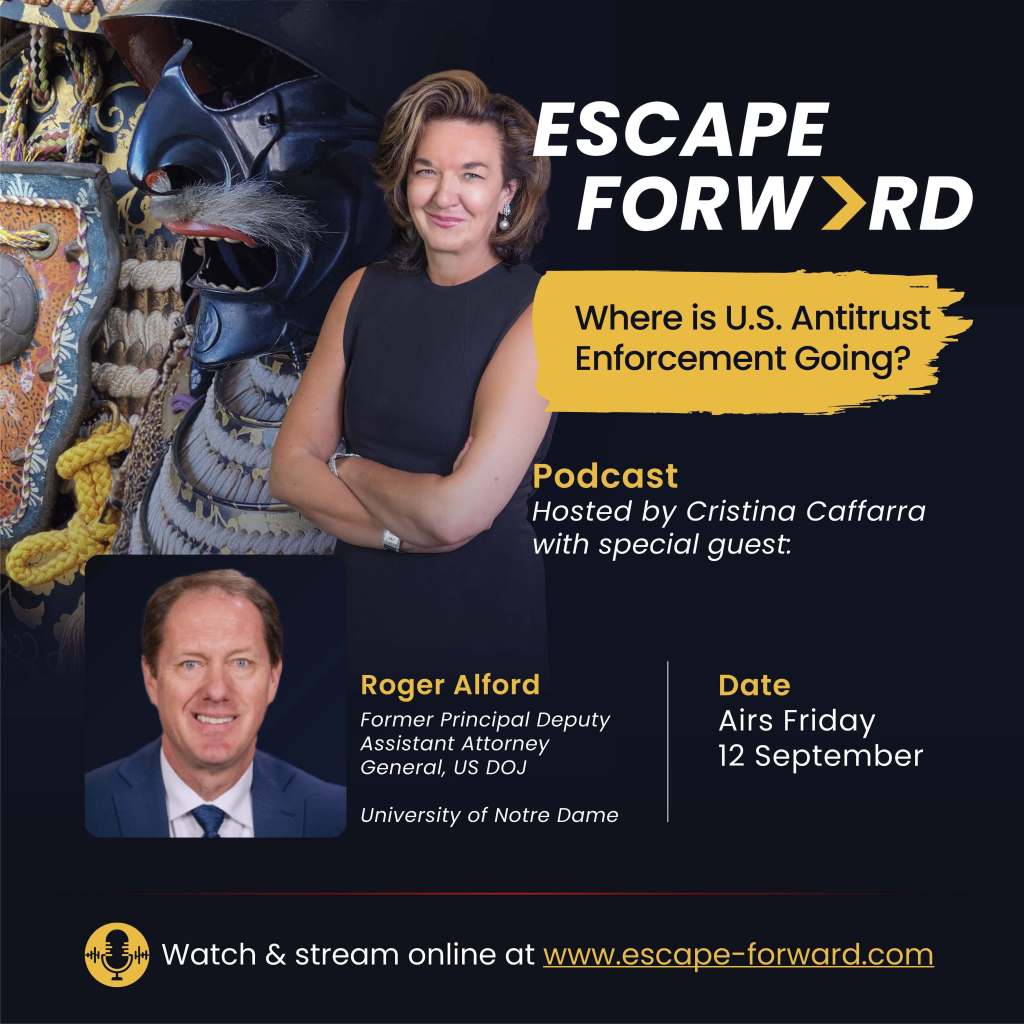
𝗪𝗵𝗮𝘁 𝗵𝗮𝗽𝗽𝗲𝗻𝗲𝗱 𝘁𝗼 𝘁𝗵𝗲 “𝗮𝗻𝘁𝗶𝘁𝗿𝘂𝘀𝘁 𝗿𝗲𝗮𝗹𝗶𝗴𝗻𝗺𝗲𝗻𝘁” in the US? What did it mean and has it evaporated? The “𝗔𝗺𝗲𝗿𝗶𝗰𝗮 𝗙𝗶𝗿𝘀𝘁” brand of antitrust populism (“everyday pocket issues for ordinary Americans”) was the flag for the new leadership at DOJ and FTC, but has it met reality? Wall Street, corporate lobbyists, Big Tech affirmation and more. Antitrust seems wielded as a tool to fight elite culture wars rather than “pocket issues”. And the courts? With Google Search we had a strong liability finding which smashed against the limits of what an individual judge “feels” he can really do to fix vast monopolies. So is antitrust enforcement against digital monopolies futile? We failed in Europe, but what signal does a weak remedy give to global regulators on that path?
𝗪𝗵𝗲𝗿𝗲 𝗶𝘀 𝗨𝗦 𝗮𝗻𝘁𝗶𝘁𝗿𝘂𝘀𝘁 𝗿𝗲𝗮𝗹𝗹𝘆 𝗴𝗼𝗶𝗻𝗴?
A frank conversation with Roger Alford, friend and former Deputy Assistant Attorney General at the DOJ Antitrust Division, who was fired by DOJ leadership for having dissented with the HP / Juniper a merger settlement, but remains a loyal Republican and supporter of AAG Gail Slater’s agenda.
Episode Transcript
CC: Welcome to Escape Forward. I’m Cristina Caffarra, and Escape Forward is a podcast in which I have the privilege of having discussions with people I like and I learn a lot from. It is about really trying to connect dots, starting from antitrust and trying to link it with other areas of policy.
There are times though when antitrust itself really gets back to centre-stage and raises questions. This is certainly one of them. I have written about antitrust developments in the US, what is known as “America First” antitrust, perhaps “MAGA” antitrust, based on discussions with friends and contacts in the Trump administration papers, articles, talks they have given. And the consensus has been that yes, the expansive antitrust push of the Biden administration would be dialled down under the Trump administration, and the scope for intervention would be narrowed, but a strong populist streak would remain, meaning that at the core of enforcement would still remain the notion that we need to pursue the interests of ordinary Americans.
Reading into what is happening in US antitrust enforcement right now is a bit difficult. There was an Executive Order that revoked the prior Biden-Harris Executive Order on Competition, and that was expected and saluted both by the Department of Justice and the FTC as a welcome development. There’s also been, for sure, the doubling down on the need to fight concentrated power by digital giants – so we’ve seen the Google cases, which had been a flagship of the Biden administration, also being continued. We’ve seen continuation of the Apple and Amazon cases, at least for now. Yet at the same time, we’ve seen a number of merger settlements, which have raised questions and signalled a return to remedy settlement of deals – which had really been almost abandoned under the previous administration. We have seen the rollback of policies like non-competes and even mention of antitrust as relevant to ideological battles like freedom of speech, DEI, wokeness and so on. Then on the positive side, we are seeing focus on algorithmic collusion, pharma and child online exploitation.
But the conflagration point really for the question of where the “antitrust realignment” is going in the US has been the firing, just over a month ago, of Roger Alford and his colleague Bill Rinner. Roger was Deputy Assistant Attorney General at the DOJ, and was fired as is well known, over the settling of the HP/Juniper case [which he disagreed with] on the eve of the trial starting.
Roger had already agreed to come and discuss with me on this podcast the direction of US antitrust, even before these latest developments, which he talked about openly at the Aspen Forum in mid-August. I’m very privileged that Roger has agreed to come on the programme and give us his views about the question, which is now very salient, of where it might all be going.
So, welcome Roger! Just as a little bit more background before I hand over to you. Roger is absolutely an outstanding American of exceptional integrity. He’s professor of law at Notre Dame. He has deep experience and expertise in antitrust going back decades and indeed was Head of International at the DOJ already during Trump 1.
RA: Thank you.
CC: Thank you for being here! In fact, you and I go back some time because we met not only during Trump 1 when you were Head of International at DOJ and you were travelling to Europe quite a bit. We’ve also spent quite a lot of time together on the Google cases when the Attorneys General in the United States essentially kickstarted the enforcement effort against Google in 2019, which was then joined by the DOJ. And you were the main advisor to Texas, which was one of the States that led that effort, particularly on the Ad Tech side. I was retained together with you as economic advisor and participant in that effort. So again, you’re welcome.
Let’s start – and I want to start from the big picture. What is “America First Antitrust”? What does it mean? I wrote about it at the beginning of the administration when Gail Slater and Mark Meador gave speeches and papers. I would like you to set out the vision. You came into the DOJ as second in command to Gail and she was seen at the time as a champion of the so-called “realignment”. She talked in her speeches about high-level classic conservative values like moral agency, freedom, individual liberty, but above all about the mission being about protecting ordinary Americans on “pocketbook issues” by “promoting housing, healthcare, food, transportation and so on”.
Will you give us your version or your vision for what you came into the Division to do – before things developed the way they did?
RA: Thank you very much, Cristina, for the opportunity to be here. I’ve had many invitations to speak in recent months, and it’s just a real pleasure to be here with you to talk about “America First Antitrust” and some recent developments. So, your question was, what exactly is “America First Antitrust”? I think probably the best signal for what that is would be to read Gail Slater’s speech,at Notre Dame at the end of April. That was her attempt to express her vision for where antitrust is supposed to go. You’ve already written about it, a lot of people have read that and commented on that. My version of “America First Antitrust” is very similar – I gave a Senate Judiciary testimony in the middle of December prior to my appointment but after Gail had been announced, and the key idea was that there is a movement toward a realignment of the Republican Party toward the working class. If you were to ask what was the key distinction that led Trump to be successful, it was convincing the average working class American that he cared about their concerns and he wanted to address their issues.
Antitrust is a part of that story, especially the idea of bringing the cost of living down, the prices of goods and services down. And so, I think that if I were to say the central message of “America First Antitrust” was to try to focus on what are the concerns that actually animate the average American about the cost of living, about economics, about jobs. Populism in the Republican sense, I think, is focused on trying to realign the Republican Party toward the average working class. And I think that’s Gail’s central concern. There are other elements to it, but I would say that’s the central concern about America First.
CC: So that’s the principle on which Gail was very much setting out. You summarized it again as this idea that ordinary pocketbook issues are at the centre. But then there is the practice of enforcement. Is it panning out that way?
And when the Executive Order of President Biden was revoked (as we widely expected it would be) there was approval from the DOJ and FTC, and Gail Slater said at the time that “instead of an overly prescriptive and burdensome approach” (which is how she described the previous administration), “the Division would promote competition with more tailored actions, more tailored Executive Orders…” – narrower, more targeted enforcement, using the analogy of a “scalpel”, rather than the more ambitious and expansive notion that one should and could use antitrust as a tool for broader market restructuring and dealing with power. Can you talk a bit more about what this analogy of “the scalpel” means and what more targeted, narrowly focused intervention looks like?
RA: Gail Slater uses the phrase “scalpel” (she is almost always using it) in contrast to regulation, which she calls a “sledgehammer”. When she talks about antitrust as a scalpel, what she means is we should be really laser focused on specific, discrete problems and trying to address those problems through litigation and enforcement. That doesn’t mean you’re not aggressive. Obviously, a scalpel is supposed to do surgical strikes on cancers, and what it means is that you don’t need to take a regulatory approach to antitrust enforcement. Antitrust enforcement is complementary to the Task Force we initiated in the Antitrust Division, there was also an Executive Order on Deregulation, and the focus there is that a lot of regulations are anticompetitive. In a way, you should think of the Deregulation Executive Order as the Trump version of the Biden administration’s Executive Order on Competition, but the focus is let’s eliminate burdensome, anticompetitive regulations that often are subject to agency capture – where corporations are influencing the development of regulations that are anticompetitive. So, litigation and deregulation are intended to be a complement to one another. And that’s the scalpel approach.
CC: So, this is a very different vision of what the purpose and scope for intervention should be, because as we know in the previous administration there was a vision that intervention through rulemaking and regulation could be quite expansive and change the way that markets behave to improve outcomes. What you’re setting out is a very different view on rulemaking and regulation that sees them as being often intrusive, often ultimately working against the interest of the public, so you favour a much narrower approach.
RA: To be clear, it doesn’t mean that all regulations are anticompetitive. It meant that the agencies are tasked with the objective of identifying those regulations that are anticompetitive and then propose which ones should be eliminated. It doesn’t mean that we’re antiregulation in all respects. There are obviously many regulations that either are pro-competitive or that serve other legitimate government objectives, right? And so, it doesn’t mean that it’s across the board. But yeah, that’s right. The idea is we should be more focused on litigation than rulemaking.
The other thing that’s important to note is that we’re still in the really early days of the Trump administration. And a lot of the work that has been done thus far is “legacy” cases. And while we’re trying to address and resolve those cases, we’re trying to launch new initiatives. The DOJ is trying to launch new initiatives, especially with respect to key industries, healthcare, housing, agriculture. Gail Slater just had a big meeting in the Great Hall at the DOJ yesterday with farmers. So there’s still a strong interest in trying to identify key priorities that are responsive to the “America First” Initiative at the same time that we’re trying to deal with the legacy cases.
Very often the legacy cases are very consistent with America First, right? The pocketbook issues were a key part of some of those cases. Take the Real Page case on housing, the investigations in the healthcare industry. The cases against Visa and Apple. Certainly, Agrostats was an example of a pocketbook issue for the average American. So, it’s not like we are denigrating the holdover cases, but it’s still early months and Gail’s not yet been able to really fully display her agenda while she’s trying to deal with some of these older cases as well. That’s especially true in the merger context, where several merger cases have been holdover cases.
CC: Let’s indeed move on to mergers – given developments in the last few weeks, issues around mergers are very much at the core of what led to your leaving the DOJ. We won’t talk specifically about the HP case but about the general approach. The difference, which is very apparent to observers, is that during the Biden administration you had a pretty aggressive approach to merger enforcement with a lot of deals being challenged in court, many successfully in fact. What we have seen is that we can expect many more settlements instead, with this DOJ.
Trying to find some sort of solution and settling mergers had been pretty much abandoned in the previous administration. The perception was settlements don’t work. You don’t restore competition effectively with a settlement. You don’t really get to undo the bad effects of a merger, so instead of doing a fudge it’s better to stop the deal altogether because markets are too concentrated anyway.
What we’ve seen with this administration is a much greater inclination to settle cases, based on some form of agreement or concessions, some quite dubious. So, there was Paramount/ Sky Dance Media, the American Express Global acquisition of CWT, T-Mobile/US Cellular, United Health/Amydisis, which was settled only days ago with a number of local divestments. And indeed, the HP/Juniper case, which was at the heart of your disagreement with the hierarchy and led to you leaving. So what is your view (aside from the individual case) about the approach? Was the previous administration overdoing it? Are we going into a world in which settlements are first in line as a possible solution to a deal’s problem? Are they preferable to challenging deals? What is the general approach here? We seem to be turning back to a world in which many more deals will happen. Is that okay? What’s the vision?
RA: It’s a very important question. It’s one of the most important issues that we’ve been dealing with lately. And I want to just preface my comments about the Biden administration by emphasizing that in the first Trump administration, there was willingness to challenge mergers that were viewed as anticompetitive even though doing so might be controversial. And the most famous example, of course, is the vertical merger in AT&T/Time Warner. There had not been a vertical merger challenge in decades. And the fact that that was the first major challenge out in the first Trump administration, I think is very notable. There’s other examples of significant merger challenges. For example, Visa Plaid was a nascent competition merger challenge that was, I think, very significant. So, there was a willingness in the first administration to be aggressive on antitrust merger enforcement compared to the Bush administration or the Reagan administration. But of course, I do agree that the Biden administration was more aggressive in merger enforcement than the first Trump administration or now the second Trump administration.
And I think that is most notable in two or three different ways. One, early terminations were not practiced for almost the entirety of the Biden administration. And obviously, early terminations simply say that if there’s no competitive issue, then we should try to get out of the way and let the parties close as soon as possible. We shouldn’t force them to wait 60 days if we can assess the situation in 30 days and let it move forward. That is a big difference for the parties with respect to pro-competitive mergers.
Then the other major difference is the Biden administration rarely would do settlements in mergers that were subject to consent decrees and Tunney Act review. They would pretty much say to the parties, if it’s a clean deal then we’ll let it go through. But if it’s not a clean deal, then we’re going to challenge it. And so the idea is there is a sort of “middle path” of a negotiation to try to fix the problems, because obviously the merging parties and the DOJ or FTC might not agree about what exactly is a clean deal or is not a clean deal. For Gail Slater and the Antitrust Division in the second Trump administration the thinking is we need to be able to approach some of these deals as potentially available for settlement if we can make the right corrections. And there have been good settlements, I think, in recent months.
But as you know from my speech in Aspen, there’s also been bad settlements. Gail Slater in her Senate testimony said, we don’t want any bullshit consent decrees, that’s not what we’re about. And then all of a sudden you have the HP/Juniper merger, which was opposed by the entire Antitrust Division, top to bottom. That’s why it was just such a shocking turn of events – as I said at the Aspen Institute.
Those are the two major differences between the two administrations. We are still waiting for enough mergers to go through the pipeline to do enforcement of Gail’s agenda. They take so much time, so much effort and take time away from the work you want to do on conduct enforcement cases.
CC: I want to go back to what you just said that there are some settlements that are acceptable (and perhaps more acceptable to you than in the vision of the previous administration which was very focused on market concentration). And there are settlements that are simply not acceptable, problematic.
The signal that sends to the world is a difficult one, a difficult one for the Division and for Gail. Because what the world takes away from it is almost a license to go forward and try to settle through every possible means, and Gail has spoken up against this in her Ohio State speech. She faces a pretty existential question for an enforcer. You are out of the Division now, and you’ve expressed strong views. You also want to support Gail’s agenda, but this is something that everyone is at the moment really struggling with. Are we going to see merger enforcement go back to a reasonably even keel, or is there going to be a prevalence of lobbying and influence and “pay-to-play”?
RA: I think the jury is still out on that, to be honest, Cristina. There are examples that are highly problematic in which the rule of law was not respected when it comes to some settlements. I spoke about that very explicitly in the Aspen Institute. And there are examples of efforts to settle on the cheap, which the Antitrust Division including Gail Slater are resisting. The reason I gave that speech was to try to highlight the fact that this is happening and it’s happening in a whole variety of different cases. And there needs to be greater scrutiny of the fact that these law firms and the clients of these law firms are accepting the possibility of basically resolving things based on political connections rather than on legal merits, which is highly problematic and highly unethical.
I would say that the jury is still out. There are certainly examples of good settlements. And I think a really good signal of a good settlement is the fact that you had cases like Greystar in RealPage, the largest landlord in United States, or cases like United Health/Amedysis where state AGs across the political spectrum that joined in the case have agreed with the settlement. The fact that there were no expressions of concern by the Democratic state AGs that had joined those cases tells you that we worked through very difficult issues and reached a good result in those cases. I think there are certainly examples of good settlements, but unfortunately there are examples of bad settlements. And that’s where we are right now, and we need to correct that. And hopefully that will be corrected with the kind of ideas that I proposed in the Aspen speech.
CC: Indeed, you mentioned the role of the state AGs going forward as being an important corrector or “guardrail” – if the states (and particularly blue states) are moving along with a settlement, then that should be a signal that something is probably okay.
It’s difficult to move on from this subject because it is so salient, what happened in your case. The head of Goldman Sachs just said we are opening the door to a merger wave right now because the perception is that it is all much easier than in the past. That is something that needs correction.
But yes, let’s move beyond mergers and look at conduct. There are cases that were started under the first Trump administration and then were majorly pursued under Biden, particularly cases against digital companies. These seem to be continuing under the current administration. But there are reports, for example from a consumer advocacy group, that about a third of enforcement actions have been ultimately dropped against Big Tech, crypto and financial groups. And then looking at the landscape beyond the DOJ, there is a sense that conduct enforcement is being used to pursue agendas that are unusual for antitrust. Things like freedom of speech, a view against DEI and wokeness and so on. This is particularly true of course of the FTC. Can you comment on that?
RA: Yes, absolutely. I do think that you’re right that there are elements of America First Antitrust that are not purely focused on pocketbook issues. They’re focused on cultural elites and the concerns of cultural elites. And that has manifested itself, most notably, in some of the decisions taken by the FCC and the FTC with respect to DEI or with respect to conservative bias concerns. Andrew Ferguson gave a very sharp speech that you and I attended in Chicago about that, on his concerns about antitrust and conservative bias.
I think what is notable is that while they are making those arguments, the FTC and the DOJ are strongly committed to remaining within the camp of the consumer welfare standards. So if you’re going to try to make those arguments, you have to be able to cabin them within the context of consumer welfare. And so, if you look at the BlackRock amicus brief that was filed by both the FTC and the DOJ with respect to ESG, that was really about output restrictions between common shareholders. And it was very much written as “to the extent the facts are as alleged in which there is potential collusion between shareholders to reduce output, then that could be an antitrust concern”. And actually, the court in Texas agreed with that. So it was an ESG issue, but it was about a central antitrust concern.
But then the recent Amicus Brief that the DOJ filed, different than the FTC case, with respect to conservative bias in media was saying: “if there is collusion between legacy media with respect to the information or the kind of stories that they would publish with respect to COVID, then that had the potential to be an antitrust violation because in the media space, the kind of information that you’re providing and you’re colluding about what is reportable or what is not, has a potential to be an antitrust concern”. I agree with you that there is a legitimate concern here that the antitrust enforcers at the FTC and the FCC are embracing the culture wars with gusto rather than focusing on the sort of core concerns of the American worker, which are again more pocketbook issues.
We want to, as Gail would always say, “keep the main thing the main thing”. That means making sure that you really keep your eye on the things that matter to the average consumer, to the farmers, to the renters, to the blue collar workers that are just trying to make ends meet. I continue to think that’s where we should really be focused on.
CC: Okay, but staying with the concerns of average workers that are trying to make ends meet… one very popular rulemaking of the previous administration, as you know very well, was around non-competes. And this has just been effectively killed with great gusto from the FTC, notwithstanding Rebecca Slaughter’s brief reinstatement and effort to keep it alive. It’s been killed on grounds that the Commission does not have the legal authority to do that. But it was a hugely popular policy that thousands of Americans welcomed. And the position that something like that, which has the potential to be very beneficial to ordinary Americans in their search for a job, is pulled back on grounds that somehow the law doesn’t permit us to go that far seems again very indicative of an agenda that is difficult to reconcile with populism and favouring ordinary Americans – focusing instead on elite issues as you say like freedom of speech that don’t really touch on ordinary Joe in the same way. Right?
RA: Right. Yes, I do agree that non-compete agreements are the corollary to the concern about no-poach agreements, right? And there have been strong Republican support for enforcement of antitrust laws with respect to competitors colluding with one another to not hire each other’s workers. And so, with respect to no-poach agreements, there’s strong Republican support.
I think Republicans are divided about non-compete agreements. And the question is whether or not that should be done through a regulatory approach or whether it should be done through a more litigation-oriented approach. The FTC in the Biden administration focused on it through a regulatory approach. And at least some of the Republican voices were concerned that that was an overreach.
In an earlier period of my life as a professor, I would teach non-competes in contract law. And usually in contract law, they’re viewed as “how long” is the non-compete, and “how geographically broad” is a non-compete, and “how broad” is the scope of the non-compete. And at least in contract law, non-competes were always viewed “it depends” on the language of each individual agreement. So I would agree with you that that is an example of a very popular measure, but the FTC decided to vacate it. I think probably the best way to look at it is to read Mark Meador’s statement: he’s very interested in aggressive enforcement, but he expressed overreach as his reason for being willing to pull back on it.
In Europe there is a different history, and we had been there for some time – but really 2019 was when the States moved and the federal agencies came along. You lived through all of that, have been central to the Ad Tech case in Texas for all those years, and also involved in the Search case. And here we are at this point in a situation where we had two pretty good liability decisions on the part of judges, both on Search and Ad Tech, and then we just received a Search remedy decision which has been widely described as a huge disappointment – in which judge Mehta (of course a decent man whose integrity is not in doubt), does not follow on his own findings with a set of strong remedies. At the same time in Europe, we just issued a very weak decision on Ad Tech.
How do you feel about all that? Where are we in this global platform antitrust enforcement effort? Everyone has been looking at the US, “we are not doing very well in the rest of the world but wait until the US comes in. They have the ability to do things. They have the ability to break up platforms that we in the rest of the world don’t have”. Yet we seem to have ended up in a place where the US after all doesn’t seem to be particularly minded to do very much. Of course, we still wait on the Adtech decision in Virginia and in Texas. Give us a sense for where you think things are.
RA: I would say in the first Trump administration there was a strong interest in addressing Big Tech antitrust violations, though it took literally months to decide which agency would deal with which Big Tech company. And then finally, in about 2017, the DOJ basically had the Google case and the Apple case and the other two, Amazon and Facebook went to the FTC. And so, in 2017, we really began to develop momentum at the Federal and at the state AG level, as well as private litigation against Big Tech from the Republican side, not just from the Democratic side. And as you said, September 9th, 2019, we were on the steps of the US Supreme Court in which state AGs, both Republican and Democrat, were there saying “we’re going to launch an investigation”. The CIDs were issued that day. And at the same time the DOJ and FTC were ramping up their investigation. The DOJ filed its Search case in October of 2020 against Google, then the state AGs, bipartisan state AG actions were filed in December of 2020, both with respect to AdTech. And with respect to Search, especially the vertical search with Colorado and Nebraska, Doug Peterson and Phil Weiser. So this has been a longstanding initiative by Republicans, both at the federal and at the state level – to go after Big Tech companies. And there have been very successful wins. The finding that Google is a serial monopolist is very significant. And we should celebrate that. The Epic Games litigation is I think incredibly important as well.
And we don’t know what Judge Brinkema is going to do in the Ad Tech case. But I would say this about Judge Mehta vs Judge Brinkema. The personalities of those two judges are very, very different. And so, I think you have to manage your expectations about the ceiling of what was possible with Judge Mehta compared to the ceiling of what is possible with Judge Brinkema. Judge Mehta was always strongly committed to trying to follow the DC Circuit precedent in Microsoft and trying to anticipate the possibility of being overturned on appeal. If you read his decision, you can see very, very consistent statements about being cautious, about being humble, about “I’m not an expert” in this area,I don’t know the area like someone in the industry knows the area. So, there is real cautiousness about Judge Mehta and therefore I think the upside was probably less than what might be the upside with Judge Brinkema, who’s a rocket docket judge, who’s very firm, very committed, very confident in her positions. And so, we’ll see where we go with the Adtech case. As you know, Jonathan Kanter in the New York Times said that Judge Mehta basically missed the goal, the hockey puck went outside the goal. I think the better analogy is not hockey, but baseball. I would say that Judge Mehta did not score a home run or a triple, but we have a double or maybe a single.
There were four or five major overlapping interlocking remedies that were being proposed in the Search case: end revenue share agreements, limitations on that, syndication, data sharing, and then the breakup of Chrome. And some of those were wins. I mean, to be honest, the data sharing was a pretty big win in the sense that legally it was uncertain whether Trinko applied not only to liability but also to remedies. Google argued very strongly that it should apply to both liability and to remedies. The judge said: No, data sharing is okay as a liability remedy, as a remedy for trying to basically unlock the potential of the other competitors.
I also do think that the judge was incredibly conservative about error cost analysis, and he was viewing Google as fragile and as potentially the kind of company that could be overtaken by events. The AI paragraphs in the opinion are quite notable in that he really sincerely believes AI is going to be a competitive threat in the near term. And that is one of the reasons why he was cautious. He notably included AI in the qualified competitor definition. So that means data sharing and syndication should be available to AI competitors. That’s a departure, I think, from where we were in the liability case, where he embraced the idea of these entities being potential competitors that could then benefit from some of the remedies.
But I agree with you that the judge did not take a full swing and really address all of the concerns that he could have. And I think it just reflected a very cautious Chicago school approach. The fact that Herb Hovenkamp, his treatise, was cited 30 times – he almost treated that as if it was literally black letter law. Anything that came out of that volume is black letter law. I thought that was quite interesting. We’ll see. Let’s see where we are in six months with the Adtech case and then reassess. So those are my initial thoughts.
CC: But, Roger, okay, a number of reactions – because I have a big investment in this case on a personal level, much as you do. We’re here discussing the personalities of the judges. And of course, this is the system. Ultimately, the judge makes a decision and you’re saying the judge was more cautious, he had a Chicago inclination. He quoted Hovenkamp 30 times. And it is certainly not reassuring that in a case of this kind of significance with such enormous effort spent into it for years, we end up ultimately talking about the personal vibes and inclinations of an individual. And we’re here hoping that Brinkema will be somewhat more courageous. This somehow feels all extremely unsatisfactory. I realize it’s the system, but it is not where you’d like to be.
Second, you are pulling out some aspects of the judgment that appear to be not entirely a loss for the DOJ. But taking a step back, there isn’t another bite of the cherry in the search case. We are kind of done because the DOJ may well appeal, but it is difficult to think that this kind of position would be overturned. You quoted Jonathan Kanter in New York Times. Mark Lemley published a piece yesterday or the day before in the Financial Times in which he said, basically, we cannot use antitrust to regulate the concentrated power of platforms. And it is difficult to escape that kind of conclusion, also coming from Europe. Look where we are. We’ve been at it for 15 years. Clearly, we are never going to do anything terribly radical. The geopolitical environment now is such that we don’t want to create any more irritation across in Washington.
But it does raise the question of what can anyone do to somehow control that power? And is it controllable? Is there a prospect that any of this could be controllable by anyone? Yes, we’re still hoping for Brinkema somehow doing something on Ad Tech. But the bigger question for antitrust at this point, which is one I think about a lot, is what are we doing? Should we be less ambitious then, because we don’t seem to be able to actually affect that power in a meaningful way. Look at what we’ve done. Look where we are. We are nowhere better than we were six years ago, seven years ago, 10 years ago. In fact, worse. So there is that issue which really I think is very salient and makes me question what are we doing in antitrust in this space?
RA: I agree with you that it is discouraging and it’s uncertain whether these remedies will be sufficient. It’s disappointing when a failure in Europe like choice screens led to the judge in this case saying, well, I’m not going to even propose that remedy because it didn’t work in Europe. You and I have talked at length about why the choice screens didn’t work in Europe and how they could have been structured differently. It’s disappointing that Judge Mehta didn’t recognize that things like product design could be part of a remedy when it clearly was viewed as a legitimate remedy in the Epic Games case.
I think the bigger point is that these cases are way too expensive and take way too long. And Google literally just benefited from its delay tactics. The emergence of AI was significant; the judge was very clear that the emergence of AI was a very significant part of that.
I think that government enforcers should be thinking about more rocket dockets, and not bringing cases that are going to take five years, because people speculate that if we had done the Google case in a rocket docket, then we might have been successful. Texas tried to do that in Northern Texas and then Google played the delay game and got it to an MDL in New York and then we literally had to have a statute passed to get it back to the rocket docket. But in the meantime, you know, we’re still in delay tactics. So, I agree with you that these cases take too long, they’re way too expensive and it is discouraging if at the end of the day this is where we are. And we’ll just have to see maybe, I do think the potential for structural remedies is greater with Brinkema because of her nature but also the nature of the market where there was an acquisition and divestiture of an acquisition, even Judge Mehta said, is more legitimate.
So we’ll just have to wait and see where we are with some of these other cases as well. I think it’s understandable to be discouraged, but also, we shouldn’t say that we just completely struck out, right? I think it was a single or a double rather than a triple or home run.
CC: I’ve said repeatedly that in antitrust terms these are egregious cases. There isn’t a question, they are very solid cases, both Search and Ad Tech. The question though remains, and I think you agree with me, that for a variety of reasons (the time it takes and how late we are and the position we are in the cycle), no one seems to be able to do a thing about it. It isn’t about being discouraged. I personally in recent times didn’t think that these judgments were going to turn history back in any way. The question though is ultimately can we conclude that antitrust can be used to disperse gigantic market power?
Or is it going to be the case that should be more modest in our ambitions, deal with cartels, deal with egregious behaviour in more traditional industries, because we don’t seem to be able to actually make a big difference. And I’m repeating myself, and I don’t want to return to this, but I am at a point where I think there is a big question that people need to consider going forward in terms of what we want antitrust enforcement to do.
Now we are coming to an end, this has been a wide ranging conversation on different aspects of antitrust. I want to just wrap up with your thoughts on where it is all going. We have heard you express general support for the agenda that Gail is trying to pursue. You have shared with her that vision, but the concern about a more transactional approach has crept in. Indeed, Gail expressed this strongly in her Ohio State speech just a couple of weeks back that she was very concerned about what she calls a tragedy of the commons in some sense. If the rule of law is not really supported and enforced by individuals and institutions, who is going to actually put themselves out there and work in the public interest. This is very much where we are. It’s not clear where things are going. Things need a correction, and I hope it will be implemented. Do you want to leave with some final thoughts on where you think things will be and how you think things will evolve.
RA: Sure, yeah. I go back to Gail’s speech at Ohio State, which had been in the works for months. What it is trying to say is that we’re in a crisis with respect to ethics right now in the antitrust bar. And it is crystal clear that the law firms are not rising to the occasion. They’re not being good stewards of the rule of law with respect to antitrust enforcement. She gave examples of denial, literally refusals to comply with judicial decisions, with destruction of documents, with privilege abuses, with delay tactics. She gave lots of examples of that. In my Aspen speech I also gave the example of clients and law firms openly willing to use political influence and lobbyists that don’t know anything about antitrust to try to resolve cases rather than resolving cases on the merits. And I think we should recognize that we are in a crisis of ethics with respect to antitrust. And it’s critical that we address the concern.
Because even traditional K Street lobbyists are embracing this new approach, they’re having 2X, 3X amount of lobbying on antitrust that they’ve had in previous years. It’s not just the MAGA lobbyists, it’s also the traditional lobbyists willing to embrace this ethical compromise of bringing in political influences rather than resolving cases on the legal merits. That’s something that has to be addressed. The ABA antitrust section should take up this cause. There are lines that should not be crossed. And right now, there’s a whole variety of different lawyers in prominent law firms that are willing to cross these ethical boundaries that I think are clearly problematic.
CC: But you know, Jonathan Kanter was complaining about issues of ethics during his tenure. He was denouncing, for example, quite vocally the fact that conflicts were not declared by experts the whole time. So this is what appears to be an evolution of something we all know very well happens in practice and ultimately boils down to lawyers and advisers will do what’s in the interest of their client. But why blame them? The question is whether it works or whether they are being told to knock it off. And the question is also how and who is going to tell them to knock it off. The DOJ has launched an initiative, but it is hard to see that something that delivers results will be abandoned. It is a difficult spot and one which is going to persist as a question, notwithstanding the good intentions of the people inside, and it is something that preoccupies everyone.
So, Roger, thank you so much for being so candid and so generous with your time and your views. I am, as always, privileged to be a friend of yours, I’m very grateful that you had the grace to be here today, and I’m sure people will learn a lot from this discussion. Thank you again.
RA: Thank you very much, Cristina. It’s been wonderful.



 Escape Forward
Leave a comment